
what is EMC fiter?
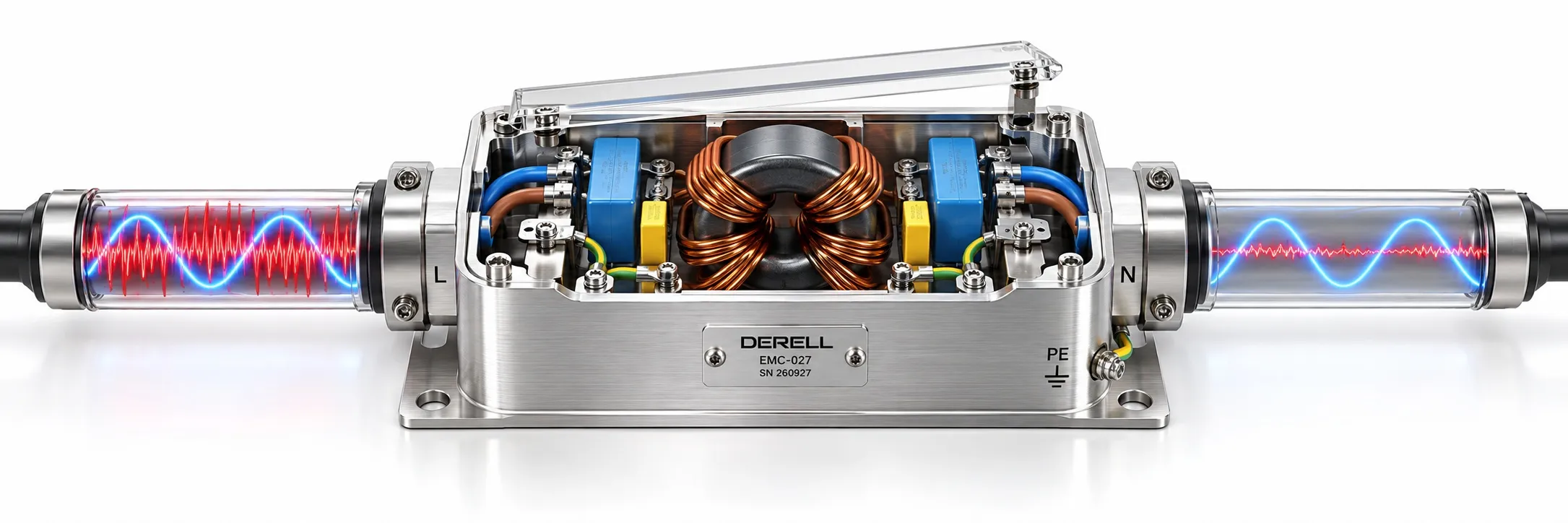
Keeping switching noise off the power line
An EMC filter reduces unwanted high-frequency electrical noise travelling along a power connection. A mains filter passes the equipment's normal 50/60 Hz supply while attenuating selected noise frequencies. It can limit noise leaving the equipment and help reduce disturbances arriving through the supply. Its performance depends on the frequency and the installation.
Electromagnetic compatibility means equipment can operate in its intended electromagnetic environment without creating excessive disturbance. Emissions describe the noise it produces. Suppliers may call a similar power-line product an EMI filter or RFI filter; the name alone does not establish a different circuit or performance class.
Why a drive can disturb nearby electronics
A variable frequency drive switches power rapidly. The sharp edges of its PWM waveform can generate electromagnetic interference across a broad frequency range. Its carrier frequency is separate from the frequency supplied to the motor. Switch-mode power supplies create switching noise for a similar reason.
A PLC input changing unexpectedly, an unstable sensor reading or missed encoder counts when a drive starts are useful clues. They are not proof of an EMC fault. Check supply dips, connections and cable routing as well as noise.
Two noise paths, different countermeasures
Typical electromagnetic filters combine inductors with capacitors. Differential-mode noise circulates between conductors. Common-mode noise flows in the same direction along the conductors and returns through chassis, earth connections or stray capacitance.
X capacitors connect across the lines; Y capacitors may connect lines to earth or chassis in an appropriate design. A common-mode choke presents high impedance to common-mode noise. The circuit redirects and attenuates unwanted components. X and Y safety classifications matter: ordinary capacitors are not interchangeable replacements.
Fit the filter where it can do its job
On an input filter, LINE identifies the supply side and LOAD identifies the equipment side. A typical arrangement is supply, suitable protection, input filter and inverter drive. A mains input filter must not be installed on the drive's PWM motor output.
Keep the filter-to-equipment connection short. Separate the supply-side wiring from the noisy equipment-side wiring. Bond the metal case to a conductive mounting surface as specified, and provide the required protective earthing. Protective earth and high-frequency bonding serve different purposes; a broad case connection does not replace the required PE conductor.
Read the ratings as a set
Match supply voltage, phase arrangement, equipment input current, temperature and leakage current. Motor nameplate current alone is insufficient. Follow the drive manufacturer's filter table and any thermal derating. An attenuation curve in dB describes performance at particular frequencies and test conditions; one headline number cannot describe the entire noise spectrum. Confirm the result in the installed system.
Earth leakage and nuisance tripping
Y capacitors can produce capacitive earth current during normal operation. The filter, drive and motor cable contribute to the overall leakage seen by residual-current protection. If an RCD trips after installation, check total leakage, insulation and the required protective-device type. Never disconnect PE to stop tripping. An IT supply also requires explicit confirmation that the filter and drive configuration are suitable.
Choose the filter for the actual problem
A harmonic filter addresses power-quality issues such as lower-order supply-current harmonics. An EMC input filter targets high-frequency conducted noise. Motor-side dv/dt and sine-wave filters address the drive's output waveform. These products have different locations and purposes; selecting one does not automatically solve the others' problems.
Related reading
References
TDK: Switching power supply noise; TDK: Power line EMC filter principles; TDK Electronics: Selection and installation; Danfoss: Drive installation, leakage current and IT supplies; Danfoss: Harmonic and motor output filters.