
What factors influence the precision and accuracy of servo systems?
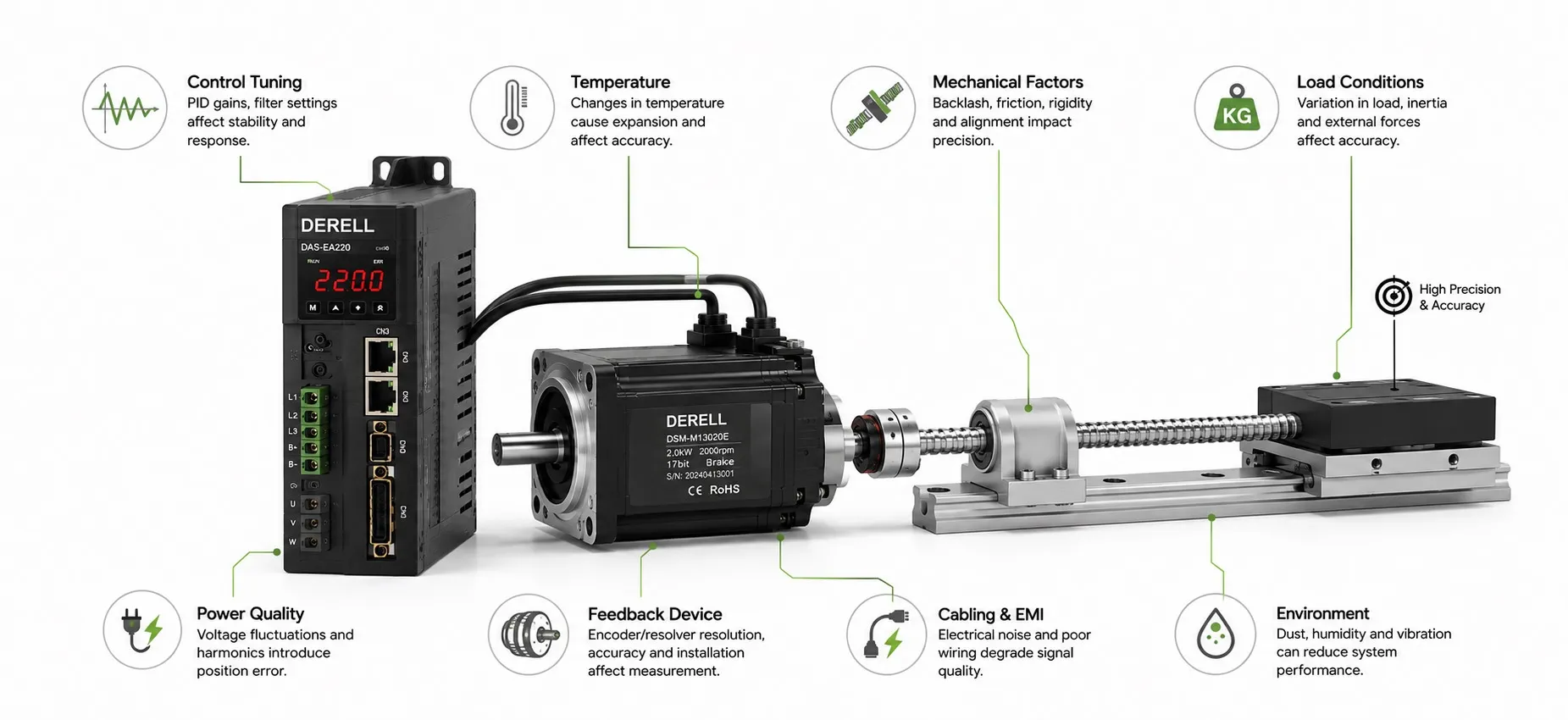
Why the load can miss its target even when the motor is on position
Positioning performance depends on the entire servo system: feedback quality, transmission mechanics, control settings and operating conditions. A servo drive may report that the motor has reached its commanded position while the table or robot tool remains slightly displaced. The motor shaft and the point where the process takes place are not necessarily at equivalent positions.
Specify accuracy, repeatability and resolution separately
Accuracy describes how closely the actual position matches the target. Repeatability describes the consistency of repeated results under unchanged conditions. Resolution is the smallest increment distinguished by the measurement or command system. “Precision” is often used loosely; a useful specification states the required property, tolerance and test conditions.
Suppose a 100.000 mm target produces measured positions of 100.178, 100.180 and 100.182 mm. The readings form a tight group, but their mean is 0.180 mm beyond the target. This illustrates good repeatability with a systematic positioning error. Before applying compensation, establish how that error behaves at other positions and under different operating conditions.
Encoder resolution is only one part of the measurement
When choosing an encoder, check measurement accuracy, signal quality, mounting and drive compatibility alongside the bit count. Periodic errors in the feedback signal can affect low-speed smoothness. The encoder output interface and cable characteristics must also match the receiving electronics.
For a directly coupled screw advancing 5 mm per revolution, a 17-bit feedback device distinguishing 217 positions per turn gives a theoretical increment of 5 / 131,072 ≈ 0.000038 mm = 0.038 µm. This calculation assumes ideal transmission. It does not establish a machine positioning accuracy of 0.038 µm.
Transmission errors and feedback location
Gearbox backlash, coupling twist, belt stretch, screw lead error and bearing wear can all displace the load. A change in error after reversing direction can indicate lost motion or friction effects. Mechanical vibration and insufficient structural stiffness can also leave the axis oscillating after a move.
A motor-mounted encoder does not directly observe every error downstream of the shaft. A load-mounted linear encoder or suitable output-angle sensor can bring some transmission errors into the position loop. However, measuring the load does not repair the mechanics. Sensor location and stable control-loop operation still matter.
Load changes and tuning affect motion accuracy
Load inertia, friction and process forces determine the torque needed to follow a trajectory. During speed and torque regulation, approaching current or torque limits can increase following error. Appropriate motor and drive sizing therefore requires more than matching a power rating.
Overly aggressive drive settings can produce overshoot and vibration; conservative gains can leave the axis lagging. Auto-tuning provides a starting point that needs validation with the actual load. Evaluate the control loops, resonance filters and feedforward together. An S-curve profile can reduce mechanical excitation, but still measure settling time: the time needed for the axis to enter and remain within the target tolerance.
Scaling, referencing, temperature and signal integrity
Incorrect electronic gearing, screw lead or unit conversion can create a systematic error that grows with travel. On pulse-and-direction axes, verify command counting as well. Inconsistent homing shifts the coordinate origin each time the machine is referenced.
Thermal changes alter screw and structural dimensions, so a cold machine may position differently from a warm one. Electromagnetic interference on feedback wiring can corrupt readings or trigger feedback faults. Use appropriate cable routing and manufacturer-specified shielding alongside signal filtering; excessive filtering adds response delay.
In multi-axis motion, accurate individual endpoints do not guarantee an accurate path between them. Command update timing and axis synchronization also influence contour error. An EtherCAT servo interface does not automatically establish correct synchronization or tuning.
Technical references: HEIDENHAIN: accuracy, repeatability and resolution · HEIDENHAIN: feedback location and positioning accuracy · PMD: servo tuning · Kollmorgen: cable shielding and EMI