
Potentiometer Prices
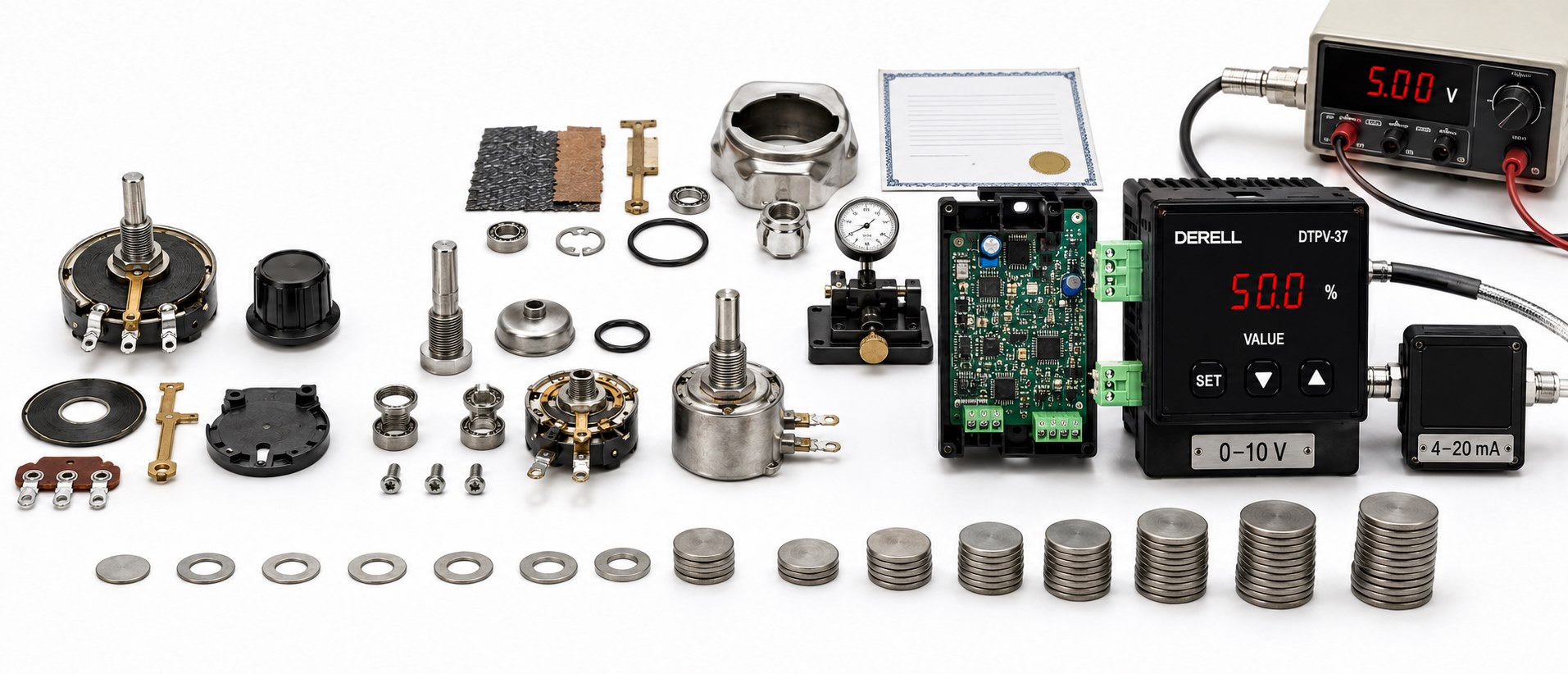
Compare matching specifications before choosing a product
Hello friends. When comparing potentiometer prices, first identify what the product must do. A small adjustment component on a circuit board, a rotary panel control and an industrial device with a display belong to different product classes. Understanding how a potentiometer works helps you compare products that can actually replace one another, rather than products with similar prices.
Editor’s note: A higher resistance value does not automatically mean a higher price. The 1 kΩ, 10 kΩ and 100 kΩ options within a series may have similar prices; construction, product series and availability matter. A digital potentiometer IC and a panel-mounted electronic potentiometer are also different products. One broad dollar range would hide that distinction.
Identify the product class you need
Mechanical potentiometer: Adjustment is made by rotating a shaft or moving a slider. Panel controls, PCB trimmers and precision multiturn components serve different purposes. When choosing between potentiometer types, distinguish frequent operator adjustment from occasional service calibration. A multiturn mechanism can make fine adjustment easier; it does not, by itself, guarantee lower electrical error.
Digital potentiometer IC: These digitally controlled potentiometers use an interface such as I²C, SPI or up/down inputs, depending on the device. For example, the Texas Instruments TPL0401A-10 is a 128-position, 10 kΩ I²C device with ±20% end-to-end resistance tolerance. This illustrates why the number of settings is different from absolute resistance accuracy. The IC price excludes the circuit board, power supply and control circuitry.
Panel-mounted electronic potentiometer: This is a complete instrument that adjusts a reference using keys, a display or external commands. In the 48 × 48 mm, 37 × 72 mm and 72 × 72 mm product groups, compare more than front-panel dimensions. Supply requirements, output type, adjustment behaviour and panel cutout must also match. Depending on the model, the output may be variable resistance, voltage or current; these are not interchangeable connections.
How do resistance, taper and accuracy affect the comparison?
Nominal resistance must suit the circuit. A 10 kΩ resistance with ±20% tolerance can measure 8–12 kΩ end to end. In an ideal, unloaded three-terminal voltage divider, however, the output mainly depends on the resistance ratio. End-to-end tolerance, linearity and repeatability must therefore be considered separately. The Bourns 3590 datasheet specifies ±5% total resistance tolerance and ±0.25% independent linearity as separate parameters; these figures describe different properties.
Linear and logarithmic taper describe the relationship between shaft position and output. A logarithmic device can produce an unexpected adjustment response where a proportional analog reference is required. Linear taper does not mean that the component has a sliding actuator. Do not assume letter codes such as A/B mean the same thing for every manufacturer; check the ordering information. Specify the allowable adjustment error instead of asking only for “high quality.”
Include mechanical compatibility and operating life
Shaft diameter, length and profile, mounting hole, terminals and number of turns affect replacement costs. Electrical travel can also differ from mechanical travel: the Vishay P12 specifies 270° ±10° and 300° ±5°, respectively. Its stated 25,000 mechanical cycles and IP67 container protection apply under that product’s specified conditions. Do not automatically extend an IP protection rating to another component or the complete panel. Check whether the knob, nut and sealing accessories are included in the price.
Which limits matter for a drive or PLC application?
For manual reference adjustment on a variable frequency drive, follow the manufacturer’s recommended potentiometer resistance and reference-output current limit. 10 kΩ is not a universal requirement. In a three-terminal arrangement, the wiper normally connects to the analog input, with the ends connected to the appropriate reference and signal common. Identify the terminals and wiring from the equipment manual. Do not assume signal common is the same as protective earth.
For a simple example, 10 V across a 10 kΩ resistance track draws 1 mA under Ohm’s law and dissipates P = V² / R = 0.01 W. That calculation alone does not establish suitability: wiper current, partial-track loading, voltage limits and temperature derating also matter. A 0–10 V voltage signal differs from a 4–20 mA current signal. An ordinary three-terminal potentiometer does not independently generate a regulated 4–20 mA output; a suitable converter or instrument is needed.
For digital solutions, compare more than step count
For a digital IC, check permitted analog-terminal voltages, wiper current and power-up setting in the datasheet. A low-voltage IC must not be assumed suitable for direct connection to a 10 V reference. Retaining the setting after power loss is also model-dependent. For a panel instrument, assess the analog input and output specifications, behaviour when power returns and any required isolation. Depending on the project, DAC-based reference generation may be another option; the required output and circuit architecture determine the choice.
Not every rotary knob operates a potentiometer. A control using an incremental encoder converts rotation into pulses, so a similar-looking resistive component cannot directly replace it. When replacing a failed part, use the full product code and wiring diagram to reduce incorrect purchases and repeat installation work.
How should you compare current prices and quotations?
Compare the same scope of supply: specify the manufacturer, complete model code, quantity, resistance, taper, tolerance, power rating, shaft or panel dimensions, output type and required accessories. A bare IC, a board module and a ready-to-use panel instrument should not be treated as one price category. Check VAT, shipping, stock, lead time and sales terms alongside the unit price.
This page provides technical selection guidance, rather than a fixed USD or TRY range that supposedly covers every product. Use the relevant product price and quotation terms for the current cost. For a drive application, review the available potentiometer assemblies and compare the total application cost, including installation and commissioning.
Related pages
Digital potentiometers, potentiometer types, analog signal controllers, drive accessories.