
what is industry 4.0?
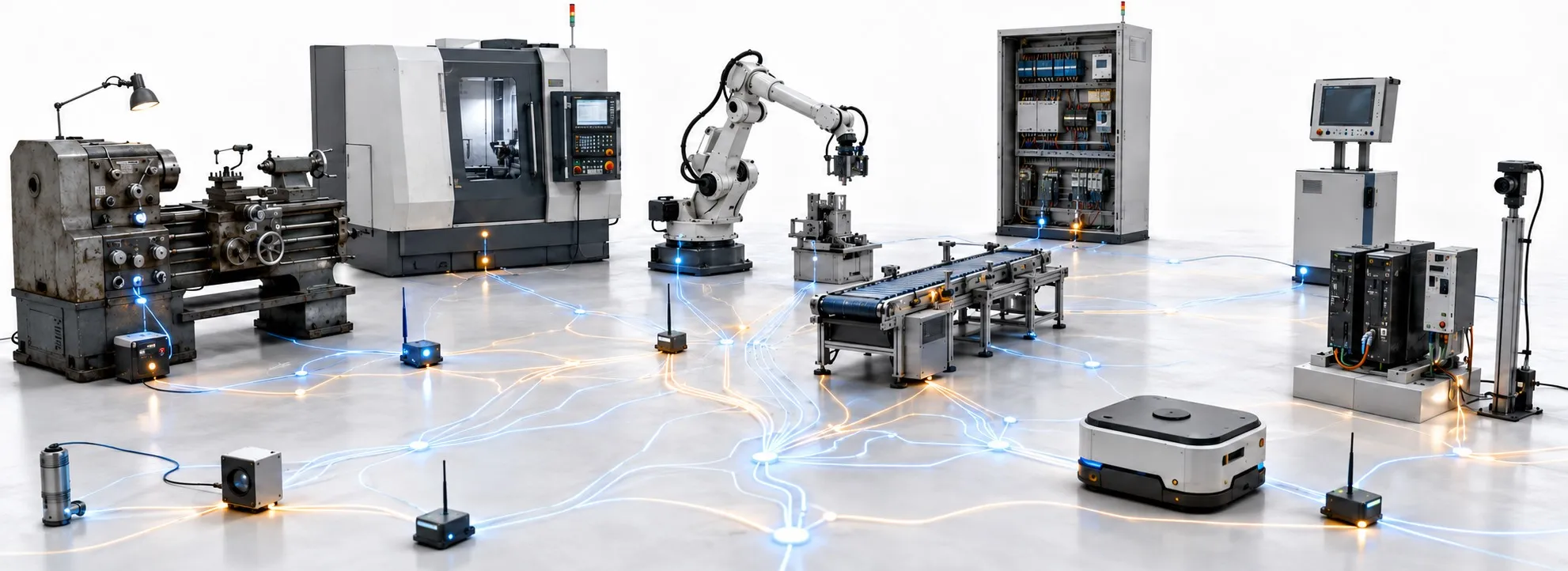
Turning connected equipment into better production decisions
Industry 4.0 brings physical manufacturing and digital systems together so that equipment, products and business software can exchange useful information and coordinate their work. Often called the Fourth Industrial Revolution, it combines manufacturing fundamentals with connected technologies. Industrial equipment could communicate long before this term appeared. The wider ambition is to make production data useful across maintenance, quality, scheduling and the business.
Understand the jobs before choosing the technology
Sensors measure; the PLC runs the machine. An HMI gives operators a local interface, while SCADA provides broader plant monitoring and supervisory control. A manufacturing execution system, or MES, manages production execution, records and traceability. ERP handles business resources such as orders and inventory. Connecting these layers lets a production result be associated with the right product, batch and order.
The Internet of Things provides a way to connect devices and their data. Industrial applications place particular demands on availability, timing and security. Interfaces such as OPC UA support communication between systems from different suppliers, but units, timestamps and the meaning of each value must also agree. This is why standards and shared definitions matter. Cloud services are one deployment option; local systems can also support connected manufacturing.
Follow one batch through a filling line
Consider an illustrative filling operation. The line records the product recipe, interruptions and inspection results against each batch. When underfilled containers become more frequent, maintenance and quality staff can investigate the operating conditions at the time. The practical impact on production is better evidence for a decision. Analytics and artificial intelligence may help identify patterns, but they cannot make an inaccurate sensor or incomplete record trustworthy.
Smart factories and digital twins build on this relationship between equipment and information. A digital twin is a digital representation linked to data about a real asset or process; a 3D drawing alone does not establish that relationship. Depending on its purpose, a twin can help explore a proposed change. Sharing production status with supply chain planning also helps coordinate materials and orders. Visibility and efficiency depend on reliable records rather than connectivity alone.
Choose a result that can be measured
Downtime, good output, changeover time and energy per good unit are useful project success measures. As a simple calculation example, producing 1,000 acceptable units with 110 kWh instead of 120 kWh reduces consumption from 0.12 to 0.11 kWh per unit, approximately 8.3%, provided operating conditions are comparable. Assessing environmental impact requires attention to output and quality; a smaller total energy bill alone does not substantiate sustainability claims.
Plan for access, people and operating responsibility
Security and privacy start with deciding who may read data and who may change settings. Protective measures include access control, network separation, backups and managed remote access. A production dashboard or AI prediction does not replace a machine safety function. The effect on employment also needs a wider view: training requirements and changing worker skills and responsibilities are part of the implementation.
Sources
Festo: Industry 4.0 applications and production integration (Turkish); OPC Foundation: OPC UA architecture and interoperability; NIST: Smart manufacturing and trustworthy systems.
Refine Search
- Are sufficient measures being taken for security and privacy issues in Industry 4.0?
- Are the impacts of Industry 4.0 on international competition fair and balanced?
- Are the sustainability promises of Industry 4.0 realistic, or are environmental impacts being ignored?
- Can artificial intelligence and automation reduce the human factor and creativity in the industry?
- Can Industry 4.0 truly make supply chain management more efficient and transparent?
- Can small and medium-sized enterprises (SMEs) face challenges in adopting Industry 4.0?
- Can smart factories and automation lead to social problems by increasing unemployment rates?
- Do the innovations brought by Industry 4.0 really make a difference in meeting consumer demands?
- Do the innovations brought by Industry 4.0 really provide a competitive advantage, or do they just lead to an increase in costs?
- Do the technological innovations brought by Industry 4.0 justify the costs and risks?
- How are data analytics and artificial intelligence used in Industry 4.0?
- How does Industry 4.0 determine the work motivation of employees?
- How will Industry 4.0 affect the labor market?
- How will Industry 4.0 change supply chain management?
- How will technological advancements affect the skill sets and job security of workers?
- Industry 4.0 vs ioT
- Is Industry 4.0 really a revolution or just a marketing strategy?
- What are smart factories and digital twins, and how do they work?
- What are the educational and skill requirements of Industry 4.0?
- What are the effects of Industry 4.0 on global competition?
- What are the impacts and opportunities of Industry 4.0 for SMEs?
- What are the sustainability and environmental impacts of Industry 4.0?
- What criteria should be used to measure the success of Industry 4.0 projects?
- What impact does Industry 4.0 have on production processes?
- What is Industry 4.0 and what are its key components?
- What is the impact of Industry 4.0 on security and privacy issues?
- What role does the Internet of Things (IoT) play in Industry 4.0?
- What steps should be taken to adopt Industry 4.0?
- Which sectors will be most affected by Industry 4.0?
- Which technologies enable Industry 4.0?
- Why are the standards and definitions of Industry 4.0 not clear?