
UU (Lu) under voltage
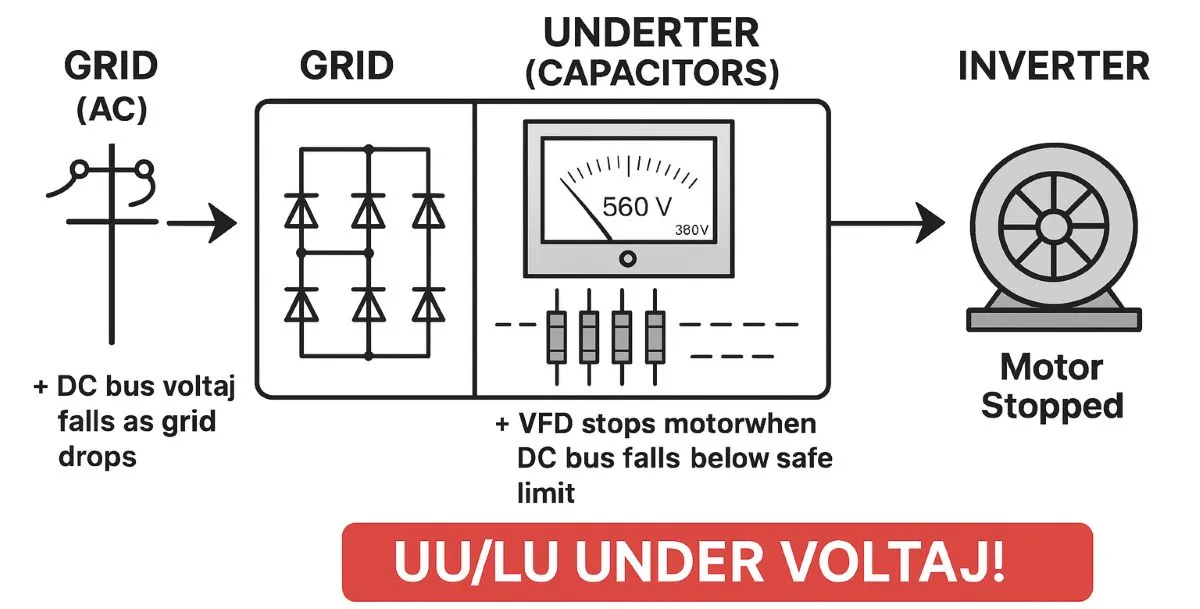
What Does a UU / LU Undervoltage Fault Mean on a VFD?
UU, LU, UV or USF are manufacturer-dependent fault codes commonly used to indicate that the DC-link / DC-bus voltage has fallen below the minimum operating level required by the VFD.
In simple terms, the drive is saying:
“There is not enough energy left on my DC bus to control the motor properly.”
To understand this fault properly, it helps to understand the DC Bus first.
A conventional VFD power path is approximately:
AC Supply → Rectifier → DC Bus → IGBT Inverter → Motor
If the incoming supply becomes too weak, a phase is lost, a connection develops excessive voltage drop or the DC link can no longer maintain enough energy, the drive can enter an undervoltage condition.
For other protection codes, see our VFD Fault Codes guide.
Live undervoltage simulation · Common causes · Input phase loss · DC-link capacitors · Troubleshooting · FAQ
What DC-bus voltage should I expect?
For a three-phase 400 V class VFD, the rectified DC-link voltage can be estimated roughly as:
400 × √2 ≈ 566 VDC
For a 230 V class system:
230 × √2 ≈ 325 VDC
These are only simplified reference values. Actual DC-bus voltage depends on supply voltage, loading, rectifier losses, ripple and drive design.
This is why seeing 540–580 VDC inside a 400 V class VFD can be perfectly normal.
The opposite DC-link problem is covered on our OV / Overvoltage Fault page.
Interactive UU / LU Undervoltage Simulation
The important lesson is that an undervoltage fault is not caused only by the utility company supplying low voltage.
Compare four different situations:
Normal Supply, Voltage Sag, Input Phase Loss and Weak Supply During Heavy Acceleration.
What does the simulation teach?
A VFD undervoltage fault does not require the entire factory supply to be permanently low.
The plant bus may measure 400 V while the actual voltage at the VFD terminals collapses only when motor current rises.
Common causes include:
long undersized cables, weak transformers, loose contactors, burned terminals, high-resistance fuse holders and heavily loaded generators.
This is why undervoltage should be measured at the VFD R-S-T input terminals under actual load, not only at the main distribution board.
Common causes of UU / LU undervoltage faults
Low mains voltage: Incoming AC supply falls below the permitted drive input range.
Short voltage sag or dip: Supply voltage may fall for only a few hundred milliseconds. A normal handheld multimeter may completely miss the event.
Momentary power failure: When AC input disappears, stored energy in the DC-link capacitors is consumed and DC-bus voltage falls.
Weak supply system: Long cables, small conductor size or high source impedance can cause major voltage drop during acceleration.
Loose or damaged power connections: Contactors, breakers, terminals and fuse holders can develop resistance that becomes significant as current rises.
Undersized transformer or generator: Starting another large machine can pull the shared supply voltage down.
Input phase loss: Losing one input phase may not collapse the DC bus immediately, but DC ripple and rectifier stress can increase severely.
Precharge-circuit problem: A faulty precharge resistor, contactor or control circuit can prevent the DC link from charging correctly.
DC-link capacitor degradation: Reduced capacitance or increased ESR can increase ripple and reduce ride-through performance, but the incoming supply should normally be checked first.
Why doesn't an input phase loss simply make the motor run on two phases?
This is one of the most important differences between a direct-on-line motor and a VFD-fed motor.
The electrical chain is:
R-S-T → Rectifier → DC Bus → IGBT Bridge → U-V-W
If the R input phase disappears, the motor U phase does not automatically disappear.
The fault first affects the rectifier and DC-link side.
DC-bus ripple increases, rectifier-current stress becomes heavier and the bus may collapse under load.
A motor-side U/V/W loss is a different fault condition.
See Input and Output Phase Loss for the full distinction.
What if UU occurs only when the motor starts?
This strongly suggests investigating the supply under load.
If the VFD measures normal voltage while idle but produces UU when RUN is commanded, check:
transformer capacity, generator capacity, supply-cable size, contactors, terminals, acceleration demand and mechanical load.
A very short acceleration time can demand high current.
On a weak electrical supply, that current can pull the input voltage down sharply.
The same machine may then produce related faults such as OC / Overcurrent or Motor Overload.
What if UU appears after hours of normal operation?
Look at what changed in the plant at that moment.
Did a large compressor start?
Did another high-power motor accelerate?
Did a welding system, press or furnace switch on?
Did transformer loading increase?
A short voltage sag may be invisible on a handheld multimeter.
A power-quality analyzer with minimum-value or waveform recording can be far more useful.
What if the fault happens only on one shift or at certain times of day?
This can point to plant-wide loading rather than a defective VFD.
When other production lines start, the common transformer or feeder voltage may fall.
Before replacing the inverter, inspect the distribution system, transformer loading, cable sizing and switching equipment.
Can DC-link capacitors cause undervoltage?
They can contribute, but they should not automatically be blamed first.
The DC-link capacitors smooth rectified voltage and temporarily store electrical energy.
If capacitance has deteriorated significantly, DC-bus ripple may increase and the drive may have less energy reserve during short supply dips.
A more sensible diagnostic order is:
AC input → all input phases → fuses → contactor → terminals → precharge circuit → DC-bus measurement → capacitors.
Can a wrong parameter actually create low voltage?
A parameter does not physically reduce the mains voltage.
But some VFDs provide parameters for:
nominal supply voltage, undervoltage threshold, undervoltage timeout, auto restart and momentary-power-loss ride-through.
An incorrect setting can therefore change when the VFD decides that a voltage dip is severe enough to trip.
Actual voltage should still be measured before changing protection parameters.
What happens during a short power interruption?
Drive behaviour varies considerably.
Some VFDs trip immediately.
Some coast.
Some use momentary-power-loss ride-through strategies.
Some can restart when the supply returns.
If the motor is still rotating when power returns, a proper Flying Start / Speed Search function may be required.
Otherwise the VFD may attempt to energize a spinning motor from the wrong electrical frequency and create a large current transient or OC fault.
Are UU and OV exact opposites?
At the DC-link measurement level:
UU / UV: DC bus too low.
OV: DC bus too high.
But the physical causes are different.
OV is commonly associated with regenerative braking and excessive supply voltage.
UU is more commonly associated with weak supply, interruption, phase loss or excessive voltage drop in the incoming power path.
Why can UU and OC appear on the same machine?
A weak supply can create more than one symptom.
If the incoming voltage collapses while the motor is trying to maintain torque, the drive has less available output voltage.
The control system may demand additional current and the machine may enter current-limiting or protection regions.
Therefore repeated combinations such as:
UU → OC → Motor Overload → Phase Loss
should make you investigate the common electrical supply rather than treating every fault as an unrelated event.
Can bad grounding cause a UU fault?
Poor protective grounding is important for safety and EMC, but it is not a normal direct cause of DC-bus undervoltage.
For UU troubleshooting, investigate the R-S-T supply, phase condition and incoming power path first.
Can VFD sizing be related to undervoltage?
Indirectly, yes.
A high-torque application combined with a weak supply can demand large input current during acceleration.
The higher current produces more voltage drop across weak transformers, long cables and poor connections.
This is particularly relevant on conveyors, crushers, mixers and other heavy-duty loads.
A practical UU / LU troubleshooting sequence
1. Record exactly when the fault occurs. Power-up, RUN, acceleration, constant speed or when another machine starts?
2. Measure R-S, S-T and T-R separately.
3. Measure voltage under load. A line showing 400 V at idle may collapse to 320 V during acceleration.
4. Check input phase loss and input fuses.
5. Inspect contactors, disconnects and terminals.
6. Trend the DC-bus monitor.
7. If UU occurs during startup, review acceleration time and mechanical load.
8. Check transformer or generator capacity.
9. Use a recording power analyzer when a short voltage dip is suspected.
10. Only after the external supply is verified should the precharge circuit, DC-link capacitors and DC-voltage sensing be investigated at service level.
Why do different manufacturers use UV, UU, LU or USF?
VFD fault codes are not standardized.
One manufacturer may use UV, another UU, another LU, and some Schneider Altivar families use USF.
The correct troubleshooting method is therefore:
MANUFACTURER + EXACT DRIVE MODEL + FAULT CODE
rather than assuming that one generic internet definition applies to every VFD.
Editor's field note
When I see UU, I don't remove the drive first. I get a voltmeter — and preferably a recording power analyzer.
An undervoltage fault may appear on the VFD display, while the actual cause is fifty meters away:
a loose contactor, undersized cable, overloaded transformer or another large machine starting on the same feeder.
The two measurements I want most are:
What is the VFD input voltage with the machine unloaded?
What is the same voltage while the motor is actually taking load?
Seeing 400 V while the machine is idle does not prove that the supply is healthy.
The real UU story often begins exactly when the motor starts asking for power.
UU / LU Undervoltage FAQ
What does UU or LU mean on a VFD?
It usually means that DC-link voltage has fallen below the drive's permitted operating threshold.
What should I check first?
Measure the three-phase input voltage at the VFD and review the DC-bus monitor.
Can input phase loss cause undervoltage?
Yes. It can increase DC-link ripple and cause deeper voltage dips under load.
Can bad DC-link capacitors cause UU?
They can contribute, especially by increasing ripple and reducing ride-through capacity, but they are not normally the first item to replace.
What if UU occurs only during acceleration?
Check the supply impedance, transformer, cable size, terminals, acceleration time and starting load.
Can parameters cause an undervoltage fault?
They can affect detection threshold or timing, but they do not physically create low mains voltage.
Is poor grounding a normal cause of UU?
No. Grounding is critical for safety and EMC, but the incoming power path should be investigated first.
Can a motor restart after a short power failure?
That depends on the drive's ride-through, auto-restart and Flying Start functions.
Are UU and OV measured on the same DC bus?
Yes. One protects against excessively low DC-link voltage and the other against excessively high voltage.
What if UU and OC alternate?
Investigate a common weak-supply or loading problem before assuming two separate VFD failures.
Related supply and DC-link topics
DC Bus · Input / Output Phase Loss · OV / Overvoltage · Acceleration / Deceleration Time
Related current and motor protection topics
OC / Overcurrent · Motor Overload Protection · Motor Stall Fault
VFD fundamentals
Understanding Variable Frequency Drives · V/F Control · VFD Fault Codes