
OV Over Voltage
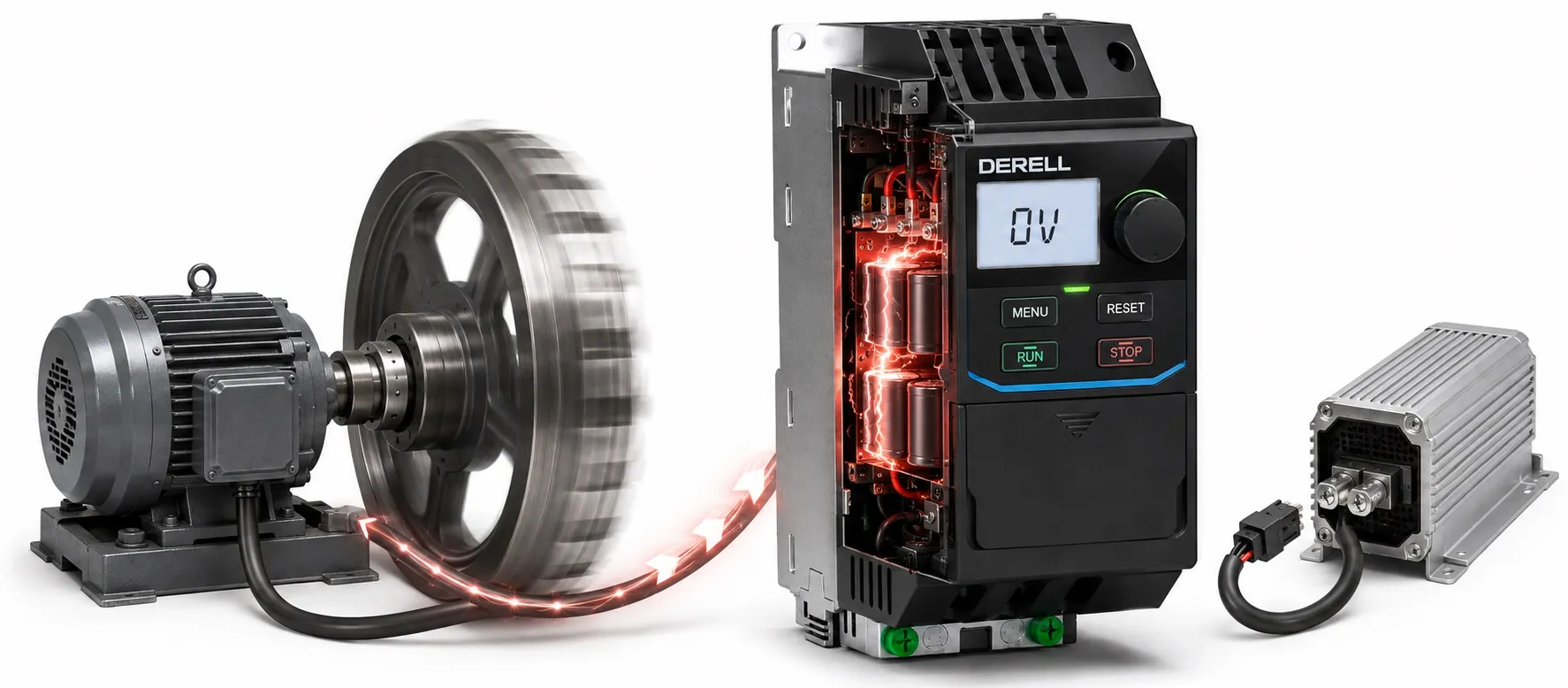
What Does an OV / Overvoltage Fault Mean on a VFD?
OV – Overvoltage means that the VFD has detected DC-link voltage above its permitted protection threshold.
The simplest way to understand the fault is:
“More energy is entering the DC bus than the drive can remove.”
That energy can come from two directions:
From the mains: excessive supply voltage or voltage transients.
From the motor: regenerative energy when the motor or mechanical load is driving energy back into the VFD.
This second mechanism is why OV faults are so common during rapid deceleration and overhauling-load operation.
For the wider fault family, see the OtomasyonAVM VFD Fault Codes guide.
Why does DC-bus voltage rise during deceleration?
During normal motoring operation, energy flows approximately:
AC Supply → Rectifier → DC Bus → Inverter → Motor
During regenerative operation the direction changes:
Rotating Motor / Load → Inverter → DC Bus
A conventional diode-front-end VFD cannot normally return that energy directly to the AC supply.
The regenerated energy therefore charges the DC-link capacitors and raises DC-bus voltage.
If the voltage reaches the drive protection limit, an OV fault occurs.
Why is a 400 V drive DC bus around 560 V?
As a simple approximation:
400 VAC × √2 ≈ 566 VDC
For a 230 V class system:
230 VAC × √2 ≈ 325 VDC
Actual DC-bus voltage varies with supply voltage, loading, rectifier losses, ripple and drive design.
Why does increasing deceleration time help?
A longer deceleration time spreads the mechanical energy over a longer interval.
That reduces instantaneous regenerative power returning to the DC bus.
This is why manufacturers commonly recommend increasing DEC time as one of the first checks for an OV fault during stopping.
ABB's standard control firmware, for example, can automatically increase programmed deceleration time when its overvoltage controller reaches the DC-link limit. :contentReference[oaicite:4]{index=4}
What does Overvoltage Control do?
Some VFDs monitor DC-link voltage during deceleration and automatically reduce regenerative torque or extend the effective deceleration time when the voltage approaches its limit.
Different manufacturers use names such as:
Overvoltage Control
Stall Prevention During Deceleration
Deceleration Ramp Adaptation
Danfoss and Schneider documentation both describe strategies that slow or adapt the deceleration process when DC-bus voltage rises. :contentReference[oaicite:5]{index=5}
How does a braking resistor prevent OV?
A braking resistor converts regenerative electrical energy into heat.
It is normally switched onto the DC bus by a braking transistor or brake chopper.
The basic sequence is:
DC bus rises → brake chopper turns on → current flows through resistor → regenerative energy becomes heat → DC-bus voltage falls.
Does every VFD accept a braking resistor?
No.
Some drives include a braking chopper internally.
Some require an external DBU / Dynamic Braking Unit.
Some drive families do not support resistor braking at all.
The hardware manual for the exact drive must be checked before connecting a resistor.
Why does resistor ohmic value matter?
A resistor below the manufacturer's minimum permitted resistance can draw excessive brake-chopper current and damage the braking transistor.
A resistance that is too high may not absorb enough regenerative power and DC-bus voltage can continue rising.
Resistor wattage must also be selected from actual braking energy, stopping time and duty cycle rather than motor kW alone.
Why can OV continue even with a brake resistor installed?
The brake chopper may not be operating.
The resistor may be connected incorrectly.
The resistance may be too high.
The resistor or wiring may be open circuit.
The braking duty may exceed the resistor/chopper capability.
Or the real problem may not be regenerative braking at all — the incoming mains voltage may already be too high.
Can high mains voltage cause OV?
Yes.
Higher AC supply voltage produces a higher normal DC-link voltage.
This reduces the voltage margin available before the OV threshold is reached.
Danfoss fault guidance lists excessive input voltage and high supply spikes alongside short deceleration time as key DC-link overvoltage causes. :contentReference[oaicite:6]{index=6}
Can OV happen at constant speed?
Yes.
If the mechanical load drives the motor — an overhauling load — the machine can continuously return energy to the VFD even while commanded speed remains constant.
Typical examples include descending hoist loads, unwinders and other mechanically driven axes.
Can OV happen during acceleration?
It is less common but possible.
A load may already be rotating, an external force may drive the shaft, or the drive may be trying to synchronize with a spinning motor.
Schneider documents acceleration-time overvoltage cases where opposing mechanical force or backfeed raises DC-bus voltage. :contentReference[oaicite:7]{index=7}
Are old DC-link capacitors a normal cause of OV?
Not as a general first-line diagnosis.
Aged electrolytic capacitors can lose capacitance and develop higher ESR, affecting DC-link ripple and reliability.
But standard manufacturer OV troubleshooting focuses first on:
regeneration, short deceleration time, high supply voltage and voltage transients.
Does poor output filtering normally cause OV?
No — that is not a good general explanation.
du/dt filters and sine filters deal primarily with PWM output waveform effects.
The central OV mechanism is excessive energy on the DC link.
When is a regenerative unit better than a braking resistor?
A braking resistor disposes of energy as heat.
If the machine regenerates frequently or continuously, a regenerative drive or Active Front End can return energy to the supply instead.
This can be preferable for high-duty hoists, test stands and continuously regenerative processes.
A practical OV troubleshooting sequence
1. Record when the fault occurs. Power-up, acceleration, constant speed, deceleration or stop?
2. Monitor DC-bus voltage. Does it climb during the event?
3. Check incoming AC voltage.
4. If OV occurs during deceleration, temporarily increase DEC time.
5. Evaluate load inertia and whether the machine is driving the motor.
6. Check Overvoltage Control or Ramp Adaptation settings.
7. If rapid stopping is required, inspect the brake chopper and resistor system.
8. Verify resistor resistance, power rating and wiring from the drive manual.
9. For continuous regeneration, consider whether a regenerative solution is more appropriate.
10. If OV occurs while the motor is not regenerating, return to supply voltage, transients and DC-bus sensing.
Editor's field note
When I see OV, I first look at the direction of energy.
Is the machine slowing down?
Is gravity driving the load?
Is a large drum being stopped in two seconds?
If so, the motor may not be a consumer at that moment.
It is a generator.
Then I ask one question:
“Where is that energy supposed to go?”
If there is no good answer, the DC bus rises.
That is the heart of most OV problems.
VFD OV / Overvoltage FAQ
What does OV mean on a VFD?
The DC-link voltage has exceeded the drive's permitted overvoltage threshold.
Why does OV often happen during deceleration?
The rotating motor and load return kinetic energy to the DC bus.
Can a longer DEC time fix OV?
Yes, when regenerative power during rapid stopping is the cause.
Does every OV fault require a braking resistor?
No. High supply voltage or an acceptable longer deceleration ramp may call for a different solution.
Does a braking resistor work without a brake chopper?
Only if the drive has the required internal braking switch; otherwise an external braking unit may be necessary.
Can OV occur at constant speed?
Yes, when an overhauling mechanical load is driving the motor.
Can OV happen when the motor is stopped?
Yes. High mains voltage, surges or sensing problems should then be investigated.
Are aged DC-bus capacitors the normal first cause?
No. Regeneration and supply-voltage conditions should normally be checked first.
Why does the brake-resistor ohm value matter?
Too low can overload the braking transistor; too high may provide insufficient braking current.
What does Overvoltage Control do?
It reduces regenerative stress, often by adapting or extending deceleration when the DC bus approaches its limit.
Related braking and DC-bus topics
DC Bus · Braking Resistor · DBU / Braking Unit · Acceleration / Deceleration Time