
Thermal Fuses
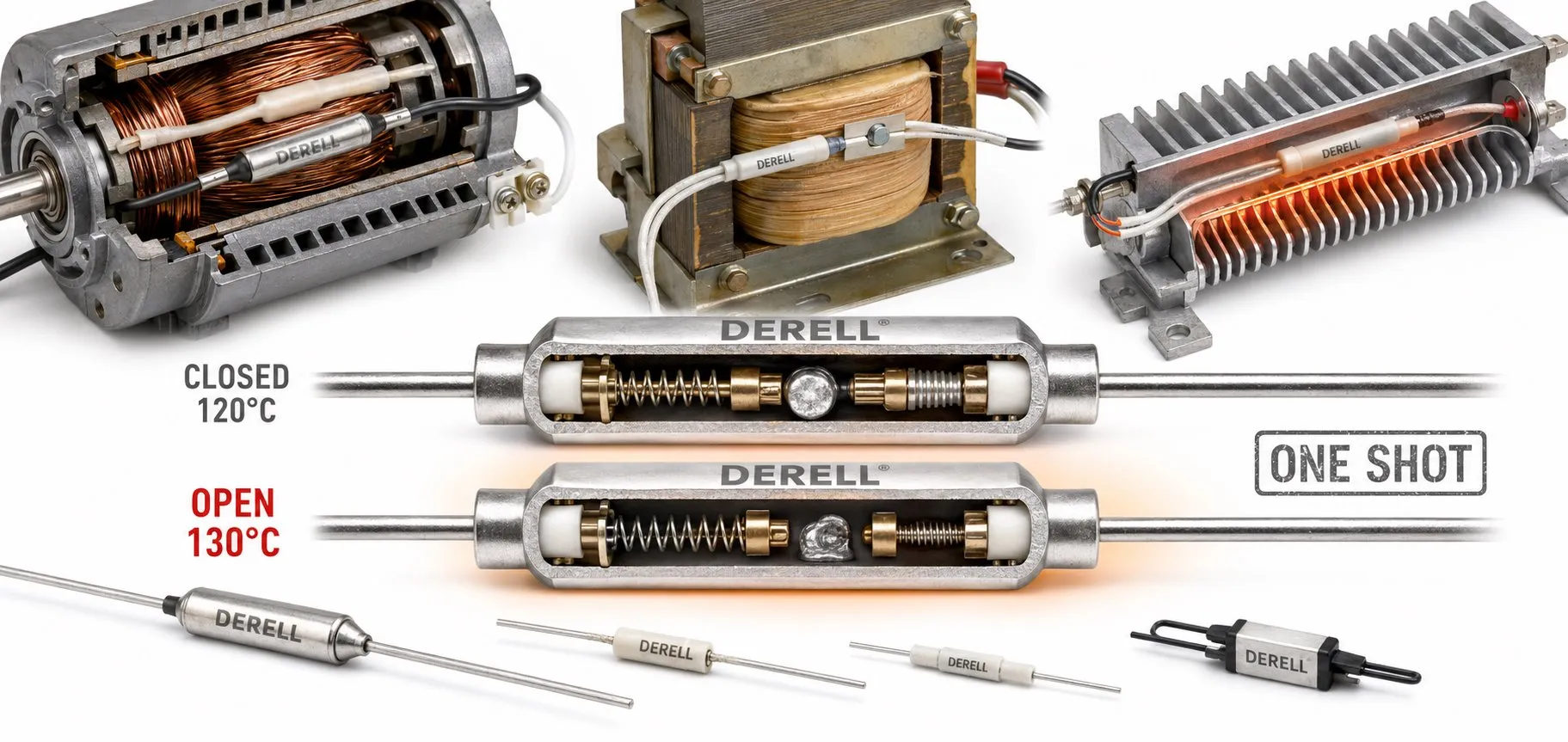
Permanently disconnecting a circuit when overheating occurs
A thermal fuse is a protective component that opens a circuit once when the temperature at its location reaches its specified operating conditions. Technical documents also use the terms thermal-link and thermal cutoff. The single-use devices discussed here do not restore conduction when they cool. They are commonly connected in series with the protected load; which part of the equipment loses power depends on the circuit arrangement.
Whereas current fuses operate in response to the effects of excessive current, a thermal fuse primarily provides protection against abnormal temperature. For example, a blocked air path in a fan heater may cause dangerous overheating without increasing current enough to operate the input fuse. A thermal fuse with suitable ratings and placement addresses this different fault condition. It cannot, however, be assumed to eliminate every fault or fire risk on its own.
The current-carrying metal does not always melt
In a fusible alloy design, a temperature-sensitive metal alloy melts under specified conditions and interrupts the conductive path. In a thermal pellet design, a temperature-sensitive solid loses its form, allowing a spring mechanism to separate the contacts. Describing every thermal fuse as a wire that melts is therefore inaccurate. The SF and SM types in SCHOTT's SEFUSE range illustrate these different constructions.
The case and leads also vary between models. The outer surface of a metal-cased thermal fuse may be electrically live; do not assume the case is insulating. Ceramic-cased versions are also available. Similar appearance does not establish identical thermal response, electrical capability or mounting requirements.
How it differs from a thermostat, sensor or overload relay
A thermostat may switch repeatedly to regulate normal temperature, while some protective thermostats require manual reset. As the distinction between a temperature sensor and a thermostat shows, measuring and switching are different tasks. A single-use thermal fuse provides permanent disconnection during abnormal overheating. PTC-based resettable fuses and motor thermal overload relays are different device classes as well.
In a coffee maker, for example, a thermostat or temperature controller may regulate normal operation while a thermal fuse provides a separate protective layer if that control fails. Other applications include loss of airflow in hair dryers, welded control contacts in heaters, and overheating in transformers or wound components. The location and disconnection duty of the protective component must be established for each equipment design.
Understanding Tf, Th and Tm
Tf is the rated functioning temperature. It describes the transition from conduction to an open circuit under standardized test conditions. Check the product documentation for the opening tolerance. This rating does not mean that every part of the equipment reaches the same temperature, or that the fuse can operate continuously at that temperature during normal use.
Th is the holding temperature. It describes the temperature at which the device can remain conductive for a specified test period under stated load conditions. It matters when assessing sustained operation, but does not guarantee an unlimited service life. Tm is the maximum temperature limit after opening. Stored heat in a heater can continue raising temperatures after power is interrupted. The resulting temperature overshoot and insulation performance must therefore also be considered.
Editor's note: Cantherm's SDF table lists Tf = 128 °C and Th = 106 °C for the DF128S. This illustrates why a 128 °C marking does not justify assuming continuous operation at 120 °C. The difference between these ratings is not a fixed rule for every product; use the specific component's technical data.
Selection requires more than a temperature marking
When selecting a fuse, consider the functioning temperature, current and voltage ratings, AC or DC suitability, load characteristics, dimensions, insulation and approved part details together. A 10 A marking, for example, does not mean the device must open when current rises slightly above 10 A. It is an electrical rating that must be read alongside the applicable voltage and test conditions. Do not transfer an AC rating to DC at the same voltage; DC circuit protection involves different interruption conditions.
Choosing a temperature “slightly above normal” is insufficient. Assess the temperature at the fuse itself, normal temporary peaks, heating caused by the current it carries and temperatures reached during faults. During product development, suitable thermocouple arrangements can help establish placement and temperature requirements. Equipment ambient temperature and fuse case temperature must not be treated as interchangeable.
Mounting is part of the protective function
Thermal contact, airflow, lead length, insulating sleeves and mechanical attachment all affect the response. Moving the fuse away from the heat source or adding an arbitrary thicker sleeve can change its behavior. For metal-cased types, provide the required electrical insulation while preserving the manufacturer's specified thermal arrangement.
Soldering heat can travel along the leads and open the fuse or damage its characteristics. Choose soldering, crimping or welding according to the product's installation instructions, and avoid bending close to the case or applying pulling forces. Contact resistance at a loose joint can also create localized heating and premature opening. Establishing electrical continuity alone does not prove correct installation.
Find the cause before replacing an open fuse
After isolating the supply and addressing stored energy, a continuity measurement can establish whether the component is open circuit. Where necessary, disconnect one lead to prevent parallel paths from misleading the reading. An intact component shows low resistance; an open reading may indicate that protection operated or that another form of damage occurred. This check does not prove correct opening temperature. A test that heats the component until it opens consumes the single-use device.
During replacement, use the part specified by the equipment manufacturer or an approved equivalent. Before replacing a fuse that requires renewal, investigate the cause of its opening, such as blocked airflow, a failed fan, welded contacts, impaired thermal contact or loose connections. Bypassing the fuse or fitting a higher-temperature component to prevent another opening changes the protection design. Preserve the original location, insulation and connection arrangement when installing the replacement.
Interpreting standards and approvals
IEC 60691 addresses requirements and application guidance for thermal-links. IEC's published scope also explains that protection effectiveness depends on placement, mounting and the current carried. When reviewing fuse standards and IEC fuse standards, check the product family, full part number and applicable current-voltage conditions together. Approval of a component does not automatically establish compliance of the complete equipment in which it is installed.
Related topics
Comparing protective components: The basic purpose of a fuse and the differences between fuse types help explain why temperature protection and overcurrent protection need separate consideration. Which type of fuse should you choose? is also useful for comparing options by their intended protective function.
Detecting temperature: PTC sensors and NTC sensors use changes in resistance with temperature. Understanding the different duties of a sensing element, control circuit and single-use disconnect helps prevent apparently similar parts from being substituted incorrectly.
Interpreting current ratings: The relationship between fuse current rating and load and fast and slow-blow fuses explain overcurrent protection. These properties do not replace a thermal fuse's temperature rating; they help explain why several different protective components may be needed in one device.
Distinguishing circuit-board faults: Varistors, TVS diodes and fuses provide useful context for comparing the different roles of overvoltage, current and temperature protection. Evaluate fuse models according to the fault they must address, alongside their appearance and current rating.
Sources
SCHOTT SEFUSE: pellet and alloy types
SCHOTT SEFUSE: construction and product variants
Cantherm SDF: operating principle, Tf and Th ratings
Cantherm: case types and Tf–Th–Tm comparison
Cantherm: bimetal thermostat operation and reset
Sensience MICROTEMP: selection, mounting and temperature definitions
IEC 60691: thermal-links, requirements and application guide