
Plasma Fuses
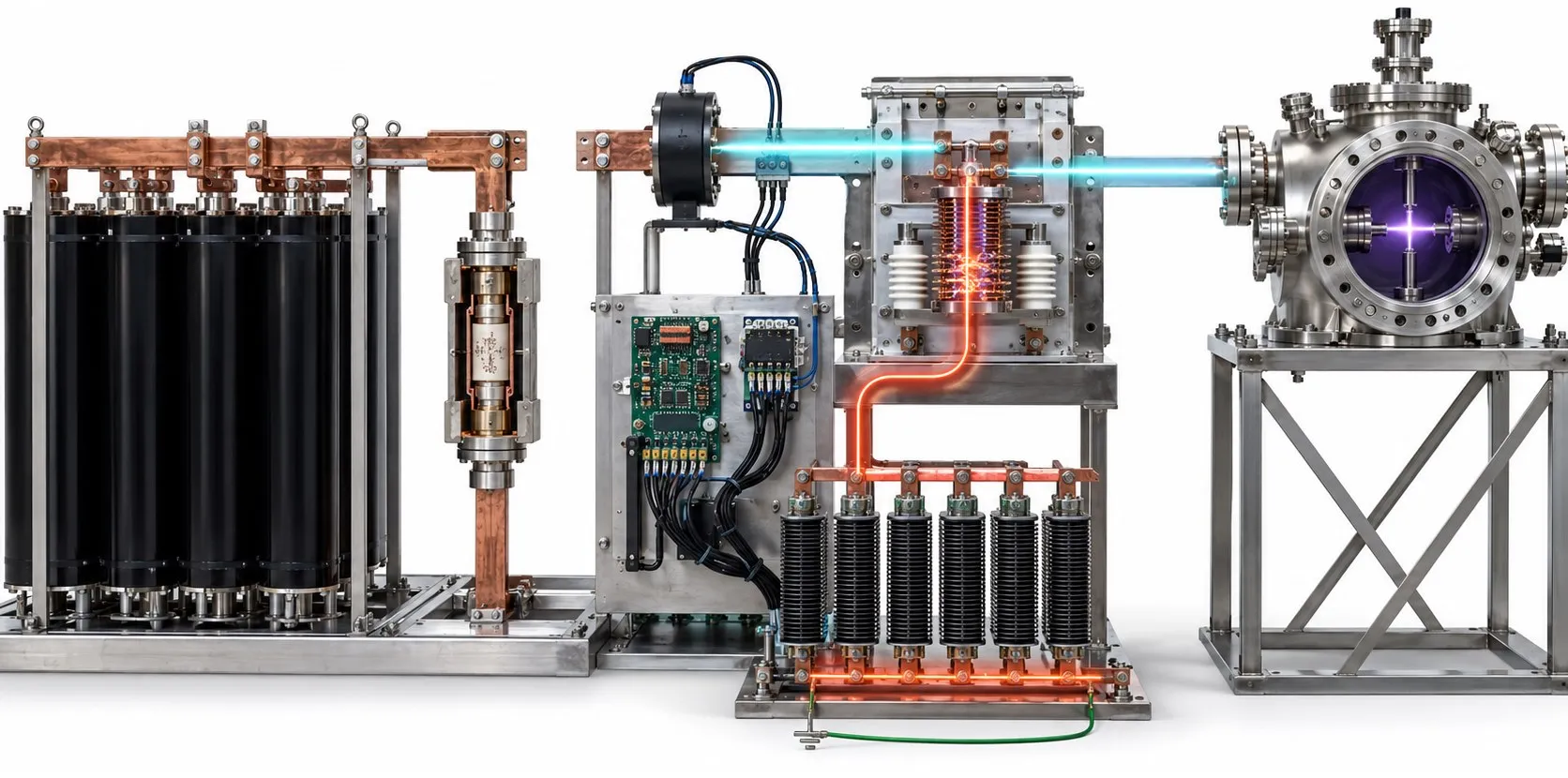
Arc plasma and safe circuit interruption
Hello everyone. Understanding the term plasma fuse starts with understanding the arc plasma that can form inside an electrical fuse. The name alone does not identify a standardized industrial fuse class, a particular voltage range or an operating speed. If a manufacturer uses it for a product, its meaning must be established from the manufacturer's technical documentation. This page explains the subject through arc formation and extinction in fuses with fusible elements.
Editor's note: Plasma is the electrically conducting medium within an arc. Extinguishing the arc requires eliminating that conducting path. Saying that “current stops automatically when plasma forms” is therefore incorrect. Element melting and complete current interruption are separate stages.
Why can current continue after the element melts?
An overcurrent or short circuit heats the fuse element. As the element melts and separates, an electric arc may form across the gap if sufficient circuit energy and voltage are available. Hot metal vapor and the ionized medium allow current to continue briefly. The protective function of a fuse therefore involves more than melting a metal connection: the arc must be extinguished and insulation between the terminals restored.
What is inside a current-limiting fuse?
Many high-breaking-capacity industrial fuses combine a silver or copper element with specially designed restrictions, quartz sand filler and an insulating body capable of withstanding mechanical stress. Ceramic bodies are common, but fuses do not all use the same materials or a chamber prefilled with gas.
Arcs forming at the restrictions transfer heat to the filler. Interaction with the quartz, cooling of metal vapor and changes in the arc path contribute to interruption. Glass-like insulating residue forms in some regions. Under suitable fault conditions, current limitation can prevent the prospective short-circuit current from reaching its first major peak. This behavior is particularly relevant to high-speed semiconductor fuses, although the same limitation and clearing time cannot be assumed at every fault-current level.
Differences in high-voltage and DC applications
High-voltage fuses include both current-limiting and expulsion designs. In expulsion fuses, gas flow generated by the arc helps interrupt the current; this does not mean that every fuse is prefilled with gas. When comparing different fuse types, consider the actual construction and applicable standard.
In DC fuse applications, the circuit current does not naturally cross zero every half-cycle as AC does. The DC voltage rating, breaking capacity and, where specified, the circuit's L/R time constant require separate checks. A fuse carrying only an AC rating must not be assumed suitable for DC operation at the same voltage.
Which ratings determine the selection?
The rated current describes continuous current-carrying capability under specified conditions; a fuse does not necessarily open immediately above that value. Ambient temperature, enclosure heating, connections and the load cycle influence selection. The voltage rating and AC/DC suitability must also match the circuit.
Breaking capacity is the prospective fault current that can be safely interrupted at the stated voltage and test conditions. For example, if the prospective short-circuit current at a location is 25 kA, a fuse with a 10 kA breaking capacity is not suitable simply because its ampere rating matches the load. This illustrates the distinction; it is not a selection calculation for a particular installation.
Fuse selection considers the time-current curve, peak let-through current and total clearing I²t together. Total operating time is the sum of pre-arcing time and arcing time. I²t is expressed in A²s, not directly in joules; it is an integral used to assess the heating effect of current. Using only melting I²t for semiconductor protection can overlook the contribution during arcing.
The utilization category also matters. gG provides full-range overload and short-circuit protection for general applications. aR provides partial-range short-circuit protection for semiconductors and does not provide overload protection on its own. For high-power equipment, the words “fast” or “plasma” alone are not a basis for choosing an equivalent fuse.
Standards must be considered alongside the application
The IEC 60269 series addresses low-voltage fuses; IEC 60269-1:2024 gives general requirements for enclosed current-limiting fuse-links within its scope. IEC 60282-1:2020 covers high-voltage current-limiting fuses for 50/60 Hz AC systems above 1,000 V. The formation of arc plasma inside a device does not automatically establish compliance with either standard.
A drive's input fuse may serve a different purpose from a fuse protecting an individual power semiconductor. The protection objective, manufacturer's recommended category and fault conditions determine the choice. Even a very fast fuse cannot guarantee that every power module will survive a fault. Some designs aim to isolate a failed branch or limit the extent of damage.
What should be checked during replacement and maintenance?
First establish why the fuse opened. Installing a higher ampere rating without correcting the fault can compromise protection. An operated fusible element must not be repaired, bridged with wire or refilled; it must be replaced with a suitable equivalent. Before replacement, energy sources must be safely isolated, stored energy considered and the absence of voltage verified by an authorized person.
Inspect the fuse holder and connections for looseness, discoloration, cracks, contamination and signs of overheating. Matching dimensions do not establish equivalent protection. Preserve the complete part number or verified equivalent, utilization category, voltage and breaking-capacity ratings, together with the manufacturer's installation requirements.
Related topics
Fuse selection and use: Which type of fuse should you choose? helps establish the application category. Compare fast-acting and time-delay fuses against the load's initial current. Fuse standards, when to replace a fuse and safe fuse replacement connect selection with practical use.
Coordination with other equipment: Consider semiconductor withstand capability in solid-state relays, the manufacturer's specified input protection for variable frequency drives, magnetizing inrush in transformers and initial charging current in power supplies. For contactors, evaluate coordination between short-circuit protection and the switching device.
Sources
Eaton Bussmann: High speed fuses application guide: Arc extinction, total operating time and utilization categories.
Mersen: Observation of Arcing Inside a Fuse: Experimental investigation of arcing inside a fuse.
Schneider Electric: Fuse: Distinction between current-limiting and expulsion fuses.
Eaton Bussmann: Fuseology: I²t, semiconductor protection and DC applications.
IEC 60269-1:2024: Scope of general requirements for low-voltage fuses.
IEC 60282-1:2020: Scope of high-voltage current-limiting fuses.