
What is the general durability and lifespan of a pump?
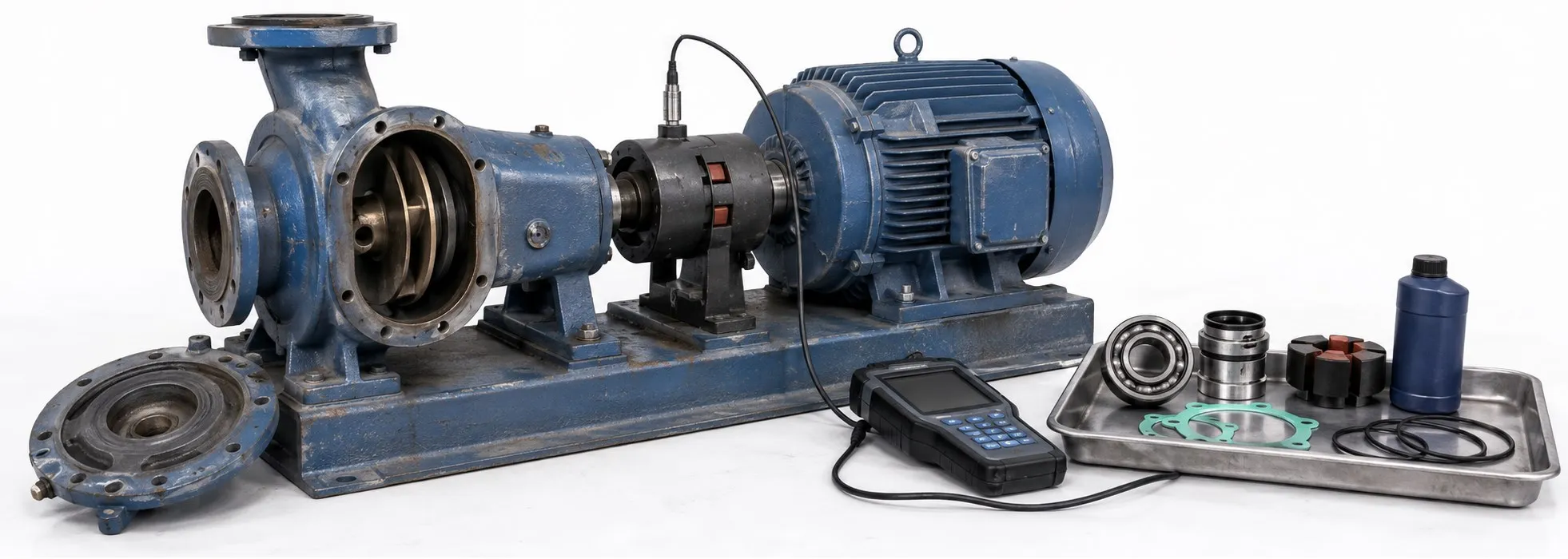
Pump service life: what determines it and when to replace a pump
How long a pump lasts depends on its duty, not just its category. A correctly selected and maintained unit can remain useful for many years. Figures such as 8–15 years for a submersible pump or 20–25 years for a centrifugal pump should not be treated as universal expectations. A meaningful assessment needs the model, operating hours, pumped liquid and maintenance history.
Start with hours, not the date on the nameplate
Over a 365-day year, a pump running two hours daily accumulates 730 hours. Continuous operation adds 8,760 hours. Both pumps are one year older, but their operating time is very different. This calculation compares usage; it does not predict a failure date. Storage and idle conditions also belong in the assessment.
The life of the assembly differs from the replacement interval of its parts. Seals, bearings, impellers and other components do not wear at identical rates. Replacing a serviceable assembly’s worn parts may allow it to remain in use. Design life, warranty duration and maintenance intervals describe different things; use the instructions for the particular model.
Four areas that deserve attention
Liquid and material compatibility. Sand and abrasive solids can wear wetted components. Chemical incompatibility may attack casing materials or seals. Consider temperature and viscosity alongside the differences between water and oil pumping. Good pump selection accounts for the liquid as well as flow and pressure.
Dry running and cooling. Designs that rely on the pumped liquid for lubrication or cooling can be damaged quickly without it. With a submersible pump, check the liquid level and required flow around the motor. Being underwater does not automatically guarantee adequate cooling. Investigate overheating and use suitable pump controls to monitor dry-running risk.
Operation outside the permitted range. A centrifugal pump running beyond its approved flow range may experience vibration, heating or cavitation. Collapsing vapour bubbles can damage surfaces. A new gravel-like noise is a useful clue, rather than proof of a diagnosis. Assess reliability and efficiency at the actual operating point.
Repeated starting and installation faults. Unnecessary cycling can increase thermal and mechanical stress, particularly in some submersible motors. Follow the motor manufacturer’s limits on starts and rest periods. Check alignment, foundation security and pipe loads. Correct mounting and suitable accessories matter alongside the quality of the pump itself.
Use automation within the equipment limits
A pressure sensor, PID loop and compatible motor drive can adjust speed to demand. For a submersible pump drive, respect minimum speed, cooling requirements and the manufacturer’s conditions for inverter operation. Reducing speed is not, by itself, a guarantee of longer life. Set controls and protection for the operating limits as well as energy consumption.
Build a useful condition record
Track operating hours, starts, flow, pressure, motor current, temperature, leakage and vibration. Compare readings taken under similar conditions. Vibration measurements and a record of fault symptoms can reveal changes early. One low-flow reading or high-current measurement does not establish that the pump has reached the end of its life.
Lubrication and seal care depend on the design. Not every bearing needs added grease, and seal arrangements need different treatment. Gland packing may require controlled leakage; a mechanical seal is assessed differently. Use the specified lubricant, quantity and service intervals. Before intervention, safely isolate energy and release pressure.
Deciding between repair and replacement
Repair may be worthwhile when damage is limited, suitable parts are available and the required performance can be verified afterward. Consider replacement for recurring failures, serious casing damage, unavailable parts or equipment that no longer suits the duty. Compare total cost, including energy, downtime and the consequences of another failure, and review the power requirement.
Condition should drive the decision. Combine the manufacturer’s inspection findings with maintenance records and performance measurements. Domestic and industrial installations can have very different duty patterns. Premature replacement may waste money; continued use of unsafe or persistently unreliable equipment is also a poor choice.
Related topics
Explore the pump knowledge centre: Pump systems · Pump FAQ · Submersible pumps
Sources: KSB — maintenance and seals · KSB — dry running · KSB — operating range · KSB — cavitation · Xylem — abrasive duty, cooling and protection · Xylem — preventive maintenance · Franklin Electric — 50 Hz submersible motor application manual · Franklin Electric — example of model-specific operating limits