
What is the difference between torque and power?
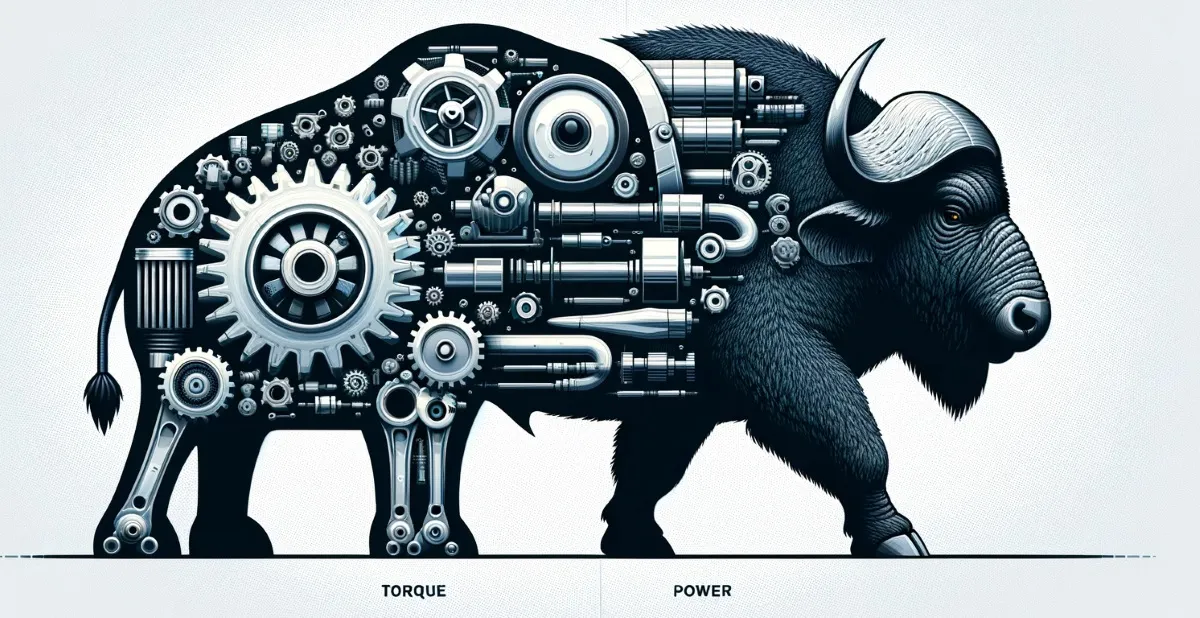
What is the difference between torque and power?
Torque is the turning effect of a force about an axis. Power is the rate at which work is done or energy is transferred. At a motor shaft, rotational speed connects the two: P = T × ω. Read torque, power and speed together. Any one of these values on its own is insufficient to establish whether a motor suits an application.
| Quantity | What does it describe? | Common unit |
|---|---|---|
| Torque | Turning moment at the shaft. | Newton metre (N·m) |
| Power | Energy transferred per unit time. | Watts and kilowatts (W, kW) |
| Rotational speed | How fast the shaft turns. | rpm or rad/s |
A practical way to understand torque
Apply a 100 N force perpendicular to a wrench at a distance of 0.20 m from its rotation axis, and the torque is T = F × r = 20 N·m. Applying the same force through a longer lever increases torque. If the force is not perpendicular, its angle also matters. Torque units differ from force units; catalogues may also use lbf·ft.
Torque is not an amount of work. Mechanical work also depends on angular displacement. For constant torque, work = torque × angle turned, with the angle in radians. Therefore, more rotation at the same torque transfers more mechanical energy. Power describes how quickly that work is done.
Animated comparison: torque, speed and power
In these three examples, the green arrow represents torque level, the rotating blue arm represents speed, and the orange bar represents mechanical power. Rotation is slowed down to make the speed ratios visible. Each example's Start / Stop controls affect the animated display; the example values remain unchanged.
A and B turn at the same speed: B has twice the torque, so it delivers twice the power. A and C have the same torque: C turns twice as fast, so it delivers twice the power. B and C have equal power but different torque and speed. This illustrates why the torque-speed relationship cannot be reduced to a single rating.
How do you calculate power from rpm?
The equation P (W) = T (N·m) × ω (rad/s) uses angular velocity. For speed in rpm, convert it using ω = 2π × n / 60. Convenient formulas are P (kW) ≈ T (N·m) × n (rpm) / 9550 and T (N·m) ≈ 9550 × P (kW) / n (rpm). Simply multiplying N·m by rpm does not give a value in watts.
For example, a shaft delivering 10 N·m at 1,500 rpm produces approximately 1.57 kW. At the same speed, 20 N·m corresponds to approximately 3.14 kW. Horsepower is another unit of power, but distinguish mechanical hp from metric PS when converting: 1 mechanical hp ≈ 745.7 W, while 1 metric PS ≈ 735.5 W.
Can a stationary motor produce torque?
Yes. A suitable servo torque-control system or energised stepper motor can produce torque at standstill. However, when ω = 0, mechanical shaft power P = 0. Electrical consumption need not be zero: current and losses can still generate heat. Assess the standstill behaviour of stepper and servo motors separately from their running capability.
Do motors with the same kW rating have the same torque?
Different rated speeds give different rated torques. A motor delivering 3 kW of shaft power at 1,500 rpm has approximately 19.1 N·m of torque. At 3,000 rpm, the same shaft power corresponds to approximately 9.55 N·m. These are values calculated for the stated operating points. Read the motor's capability across its operating range from the torque-speed curve.
When selecting a motor, check continuous torque, peak torque and permitted duration together. A kW rating alone does not establish starting torque or acceleration capability. The constant-torque region, high-speed limits and the drive's current capability affect usable performance.
Does a gearbox produce more power?
A speed-reducing gearbox lowers output speed and increases load-side torque. Approximate relationships are Toutput = Tmotor × i × η and noutput = nmotor / i, where i is the speed reduction ratio and η is transmission efficiency. This torque multiplication does not create power; transmission losses reduce output power. Load and transmission calculations must assess the torque requirement together with the target speed.
A high-torque motor therefore does not automatically deliver higher power or higher speed in every application. When choosing suitable speed or torque control, consider the torque-speed balance and the loads imposed on mechanical components together.
Separate electrical input from shaft output
Electrical input power differs from mechanical shaft output power because of losses. Motor efficiency is defined as η = Pshaft / Pelectrical. The kW value on a motor nameplate generally represents mechanical output under rated conditions. When assessing energy efficiency or consumption, identify where each power value applies.
Shaft power can be calculated from torque measurement and speed at the same operating point. An encoder can provide speed feedback, while a torque sensor can measure shaft torque directly. A drive's estimated torque display and a measured torque value are obtained by different methods.