
What is IEC Standard for PLC?
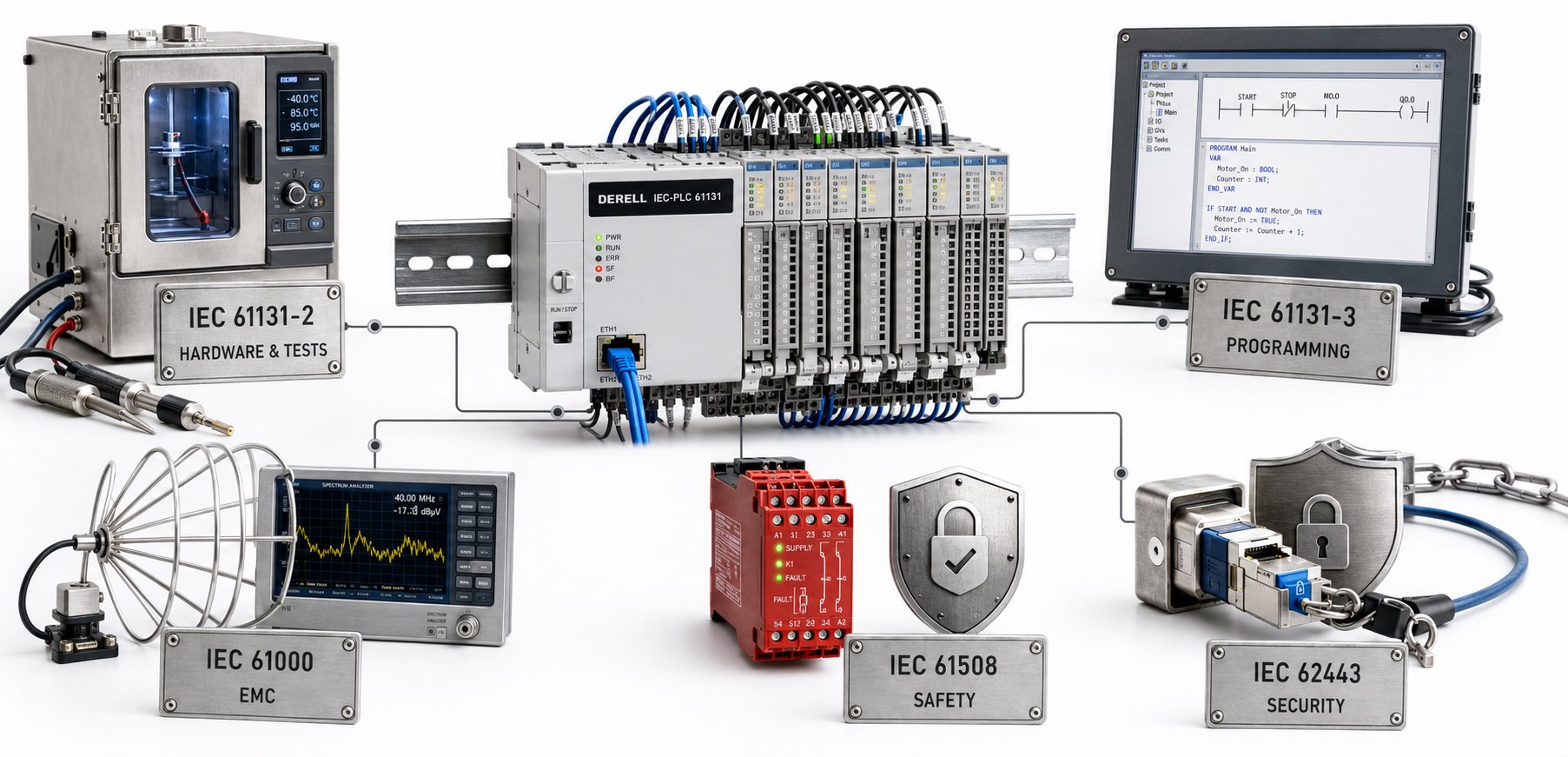
IEC standards for PLCs provide a shared technical framework for controller hardware, programming languages, communications and specific safety requirements. The main series for PLCs is IEC 61131. When reviewing IEC standards, check the particular part, edition and product scope together.
How do you read a standard reference? In IEC 61131-3:2025, 61131 identifies the series, -3 identifies the part, and 2025 is the publication year. Parts of a series need not share the same publication year. IEC TR identifies a technical report. Within industrial standards, assigning one part's description to another part can lead to the wrong equipment or documentation being selected.
IEC 61131-1:2003 — General information: This part defines terminology and principal functional characteristics for programmable controllers and associated peripherals. It provides context for understanding a CPU, the I/O structure and components such as an HMI. Its focus is the basic definition of the controller system. Consider associated peripherals when assessing a PLC's capabilities.
IEC 61131-2:2017 — Equipment requirements and tests: This part covers functional requirements, electromagnetic compatibility and related verification tests for PLCs/PACs and associated peripherals. Review the manufacturer's technical data when assessing input/output modules and power supply characteristics. Even compliant equipment has operating temperature, installation and connection limits that must be checked in its documentation.
IEC 61131-3:2025 — Programming languages: This part defines language rules for Structured Text (ST), Ladder Diagram (LD) and Function Block Diagram (FBD). SFC is defined for structuring the internal organisation of programs and function blocks through steps and transitions. Shared language rules help make code understandable. CPU hardware, libraries and project settings still require separate consideration for each manufacturer.
Instruction List and edition differences: Instruction List (IL) can appear in legacy PLC projects; it is absent from the IEC 61131-3:2025 language suite. One programming tool may open an older IL project while another model or version lacks support. Check legacy project support separately from the scope of the current standard.
IEC TR 61131-4:2004 — User guidelines: This report introduces users to the IEC 61131 series and helps with controller selection and equipment specifications. When evaluating PLC systems, consider channel counts, expansion and application conditions together. It is a technical report intended to guide equipment selection and use.
IEC 61131-5:2000 — Communications: This part addresses the behaviour of communication services that a PLC provides to other devices or requests from them. When choosing industrial communications, verify support for Modbus, PROFINET or EtherCAT separately. A reference to this part does not establish support for every field protocol.
IEC 61131-6:2012 — Functional safety: This part specifies requirements for functional safety PLCs (FS-PLCs) and associated peripherals intended to act as the logic subsystem of a safety-related system. When assessing PLC system safety, review the equipment's safety scope and conditions of use. Adding a stop instruction to a standard PLC does not turn it into a safety PLC.
IEC 61131-7:2000 — Fuzzy control programming: This part defines a language for programming fuzzy control applications in PLCs. Graded descriptions such as “low”, “medium” and “high” can help explain fuzzy logic. PID control is a different control approach. This part is not a hardware specification for PLC dimensions or general power consumption.
IEC TR 61131-8:2017 — Language application and implementation guidelines: This report provides guidance on applying IEC 61131-3 languages and implementing them in development tools. It also addresses programming and debugging tools. Environments such as CODESYS and their debugging features illustrate the practical side of this topic. Read the 2017 report alongside relevant changes in newer language editions.
IEC 61131-9:2022 — IO-Link / SDCI: This part defines a point-to-point digital communication interface for small sensors and actuators. Parameters, identification and diagnostic information can be exchanged alongside measurement or status data. IO-Link requires a suitable master and device; a normal digital input does not become an IO-Link port through a software setting alone.
IEC 61131-10:2019 — PLCopen XML exchange format: This part defines an XML-based format for importing and exporting IEC 61131-3 projects. PLCopen XML helps transfer program information between development environments. After importing, check hardware addresses, libraries and manufacturer-specific features, then validate the project on its target device.
Product safety for control equipment: IEC 61010-2-201:2024 covers particular safety requirements for control equipment and is used with IEC 61010-1. IEC 61131-2:2017 points to this standard for product safety requirements. Protection against hazards originating in the equipment, such as electric shock, is a different assessment from whether a machine correctly performs its safety functions.
Machine safety functions: IEC 61508 provides a general framework for electrical/electronic/programmable electronic safety-related systems. Standards such as IEC 62061 and ISO 13849-1 are also considered for machine control, depending on the application. Assess a safety relay or safety PLC together with sensors, final switching elements and software. A component's safety documentation does not establish that the complete machine safety function has been validated.
Switchgear and machine electrical equipment: The IEC 60947 series concerns low-voltage switchgear and controlgear; it is not a general standard for everything associated with a motor. IEC 60947-1 provides general rules. IEC 60204-1 addresses the machine's electrical equipment. Assess the PLC, contactors, protective devices and panel connections within their respective scopes.
IEC 61499 — Distributed control architecture: IEC 61499-1 defines a generic architecture for using function blocks in distributed industrial control systems. Moving channels into the field through remote I/O and distributing the control application across devices are separate design decisions. Adding remote I/O does not automatically establish an IEC 61499 architecture.
IEC 62443 — Industrial cybersecurity: Relevant parts of this series address access, network and control system security. Include cybersecurity in projects involving SCADA, HMIs and remote connections. Functional safety and cybersecurity can influence each other; documentation for one does not replace assessment of the other.
How should an “IEC compliant” claim be assessed? Check the full standard reference, edition, product model, hardware/software version and scope of the documentation. A manufacturer declaration, test report and third-party certificate are different types of evidence. Application-specific verification is still needed during PLC programming and commissioning. For example, support for IEC 61131-3 languages is not, by itself, certification as a safety PLC.