
what is profinet?
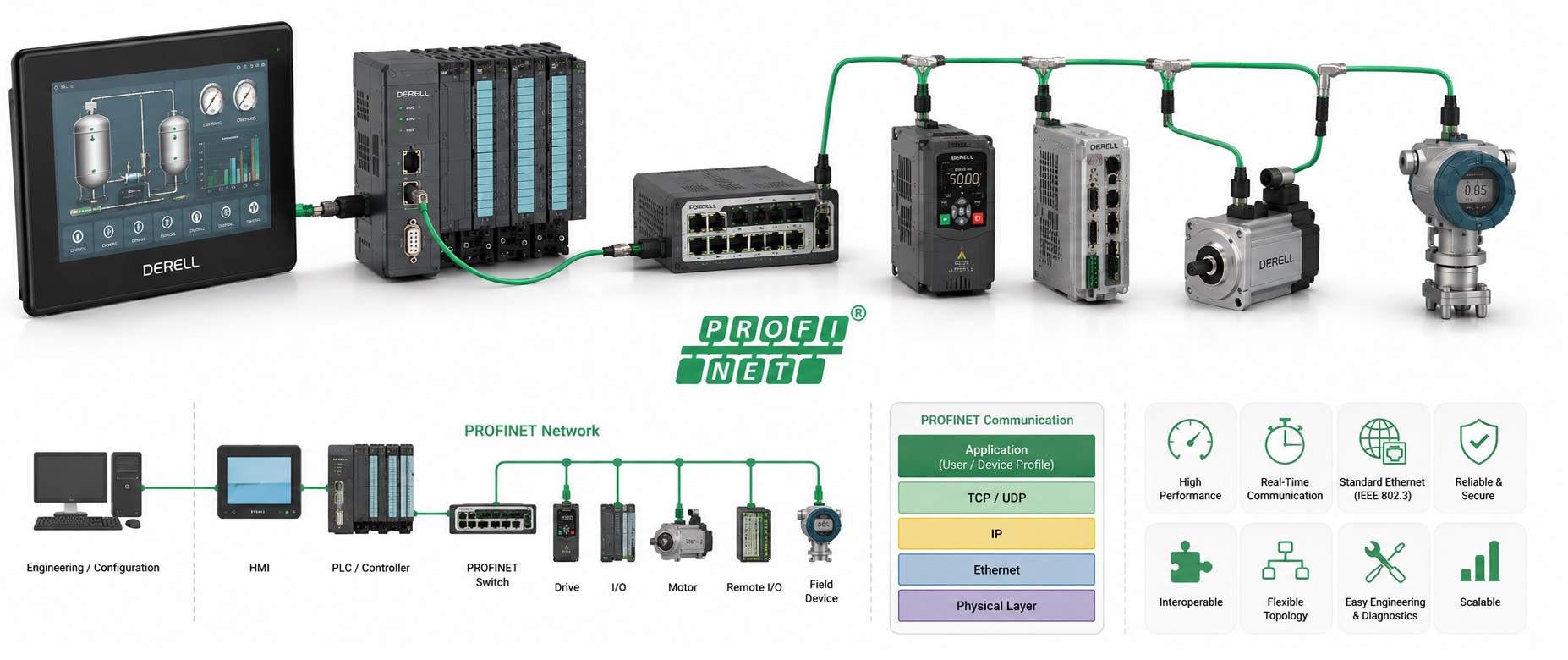
PROFINET is an Ethernet-based industrial communication technology designed for real-time data exchange between controllers and field devices. It is widely used to connect PLCs, remote I/O, motor drives, servo systems, robots, sensors and other automation equipment over an industrial Ethernet network. Within the wider field of industrial communication, PROFINET is one of the major Ethernet-based technologies used for machine and process automation.
In simple terms: PROFINET allows a PLC and the devices around a machine to exchange control data over Ethernet. Instead of using Ethernet only for ordinary computer networking, PROFINET adds the timing, device configuration, diagnostics and cyclic I/O functions required by industrial automation.
What does PROFINET mean?
The name PROFINET is derived from PROcess FIeld NETwork. It should not be expanded as “PROFIBUS for Industrial Ethernet.” PROFINET grew from the same PI automation ecosystem and shares engineering concepts with PROFIBUS, but it is not simply PROFIBUS transferred onto an Ethernet cable.
PROFINET has its own device model, real-time communication mechanisms, engineering structure, diagnostics and Ethernet-based network architecture. It uses standard Ethernet technology as its networking foundation while adding the functions required for deterministic industrial control.
How does PROFINET work?
PROFINET IO does not normally describe its communication architecture using the traditional master-slave terminology. The principal device classes are IO-Controller, IO-Device and IO-Supervisor. A PLC typically acts as the IO-Controller and executes the automation program.
Remote I/O stations, drives, valve terminals and other field units are commonly configured as IO-Devices. The IO-Controller exchanges process data with these devices and manages their configured relationships within the automation project.
An IO-Supervisor is typically an engineering station, PC or diagnostic tool used during commissioning, maintenance or troubleshooting. In some applications an HMI can also participate in supervisory or diagnostic functions, depending on the system architecture.
For example, a PLC can send speed reference and control information to an AC drive while cyclically receiving motor current, operating state and fault information from the same device. At the same time, distributed I/O can deliver sensor states to the PLC and receive output commands for actuators.
What are cyclic and acyclic data in PROFINET?
Cyclic I/O data is the regular process data exchanged continuously between an IO-Controller and its IO-Devices. Digital inputs, output commands, drive control words, actual values and other time-critical process information are commonly transferred in this manner.
Information that does not need to be exchanged every control cycle can use acyclic read and write services. Device parameters, identification information and certain maintenance or diagnostic records are examples of data that may be transferred acyclically.
PROFINET also provides alarm and diagnostic mechanisms so that devices can report faults, module changes and other important conditions to the controller. For this reason, the old description of “CDE, EDDE and ADE as three PROFINET protocols” is misleading. A more accurate engineering distinction is between cyclic process data, acyclic services and alarm or diagnostic communication.
What is PROFINET RT?
PROFINET RT — Real Time is used for time-critical cyclic automation data. Rather than relying on the complete normal TCP/IP communication path for every process frame, PROFINET can exchange real-time I/O directly at Ethernet level, reducing communication overhead for control traffic.
RT is suitable for many standard machine automation, distributed I/O and drive applications. Standard Ethernet and IP-based communication can still coexist on a properly engineered PROFINET network, which allows control traffic and non-real-time information services to share the same general infrastructure.
What is PROFINET IRT?
IRT — Isochronous Real Time is intended for applications requiring tighter synchronization and highly predictable timing. It is particularly relevant to synchronized servo systems, multi-axis motion and demanding machine-control applications where communication jitter must be tightly controlled.
Not every PROFINET device supports IRT. The presence of an Ethernet connector or even a PROFINET interface does not by itself prove that IRT operation is available. Controller, IO-Device, network components and engineering configuration must support the required real-time class.
This distinction becomes especially important in industrial robotics and coordinated motion systems, where cycle time, synchronization and jitter can be as important as raw network bandwidth.
How do the PROFINET device name and IP address work?
PROFINET commissioning depends on more than an IP address. An IO-Device is assigned a PROFINET device name, and the engineering project associates the configured device with this identity. DCP — Discovery and basic Configuration Protocol is used for device discovery and for functions such as assigning the device name and network parameters.
This is why installing a replacement device and simply copying the old IP address may not restore communication. If the PLC project expects a particular PROFINET device name and the replacement device has another name, the physical Ethernet link can be active while PROFINET I/O communication still fails.
PROFINET networks can also make use of Ethernet mechanisms such as LLDP to identify neighbouring devices and ports. This allows engineering and diagnostic tools to obtain useful topology information about how field devices and switches are physically connected.
What is a GSDML file?
GSDML is the XML-based device description format used for PROFINET engineering. A GSDML file can describe the identity, modular structure, communication features, process data, parameters and diagnostic capabilities of an IO-Device.
When a new VFD, remote I/O station or another PROFINET device is added to a PLC project, its GSDML file may be imported into the engineering software. The engineer can then select the correct device structure, modules and I/O data configuration.
Importing a GSDML file does not complete the network automatically. The device name, module arrangement, I/O mapping and controller configuration must still correspond to the actual hardware installed in the machine.
Which network topologies can PROFINET use?
Because PROFINET is Ethernet based, networks can be designed in line, star, tree and ring arrangements. Many field devices include two Ethernet ports with an integrated switch, making it possible to connect devices sequentially in a line without a separate external switch at every point.
Larger installations can use industrial Ethernet switches to create star or tree structures. This gives PROFINET considerably more physical topology flexibility than traditional serial fieldbus networks.
For redundant ring structures, suitable devices can use MRP — Media Redundancy Protocol. If a single connection in a correctly configured ring fails, communication can be redirected through the remaining path. Simply connecting cables in a circle does not create redundancy; the relevant devices and network configuration must support MRP.
Which cable should be used for PROFINET?
PROFINET uses Ethernet physical technologies, but cable and connector selection should still be appropriate for industrial conditions. Fixed installations, continuously moving machinery, robot applications, electrical noise and environmental exposure may require different cable constructions.
Communication cable should not be routed carelessly alongside motor power wiring or PWM outputs from frequency drives. Correct shielding, equipotential bonding, connector installation and cable routing remain important even though Ethernet uses differential signalling.
The fact that a normal office Ethernet patch cable can establish a link does not automatically make it a suitable permanent cable for a machine, drag chain or electrically harsh industrial environment.
What is the difference between PROFINET and PROFIBUS?
PROFIBUS is a traditional fieldbus family. PROFIBUS DP commonly uses an RS-485 serial bus physical layer, while PROFIBUS PA uses a physical layer designed for process field instruments. PROFINET, by contrast, is based on Ethernet networking.
PROFINET should therefore not be described simply as “a faster PROFIBUS.” Its Ethernet topology, IO-Controller/IO-Device model, GSDML engineering, device naming, topology discovery, real-time RT and IRT communication and diagnostic capabilities form a substantially different network architecture.
PROFINET normally offers much higher network bandwidth than classic PROFIBUS DP, but raw communication speed alone does not determine whether one technology is better for a particular machine. Existing hardware, control-cycle requirements, installation cost, maintenance knowledge and migration strategy must also be considered.
A plant moving toward Ethernet-based industrial automation does not necessarily have to remove every working PROFIBUS segment. Proxies and gateways can integrate established fieldbus equipment into a newer Ethernet-oriented architecture.
Are PROFINET and EtherNet/IP the same?
No. Both use Ethernet as their networking foundation, but their application protocols and device models are different. PROFINET belongs to the PI technology family, while EtherNet/IP uses CIP — Common Industrial Protocol.
An Ethernet port on a PLC, HMI or drive does not mean that the device automatically supports both protocols. The supported industrial Ethernet protocols must be checked in the device specifications before integration.
Are PROFINET and EtherCAT the same?
PROFINET and EtherCAT are also separate industrial Ethernet technologies. Both can be used for real-time machine control, but their frame handling, network operation, device models and synchronization mechanisms are different.
This is particularly important when selecting hardware for motion control. A servo drive with an EtherCAT interface cannot simply be connected as a PROFINET IO-Device unless the drive also provides the required PROFINET interface or a suitable conversion solution is used.
What is the difference between PROFINET and standard Ethernet?
Ethernet provides the underlying networking technology for transmitting frames between connected equipment. PROFINET uses Ethernet to provide an industrial automation system with controller-device relationships, cyclic process data, parameter access, alarms, diagnostics and real-time communication.
A laptop with an Ethernet interface is therefore not automatically a PROFINET IO-Device. PROFINET operation requires the appropriate protocol implementation, device model and engineering information in addition to the Ethernet hardware itself.
Which devices use PROFINET?
PROFINET can be found on PLCs, distributed I/O systems, motor drives, servo drives, robots, machine-vision equipment, RFID systems, valve terminals and many other automation devices.
A machine may collect signals from industrial sensors through a remote PROFINET I/O station, process those signals in the PLC and issue control commands to drives or actuators on the same network.
The resulting process and machine information can then be displayed locally on an HMI panel or passed to a higher-level SCADA system for monitoring, alarms, trending and production analysis.
What are the main advantages of PROFINET?
One of the major advantages of PROFINET is that cyclic machine-control data, device configuration, diagnostics and higher-level Ethernet communication can coexist within the same overall network architecture. Support for line, star, tree and ring structures also provides considerable flexibility when designing machines and production lines.
Device naming, topology information and detailed diagnostics can make troubleshooting more precise than on many traditional serial networks. In a correctly engineered system, maintenance personnel can often identify the affected device, module, port or communication relationship directly from controller diagnostics.
However, PROFINET does not make poor network engineering harmless. Switch performance, update times, network load, cabling, shielding, topology and device configuration still have to be designed correctly.
Why does a PROFINET device fail to communicate?
Start troubleshooting at the physical network. Check device power, Ethernet cable, connectors, switch ports and link status. An active Ethernet link only proves that a physical connection exists; it does not prove that the PROFINET configuration is correct.
If the physical network is operating, verify the PROFINET device name, IP configuration, selected hardware model, GSDML version, slot and subslot configuration and I/O data lengths in the PLC project.
A mismatched device name is particularly important. The device may respond on Ethernet and still fail to establish normal PROFINET I/O communication because the controller cannot match the physical IO-Device to the configured station.
A generic “communication error” displayed on an HMI does not identify the actual cause. Controller diagnostics, device LEDs, port information, topology view and online engineering diagnostics should be evaluated together.
Practical PROFINET troubleshooting sequence
1. Confirm that both the controller and field device actually support PROFINET IO.
2. Check power, Ethernet link status, cables, connectors and switch ports.
3. Verify that the device has the PROFINET name expected by the PLC project.
4. Check IP address and subnet configuration where applicable.
5. Confirm that the correct GSDML file and device version have been selected.
6. Compare slots, subslots, modules and I/O data lengths with the real hardware.
7. Confirm that any required RT or IRT functions are supported by the controller and IO-Device.
8. Inspect EMC conditions, shielding and cable routing, particularly near motor and drive wiring.
9. If a ring is used, check the MRP configuration and designated ring ports.
10. Read the controller's actual online diagnostic message before changing parameters at random.
Should a new system use PROFINET or PROFIBUS?
The decision should not be based only on which technology has the higher nominal speed. Existing equipment, required cycle time, motion-control demands, cable infrastructure, maintenance knowledge, spare-parts strategy and future expansion all influence the engineering decision.
For new PLC and automation systems, Ethernet-based architectures can provide substantial advantages for integration, diagnostics and future expansion. In an established production line, however, a reliable PROFIBUS network may continue to perform its task effectively for many years.
Related Industrial Communication Guides
Industrial Communication · What Is Ethernet? · EtherCAT · EtherNet/IP in Industrial Automation
Related Automation Pages
PLCs and Modules · HMI Panels · SCADA · AC Drives and VFDs · Servo Systems · Sensors · Industrial Robotics