
How is Ethernet/IP used in industrial automation?
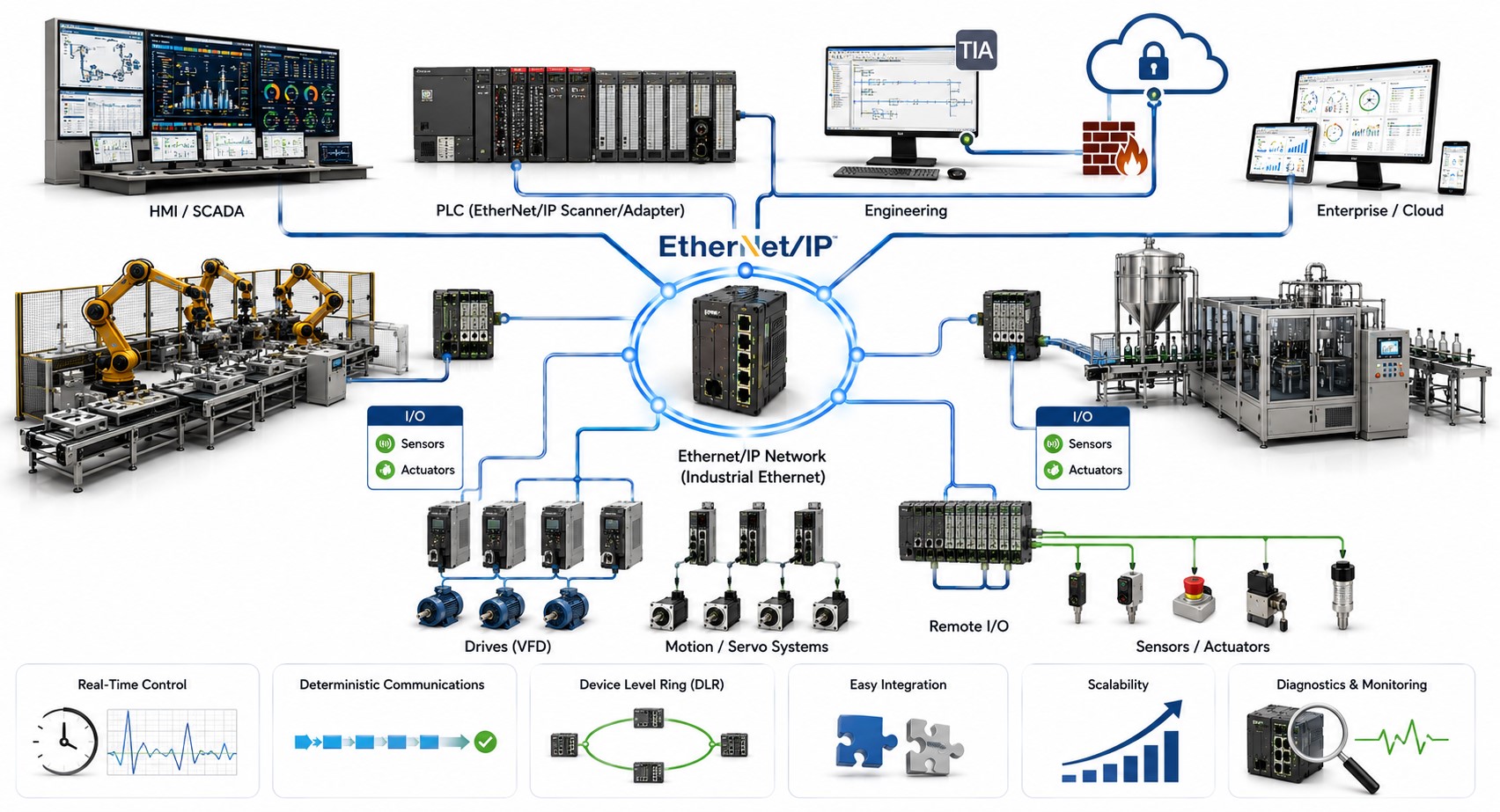
Connect control commands, field feedback and production information
Hello friends, EtherNet/IP's role in industrial automation is to carry control data between PLCs and field devices while providing access to their status, maintenance and production information. A conveyor can receive speed commands, remote I/O can report sensor states, an HMI can display faults, and production counts can reach a supervisory system. EtherNet/IP is based on CIP over standard Ethernet; its communication mechanisms organize these different exchanges using shared rules.
Editor's note: A stop command sent over a standard network does not, by itself, implement an emergency-stop safety function. Using CIP Safety requires suitable safety controllers and devices, configuration and validation. Using Ethernet in both the office and the factory also does not require connecting every device to one flat network.
Define device roles and data direction first
In a typical I/O arrangement, the PLC is the scanner/originator, while remote I/O or a drive acts as the adapter/target. The PLC initiates the connection, and I/O follows the established relationship. Assess device compatibility by supported roles, connection types and data profiles as well as physical ports. For example, Siemens' EtherNet/IP I/O library for the S7-1500 demonstrates a specific software implementation of this role; it does not establish automatic support in every CPU.
A sensor can communicate through a native EtherNet/IP interface or through remote I/O or an IO-Link master. Likewise, an HMI reading PLC variables does not mean all HMI traffic is cyclic EtherNet/IP I/O. Distinguishing Ethernet infrastructure from the application protocol and separating the communication layers helps prevent unsuitable device selections.
A conveyor example: from sensing to speed control
In an illustrative application, a product sensor connects to remote I/O. The PLC evaluates product presence and process permissives before sending a drive its run command and speed reference. The drive's ready, running and fault feedback is used in the PLC logic and displayed on the HMI. Actual speed or current can also be read where the device's data profile supports them.
In packaging and material-handling applications, evaluate feedback and process conditions alongside outgoing commands. A command bit and physical movement are different information. The PLC application must handle data validity, permissives and restart conditions explicitly. This example explains the operating concept; it is not a complete control or safety program for a particular machine.
Use cyclic I/O and maintenance messages for different tasks
Implicit messaging exchanges I/O using an agreed data layout. Explicit messaging supports request/response transactions such as parameter access, configuration and detailed diagnostics. Conventional cyclic I/O uses UDP 2222, while explicit transactions typically use TCP 44818. The purpose of each exchange matters alongside the port numbers: excessive parameter polling from a maintenance screen should not consume resources needed for control.
Complete the data mapping as well as the addressing
During commissioning, match Assembly instance numbers, data lengths, data types and scaling after establishing IP and subnet settings. In a purely hypothetical map using units of 0.01 Hz, a 35 Hz reference would be encoded as 3500. Do not carry that number unchanged into another device's map; obtain the actual units and layout from its manual.
An EDS file describes communication capabilities to an engineering tool; it neither writes the PLC application nor replaces firmware. Select appropriate software and device profiles, checking the model, firmware and supported I/O connections. Conformance testing does not remove the need to configure data direction, byte lengths and scaling correctly.
Choose RPI from the process requirements
RPI, Requested Packet Interval, is the requested I/O production interval. For one cyclic stream, 10 ms represents approximately 100 updates per second; 2 ms represents approximately 500. Multiple connections increase the combined packet load. Setting every device to its minimum RPI without assessing bandwidth, latency and jitter is not a sound design method.
RPI is not the total response time from sensor to actuator. PLC task timing, device updates and network delay also contribute. Performance limitations include packet-processing and connection capacity. Slow monitoring data and fast control data may require different update intervals.
Define communication-loss behavior before operating the machine
A disconnected cable, a PLC leaving RUN and a device restarting are different events. Test their consequences under suitable conditions. For example, the PowerFlex 25-COMM-E2P manual defines separate behavior parameters for communication loss and controller idle states. Those options and parameter numbers do not apply to every drive.
Do not treat the last received value as current when communication health is unverified. Define the HMI alarm, the intended output response and how operation resumes after reconnection. Diagnostics should assess CIP connection status, error codes and data freshness together; a successful ping is insufficient.
Select supported motion services for robots and servos
CIP Motion supports coordinated motion with suitable controllers and drives; CIP Sync provides time synchronization. Sending a speed reference through an ordinary EtherNet/IP I/O connection does not automatically create synchronized multi-axis motion. A robot exchanging start, ready and fault signals with a cell PLC is also a different task from controlling the robot's axes in real time.
Send the required information to SCADA, MES and ERP
Production counts, downtime reasons and energy information can reach supervisory systems through a PLC, SCADA platform or suitable data-collection layer. EtherNet/IP support does not automatically provide MES or ERP integration. Define the supervisory driver, data model, timestamps and data quality. Consider the requirements of fast control independently from reporting rates.
If OPC UA, MQTT or another higher-level interface is needed, select the device or software that provides it. Transferring data between Modbus TCP and EtherNet/IP likewise requires appropriate protocol support and mapping. Carrying a numeric fault code is only part of the task; the receiving system must also interpret it correctly.
Integrate office and control networks through controlled paths
OT and IT can share Ethernet technology, while control networks use appropriate segmentation, firewalls and access rules. Remote maintenance should follow an authenticated, authorized and logged access path. Exposing a PLC or drive's communication port directly to the internet is not the equivalent of that integration.
CIP Security provides cybersecurity capabilities such as authentication and data protection, depending on the supported profile. CIP Safety addresses functional safety communication. Keep these roles separate when assessing network-specific security measures, and check which features the actual devices implement.
Interpret energy information in its production context
Available power, energy and operating-time values from meters and drives can support maintenance and efficiency analysis. CIP Energy provides energy information and management objects and services in supporting products. Not every EtherNet/IP device implements it. Collecting data does not itself save energy. For example, compare kWh per part alongside product type, production count and idle operating time.
Review capacity and topology before expanding
Before adding I/O stations, recheck controller connection limits, switch/uplink load and IGMP arrangements where multicast is used. Select cables and connectors for the environment. A DLR ring requires suitable devices and supervisor configuration; continued communication does not prove that the ring is fault-free.
Successful commissioning combines correct data mapping, adequate updates under actual load, clear alarms and verified communication-loss behavior. EtherNet/IP provides useful access to control and operating information when these design decisions are handled correctly.
Related topics
EtherNet/IP fundamentals
Network configuration
Diagnostics and fault detection
Ethernet questions
PLC and HMI main page
Sources
ODVA: EtherNet/IP architecture and messaging
Rockwell Automation: PowerFlex I/O and communication-loss behavior
Schneider Electric: device profiles and EDS
Siemens: S7-1500 EtherNet/IP I/O implementation
Cisco: industrial network design and timing
NIST SP 800-82 Rev. 3: OT network security and access