
What exactly is a pump used for?
Moving liquid is only one part of a pump's job
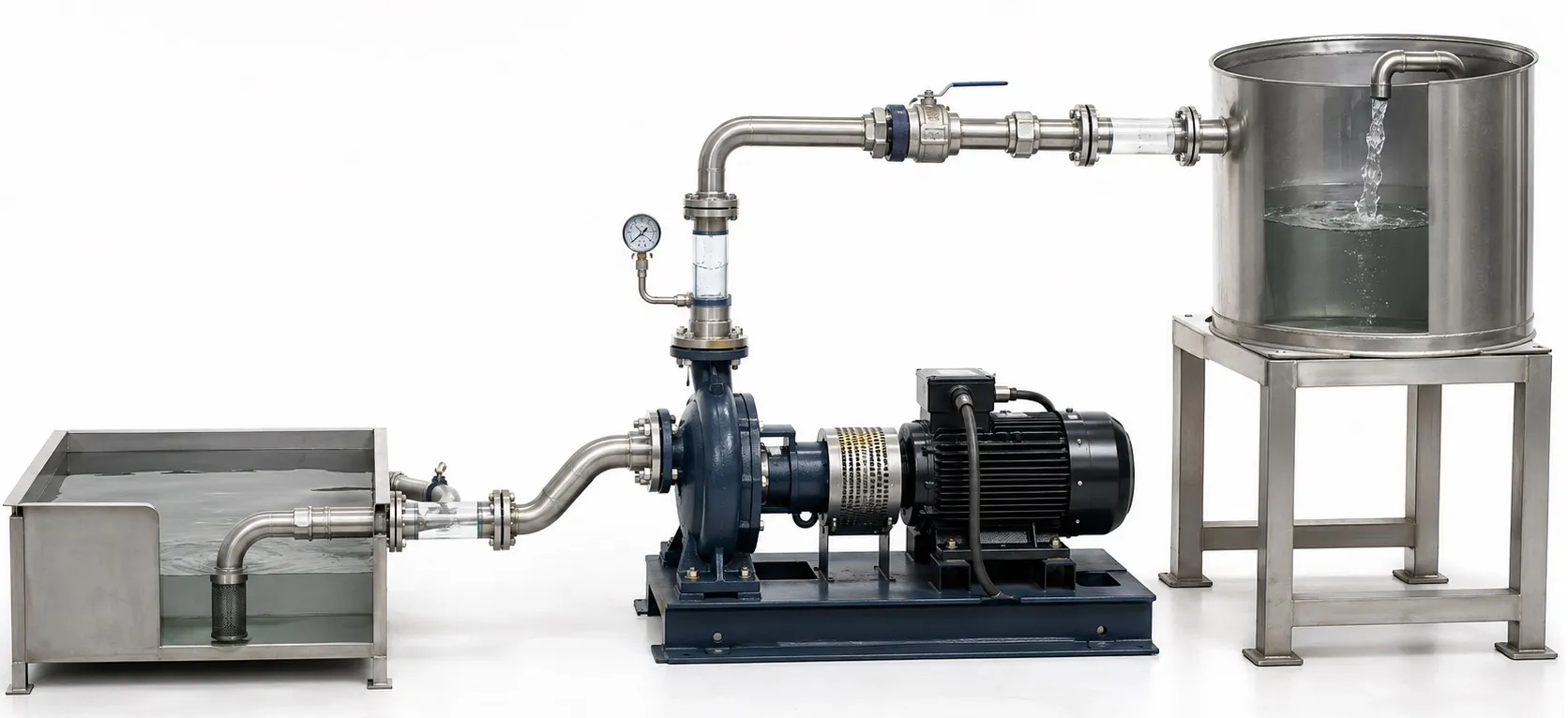
A pump transfers energy to a fluid. That energy can move liquid between tanks, deliver water at a useful pressure or keep a heating circuit circulating. In hydraulic machinery it carries power to actuators. The task determines what the pump must deliver. This page covers liquid pumps; vacuum pumps have a different duty, removing gas from an enclosed space.
Two questions define the duty
How much liquid is needed, and how much energy must it gain? The first question concerns flow rate, commonly measured in litres per minute or cubic metres per hour with a flow meter. The second involves elevation changes, pipe resistance and the pressure needed at the destination. Pressure is commonly expressed in bar or pascals. A high pressure reading does not prove that a large volume is flowing.
Pump head expresses energy added per unit weight of liquid, in metres. Head is not simply the height of a vertical pipe. For transfer between open tanks, the difference in liquid levels matters, alongside friction losses and any required outlet pressure. Pump power depends on both flow and head, as well as efficiency. Motor kilowatts alone cannot tell you how quickly a tank will fill.
Why the mechanism and liquid matter
An electric motor supplies shaft power; the pump passes energy into the liquid. In a centrifugal pump, a rotating impeller does this through fluid motion. Positive displacement designs move liquid in successive volumes. Understanding how the pump works helps explain why different pump designs suit different duties. Viscosity, temperature, solids and material compatibility all matter. A water pump and an oil pump are not automatically interchangeable.
Match the pump to the result you need
| Application | Required result | What to check |
|---|---|---|
| Domestic water supply | Usable water flow and pressure at the outlets. | Simultaneous demand and pressure at the least favourable outlet. |
| Agricultural irrigation | Water delivered from the source into the irrigation network. | Total flow, pipe losses and emitter or sprinkler pressure. |
| Heating and cooling | Liquid circulation that carries heat through the circuit. | Required circulation rate and circuit resistance. |
| Drainage and wastewater | Liquid transferred to a suitable discharge point. | Solids handling, discharge elevation and liquid level. |
| Hydraulic machinery | Oil flow that transmits power to cylinders and hydraulic motors. | Pressure required by the load and flow required by the movement. |
A dosing pump has another priority: delivering a controlled amount of chemical into a process. Accuracy and chemical compatibility can matter more than a large flow rate. Likewise, moving water does not make it clean; filtration and treatment require their own equipment.
A heating circulator does not lift water from scratch
In a filled, closed heating circuit, the rising and returning water columns balance. The circulator mainly overcomes flow resistance in pipes, valves and heat exchangers. Building height therefore does not directly determine its required head. Static filling pressure and expansion arrangements remain separate design considerations. A closed circulation loop and an open tank transfer need different calculations.
Control the delivery as demand changes
A suitable variable frequency drive can adjust motor speed and pump performance. PID control compares measured pressure or flow with a target and adjusts the output. Tank filling or sump drainage may instead use a float level switch to start and stop the pump. Choose pump control for the actual duty. Variable speed can reduce energy consumption in suitable applications, but the savings depend on the system.
Turn a flow reading into a useful estimate
If the measured delivery stays at 20 litres per minute, filling an empty 1,000-litre tank takes approximately 50 minutes. Water being drawn from the tank, or a changing duty as the level rises, changes that result. Use the flow at the actual operating point, rather than the largest flow number in a catalogue.
Continue exploring
Pump questions and answers · How pumps work · Selection criteria · Calculating pump power
Technical references
KSB — Positive displacement pumps