
How does EtherCAT differ from other industrial Ethernet protocols?
EtherCAT, PROFINET, EtherNet/IP, POWERLINK, Sercos III, Modbus TCP and CC-Link IE can all use Ethernet technology, but they are not interchangeable protocols. The important differences are not just link speed. They concern how cyclic traffic is scheduled, when a field device may transmit, how distributed clocks are synchronized, how topology is built, how devices are described, and how safety, diagnostics and IT traffic are integrated. The useful engineering question is therefore not “which protocol wins?” but “which architecture fits the machine and the installed ecosystem?”[1]
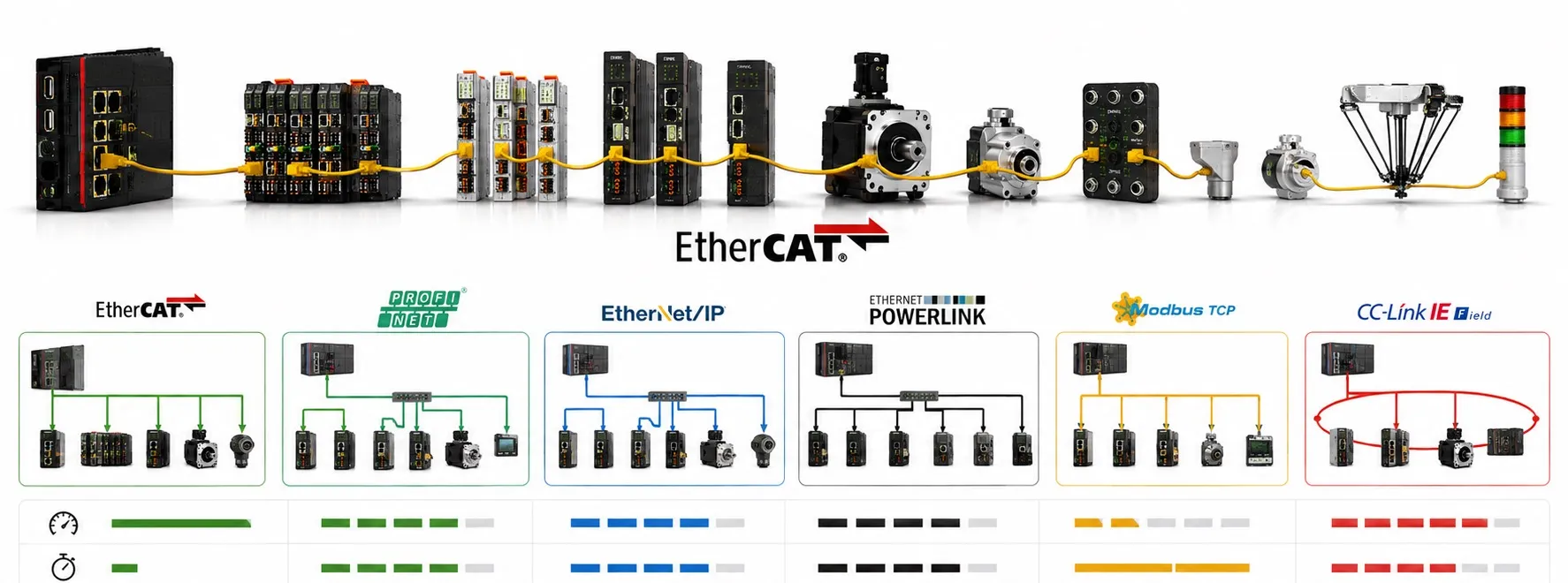
Read the image carefully: it places EtherCAT, PROFINET, EtherNet/IP, POWERLINK, Modbus TCP and CC-Link IE Field next to each other. It should not be treated as a universal performance scorecard. The same class of drive, PLC or I/O product may exist in several protocol variants, and a common RJ45/M12 connector does not make those variants protocol-compatible.
EtherCAT: processing process data while the frame is travelling
EtherCAT can carry process data for many SubDevices in one or more EtherCAT frames. The EtherCAT Slave Controller reads and writes the assigned data as the frame passes. Distributed Clocks provide the shared timing mechanism, while the Working Counter helps the MainDevice verify that expected memory operations were completed. Line, tree, star and branch structures use EtherCAT-aware ports and junctions rather than a generic switched-LAN model.[2]
This is attractive for dense I/O, multi-axis servo systems, robotics and synchronized measurement. It does not make local sensor or drive physics disappear, so the complete real-time response still has to be budgeted.
PROFINET: RT, IRT and TSN profiles in one PI ecosystem
PROFINET uses the IO Controller / IO Device model and combines industrial I/O, diagnostics and device modeling with Ethernet infrastructure. Current PROFINET should not be reduced to the old “RT versus IRT” description: PI also integrates PROFINET over TSN into the technology roadmap and specification. Standard Ethernet/TCP-IP communication can coexist with industrial control and diagnostic services.[3]
Integrated switches support line structures; separate switches support star/tree designs; ring availability uses mechanisms such as MRP/MRPD. That makes the old statement “PROFINET always needs a central star switch” too simplistic. In plants with a large PROFIBUS installed base, the PI migration and proxy ecosystem can also matter.
EtherNet/IP: CIP object model and producer–consumer communication on standard Ethernet
EtherNet/IP adapts ODVA's Common Industrial Protocol (CIP) to standard Ethernet and TCP/UDP/IP. CIP adds producer–consumer communication, device profiles and services such as CIP Safety, CIP Security, CIP Sync and CIP Motion. Cyclic I/O typically uses UDP-based implicit messaging; explicit services handle configuration and parameter access.[4]
For motion, EtherNet/IP is not merely “ordinary TCP traffic.” CIP Motion + CIP Sync use synchronized device time based on IEEE 1588 principles to coordinate distributed axes. That makes any blanket statement that EtherNet/IP cannot support demanding real-time motion technically incomplete.[5]
The shared CIP family with DeviceNet and ControlNet can also be valuable where a plant already has ODVA/CIP engineering practices.
POWERLINK: a Managing Node schedules deterministic time slots
Ethernet POWERLINK extends IEEE 802.3 with predictable timing. A Managing Node (MN) runs Slot Communication Network Management (SCNM); the Controlled Nodes (CN) exchange data in a scheduled cycle. The POWERLINK cycle separates time-critical isochronous communication from an asynchronous phase used for less time-critical TCP/UDP and other traffic.[6]
This is architecturally different from EtherCAT's travelling-frame processing model. Both can be used for synchronized motion and I/O, but they control media access in different ways.
Sercos III: motion heritage, but a wider automation scope
Sercos III uses line and ring structures with two-port devices and synchronized cyclic telegrams. Motion remains a strong part of its heritage, but modern Sercos is not limited to servo drives; I/O, safety and other automation devices can participate. A physical ring can provide cable redundancy, and Sercos also provides a UC Channel for standard Ethernet communication alongside the real-time channel.[7]
So the old shorthand “Sercos is only a servo network” is no longer a sufficient description. Controller support, device profiles and the installed motion ecosystem matter more than the label alone.
Modbus TCP: simple client/server messaging with a different real-time target
Modbus TCP carries Modbus application messages over TCP/IP, normally using TCP port 502. Its basic interaction is client/server request–response around the Modbus data model and function codes. Simplicity, openness and a very broad installed base are major reasons for its continued use.[8]
The Modbus TCP specification does not define an EtherCAT-style Distributed Clocks system, PROFINET IRT profile or CIP Motion layer. That makes it more natural for many process variables, energy meters and straightforward I/O tasks than for tightly synchronized multi-axis motion. The wider Modbus guide covers the serial and TCP variants separately.
CC-Link IE Field and CC-Link IE TSN belong in the comparison too
The page image also includes CC-Link IE. CC-Link IE Field combines deterministic cyclic control and asynchronous information communication on a 1 Gbit/s field network, with line, ring and star layouts. CC-Link IE TSN adds IEEE TSN mechanisms so time-sensitive control and standard Ethernet communication can share infrastructure in a more converged architecture.[9]
Again, the common Ethernet medium does not create protocol compatibility; station roles, profiles, device descriptions and conformance belong to the CLPA ecosystem.
Even the role names reveal different communication models
| Technology | Control roles | Cyclic communication | Device description / profile | Time / motion approach |
|---|---|---|---|---|
| EtherCAT | MainDevice / SubDevice | On-the-fly datagram processing | ESI + device profiles | Distributed Clocks |
| PROFINET | IO Controller / IO Device | RT / IRT / TSN profiles | GSDML + PI profiles | IRT / time sync / TSN |
| EtherNet/IP | Scanner / Adapter, Producer / Consumer | CIP I/O over UDP + explicit services | EDS + CIP profiles | CIP Sync + CIP Motion |
| POWERLINK | Managing Node / Controlled Node | SCNM time slots; isochronous + asynchronous phase | Object Dictionary / XDD | Scheduled cycle + synchronization |
| Sercos III | Master / Slave | Cyclic telegrams in line/ring | Sercos device model / profiles | Synchronized cyclic channel |
| Modbus TCP | Client / Server | TCP request / response | Modbus data model / function codes | No native isochronous motion layer |
| CC-Link IE TSN | Master / Remote / Local roles by profile | Cyclic control + transient/standard Ethernet traffic | CSP+ / CLPA profiles | IEEE 802.1AS / TSN scheduling |
Why a single “speed ranking” is misleading
Raw link speed is not machine response time. A 1 Gbit/s network is not automatically faster in every control application than a 100 Mbit/s one. Cycle time also depends on frame organization, node count, process-image size, switching or junction delays, runtime scheduling, device application time and local I/O filtering.
For that reason this page does not reproduce a universal “EtherCAT is X times faster” ranking. Older comparison charts can be useful when their assumptions are explicit, but current PROFINET TSN, CIP Motion/Sync and CC-Link IE TSN developments make project-specific measurement under the same node count, data size and timing target far more useful.
Functional safety and cybersecurity also use different families of services
EtherCAT may use FSoE, PROFINET may use PROFIsafe, EtherNet/IP may use CIP Safety, and CC-Link has its own safety profiles. These are functional-safety communication mechanisms. They do not replace cybersecurity controls such as authentication, certificates, firewalls or network segmentation.
Use OtomasyonAVM to compare the real machine, not only protocol logos
OtomasyonAVM already has separate technical branches for PROFINET, EtherNet/IP, POWERLINK, SERCOS, Modbus, CC-Link and general Ethernet.
The device side is equally important: PLCs, servo systems, VFDs, sensors, robotics and SCADA provide the context needed to ask the right question: which controller supports the network, which profile is implemented by the drive or sensor interface, what cycle is required, and which diagnostic tools can the maintenance team actually use?
A short engineering checklist
Installed base: is the plant already centered on PI, CIP, Sercos or another ecosystem? Motion: how tightly must axes be synchronized? I/O: what is the process-image size and update target? Topology: does the machine naturally want line/branch/ring or a conventional switched infrastructure? Safety: which safety profile is actually implemented in the selected products? IT/OT: how much standard Ethernet/IP traffic must share the infrastructure? Maintenance: which diagnostic tools, spare devices and engineering skills are already available?
After those questions are answered, the detailed EtherCAT specifications, topology, device integration and limits pages become much more useful.
Related OtomasyonAVM guides
• What is EtherCAT?
• What is PROFINET?
• What is EtherNet/IP?
• What is Ethernet POWERLINK?
• SERCOS communication
• Modbus FAQ
• What is CC-Link?
• What is Ethernet?
• EtherCAT MainDevice–SubDevice communication
• EtherCAT real-time performance
• EtherCAT and industry standards
• Industrial communication
Technical references
[1] EtherCAT Technology Group — EtherCAT technology architecture and international standardization. ETG Technology
[2] EtherCAT Technology Group — on-the-fly processing, Distributed Clocks and topology. EtherCAT Technology
[3] PROFIBUS & PROFINET International — PROFINET system description, current specification and PROFINET over TSN guidance. PROFINET System Description / Specification / TSN
[4] ODVA — EtherNet/IP uses standard Ethernet/TCP/IP, UDP for cyclic I/O and CIP at the upper layers. EtherNet/IP
[5] ODVA — CIP Motion and CIP Sync for synchronized motion and IEEE 1588-based time. CIP Motion / CIP Sync
[6] OPC Foundation / POWERLINK — SCNM, Managing Node/Controlled Node, isochronous and asynchronous POWERLINK phases; IEEE 61158 adoption of EPSG DS 301. POWERLINK overview / IEEE 61158-2017
[7] Sercos International — line/ring topology, cyclic real-time behavior and common infrastructure with standard Ethernet traffic. Sercos topology / Common infrastructure
[8] Modbus Organization — Modbus TCP/IP implementation and client/server messaging over TCP. Modbus Specifications / Introduction
[9] CC-Link Partner Association — CC-Link IE Field and CC-Link IE TSN architecture. CC-Link IE Field / CC-Link IE TSN