
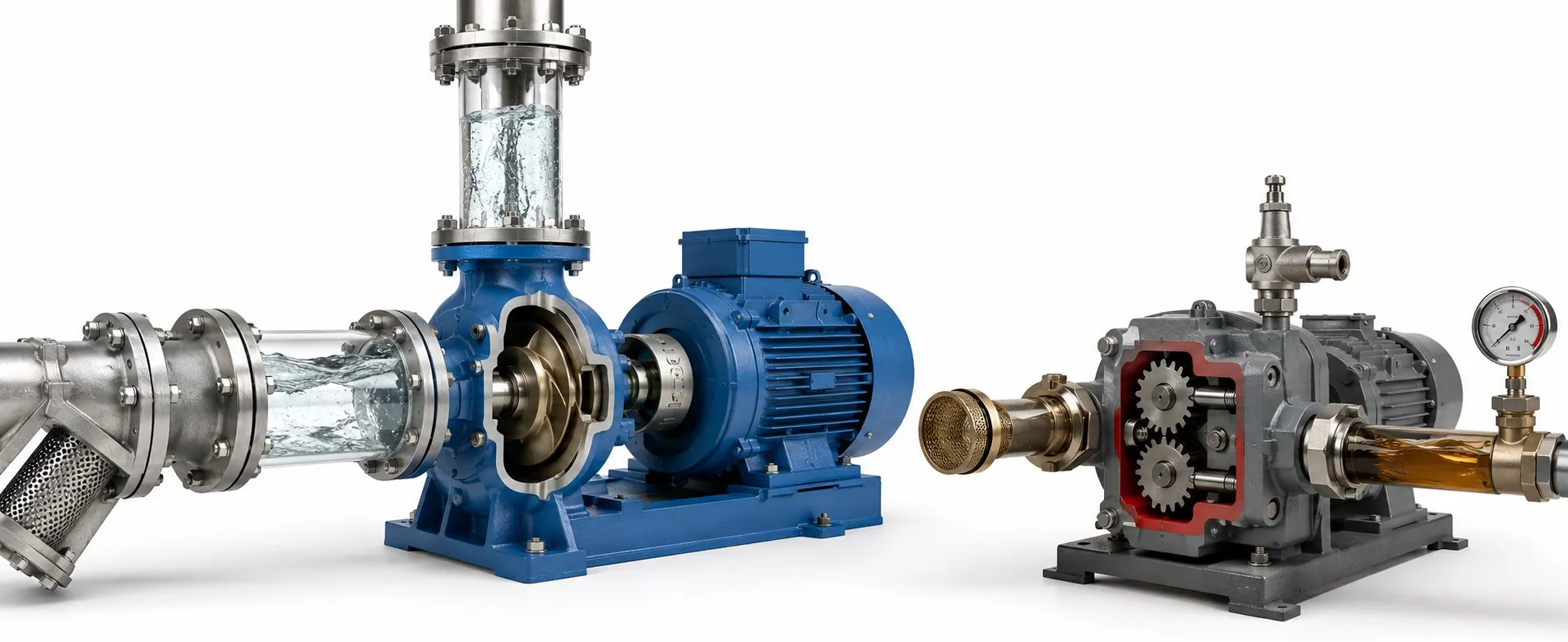
What are the differences between water pumps and oil pumps?
Hello, dear colleagues,
The main difference between a water pump and an oil pump is how its design suits the fluid and the application. Viscosity, temperature, material compatibility, lubricating properties and operating pressure affect the internal components, seals and motor selection. Two pumps with the same motor rating will not necessarily deliver the same flow when handling different liquids.
The labels “water” and “oil” are therefore only a starting point. When comparing pump types and their applications, consider both the actual fluid properties and the required operating point. Our guide to how a pump works explains the basic principles behind that choice.
1. Operating principle: Water does not always mean centrifugal, and oil does not always mean gear
Centrifugal pumps are common in clean water transfer, circulation and many agricultural irrigation applications. An impeller transfers energy to the liquid to produce flow. However, water can also be handled by positive displacement pumps when dosing, high pressure or a particular process requires them.
Gear and screw pumps are common options for oil transfer. Suitable centrifugal pump designs can also handle oil when viscosity and operating conditions allow. Selection depends on the liquid together with the required flow, pressure and temperature; no single pump type suits every oil.
An oil transfer pump moves liquid between containers or tanks. A hydraulic power pump supplies flow to a hydraulic system that produces movement and force. An engine lubrication pump serves a lubrication circuit. These duties have different requirements. Our explanation of how a hydraulic pump works and our hydraulic pump range help clarify the distinction.
2. Viscosity: Flow, suction conditions and motor load can change
Higher viscosity can increase resistance in pipes and filters. A pump that delivers enough water through a particular line may fail to provide the required flow with cold oil. In centrifugal pumps, viscosity can affect flow, head and efficiency. A performance curve measured with water should not be used directly for oil without the appropriate assessment.
The claim that “all oil pumps run at low speed” is also too broad. Permissible speed depends on the pump design, viscosity, suction conditions and lubrication requirements. Starting torque can be particularly important when the oil is cold. Understanding what torque means and how pump power is calculated helps avoid choosing a pump solely from the motor's kilowatt rating.
A suction line needs a suitable diameter, a short flow path and a clean filter. An excessively narrow line or a clogged filter can restrict the oil supply to the pump. Our guide to reducing pressure losses in hydraulic systems explains how piping and connections affect system performance.
3. Materials and seals: Compatibility depends on the actual fluid
The casing, impeller or gears, shaft and seals must suit the liquid's chemistry and temperature. Water applications may involve salt, chlorides, abrasive particles or drinking water requirements. Oil applications require attention to the base oil, additives and contamination. Oil is not inherently more corrosive than water in every situation.
EPDM, in a suitable compound, can serve many water applications, but it is generally unsuitable for mineral oils. NBR or FKM may suit certain oil applications. However, an elastomer abbreviation alone does not establish compatibility: the actual fluid, seal compound, temperature and operating conditions must be checked against the manufacturer's data.
Reading about the main components of a pump alongside material selection in hydraulic systems explains why two similar-looking pumps may not be interchangeable. Hoses, gaskets and other pump accessories belong in the same compatibility assessment.
4. Temperature: Check both cold starts and hot operation
Oil viscosity generally increases as temperature falls, which can make suction and starting more demanding. As the oil heats up, its viscosity decreases; internal leakage can increase in some positive displacement pumps. The lubrication conditions required by the pump can also change. Assess minimum and maximum operating temperatures together with the permitted viscosity range.
Not every oil pump is designed for high temperatures. Hot water and boiler circuits can also require specialised temperature resistance. A suitable PT100 sensor can monitor temperature, provided its measuring range and wetted materials suit the duty. When investigating pump overheating, consider the operating point and mechanical losses as well as the fluid.
5. Pressure: An oil pump is not automatically a high pressure pump
Operating pressure depends on the application and pump design. A low pressure oil filling line and a high pressure hydraulic power unit serve different duties. Water pumps can also operate at high pressures when designed for them. Setting and controlling hydraulic pressure requires consideration of the system load and its protective devices.
If a positive displacement pump's discharge is blocked, pressure can rise rapidly and damage the pump, motor or piping unless suitable protection is provided. These systems need an appropriate pressure relief arrangement. A pressure gauge or pressure sensor provides a measurement; measurement alone does not limit pressure.
6. Energy and automation: Match the control method to the pump
Energy consumption is not determined by fluid thickness alone. Flow, pressure, efficiency and motor load must be considered together. An oversized pump or poorly configured control system can waste energy in both water and oil circuits. Our articles on pump energy efficiency and hydraulic system efficiency discuss this from different application perspectives.
In suitable systems, a variable frequency drive and PID control can adjust operation to the required flow or pressure. However, speed control does not apply identically to every pump. Verify the permitted speed range of the pump and motor, along with suction and lubrication requirements. These limits should be part of the design when considering pump control solutions.
7. Maintenance and safety: Leakage and contamination matter in both services
Water circuits may suffer from sediment, scale, blockages and leaks. Oil circuits require attention to particle contamination, water ingress and oil degradation. Inspection intervals depend on operating hours, site conditions and the manufacturer's instructions. Our guides to pump maintenance and repair and hydraulic system maintenance cover complementary aspects of this work.
Reliable sealing matters in both applications. Water leakage can affect electrical equipment and buildings. Oil leakage can cause slipping hazards, contamination and, under suitable conditions, a fire risk. Assess flammability using the actual fluid's safety data sheet. Our articles on hydraulic system safety and the environmental impact of pumps help put application-specific precautions into context.
8. Which approach suits your application?
Clean water tank filling or irrigation: Assess a water pump against the required flow, total head and suction conditions. If the liquid contains solids, the pump's solids-handling capability also matters.
Oil transfer from a drum to a tank: Identify the oil, its viscosity at the lowest expected ambient temperature, hose diameter and required transfer time. Instead of assuming that a water pump will do the job, look for manufacturer-confirmed compatibility and performance for the oil concerned.
A hydraulic press or power unit: Consider system flow, pressure, filtration and control requirements in addition to moving the oil. A transfer pump should not be assumed to replace a hydraulic power pump.
Before selecting a model, establish the fluid name and product code, temperature range, viscosity, density, target flow, pressure, suction conditions and operating duration. Working through the factors to consider when choosing a pump then makes model comparisons useful. The right pump suits both the fluid and the system.
Technical references: KSB — viscosity; Grundfos — fluid properties and pump performance; Parker — seal materials; Viking Pump — pressure relief valves; Mobil — hydraulic oil properties.
You may share this content with attribution to Otomasyon AVM. Application selection should be based on the technical data supplied by the pump and fluid manufacturers.