
What are the differences between industrial pumps and household pumps?
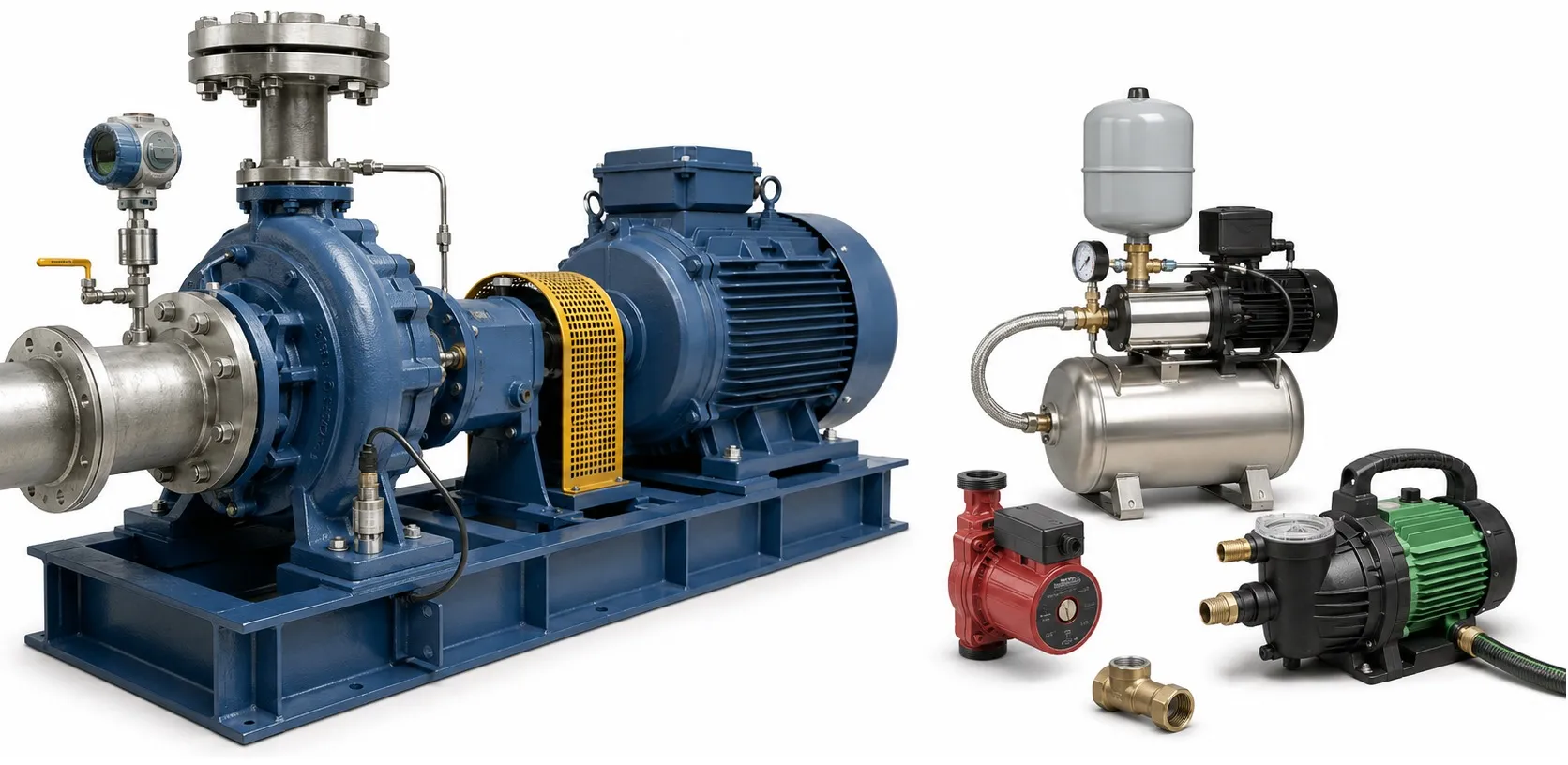
Choosing a pump for the job: a house, a workshop or a production line
Residential and industrial pumps are distinguished mainly by their intended service conditions. A homeowner may need reliable showers, heating circulation or basement drainage. A plant may need repeatable flow, chemical compatibility and predictable maintenance. Neither category label guarantees higher pressure, better efficiency or a longer service life. Start with the selection requirements and check the actual pump specification.
The pumping principle does not tell you where it belongs
Centrifugal pumps serve both homes and factories. A submersible pump may supply a private well or drain an industrial sump; “submersible” describes its installation, rather than its market. Understanding different pumping duties alongside how pumps work helps avoid these category shortcuts. A large residential building can also need a sophisticated booster set with several pumps and coordinated controls.
Compare the duty point before comparing motor sizes
Flow rate describes how much liquid moves per unit of time; head describes the energy added per unit weight of liquid. Household sizing considers simultaneous demand, elevation and pipe losses. Process sizing also considers the required operating range and inlet conditions. An industrial metering pump can be very small. A building water supply system can be much larger. The motor power rating alone will not settle the choice: maximum flow and maximum head are generally reached at different points on the performance curve.
| Selection factor | Residential use | Industrial use |
|---|---|---|
| Liquid | Clean water, heating water or domestic wastewater, depending on the model. | Process water, oil, chemicals, food products or mixtures containing solids. |
| Operating pattern | Demand-driven use, with longer circulation periods in some applications. | Continuous service, shift operation or intermittent batches. |
| Wetted parts | Selected for water quality, temperature and intended use. | Selected for chemical exposure, abrasion and cleaning conditions. |
| Controls | Pressure switch, float switch or integrated speed control. | Process feedback, plant integration and duty-specific redundancy. |
| Maintenance priorities | Accessible service, low noise and available spares. | Planned interventions, short repair times and reduced production losses. |
Compatibility runs through the entire liquid path
A domestic clean-water pump should not be repurposed for oil, acid or solvent. The differences between water and oil pumping include viscosity, which describes resistance to flow. The casing, impeller, elastomers and shaft seal must all suit the liquid. Check the individual pump components against temperature, chemical concentration and solids content. “Stainless steel” is not a universal chemical compatibility statement. Hydraulic pumps have a different job again: supplying a hydraulic oil circuit.
A food process may require a cleanable design and documented hygienic suitability. Drinking-water suitability and hygienic process suitability are separate checks. Handling clear water does not establish drinking-water approval. For a food application, check the product and cleaning procedure; for potable service, verify the suitability of every wetted component for that intended use.
Some chemical process pumps are specified against dimensional and technical design standards: ISO 2858 addresses dimensions, while ISO 5199 addresses technical requirements. These are not universal labels for every industrial pump. For an explosive atmosphere, verify the suitability of the exact configuration for the intended environment; approval of one variant does not establish suitability of the entire product range.
Read the duty rating instead of assuming a running time
Industrial pumps are not automatically rated for uninterrupted operation, and residential pumps are not automatically limited to short runs. S1 denotes continuous duty; S3 denotes intermittent periodic duty. A specification of S3 20%, with a 10-minute cycle describes two minutes running and eight minutes stopped within that cycle. Do not transfer this example to a different model: its stated cycle and operating conditions govern. On submersible units, the permitted duty can also depend on liquid level and motor cooling. Investigate overheating against those conditions, rather than judging by motor size.
Controls can be simple or sophisticated in either setting
A home booster can offer variable-speed pressure control, dry-run protection and automatic stopping at low demand. Industrial pump control may add process signals, alarm histories and communication with plant automation. PID control adjusts operation toward a pressure or flow setpoint using sensor feedback. In a multipump installation, pump alternation can distribute running hours. Balancing operating hours does not provide the spare capacity needed to maintain service after a failure.
Check the specified supply voltage and phase arrangement for the actual model. Its category does not define its electrical connection. Suction conditions matter in both settings too: available NPSH must be assessed against the pump requirement with a suitable margin. When diagnosing a pump fault, include the suction line, liquid level and possible air entry.
Serviceability and energy costs depend on how the pump is used
In a plant, planned maintenance and access to replacement parts can limit production disruption. At home, convenient service and low noise may be more immediate concerns. Both benefit from suitable pump accessories, a clear suction path and operation within the intended range. These conditions influence service life; an industrial label alone cannot justify a lifespan claim.
Compare energy efficiency at the same liquid, flow and head. Oversizing can waste energy in either application. Average measured electrical input power multiplied by annual running hours gives annual energy consumption. A hypothetical 0.2 kW difference amounts to 100 kWh over 500 hours, or 1,200 kWh over 6,000 hours. That comparison assumes both options deliver the same service. Decisions about reducing consumption and ownership costs should include electricity, maintenance, replacement parts and downtime.
Make every quotation answer the same brief
State the liquid and temperature, flow range, total head, suction conditions, daily running time and electrical supply. Then compare performance curves, duty ratings, material compatibility and service support. The home pump selection guide covers residential applications in more detail, while the pump range provides an overview of available categories.