
Ethernet/IP and standard Ethernet?
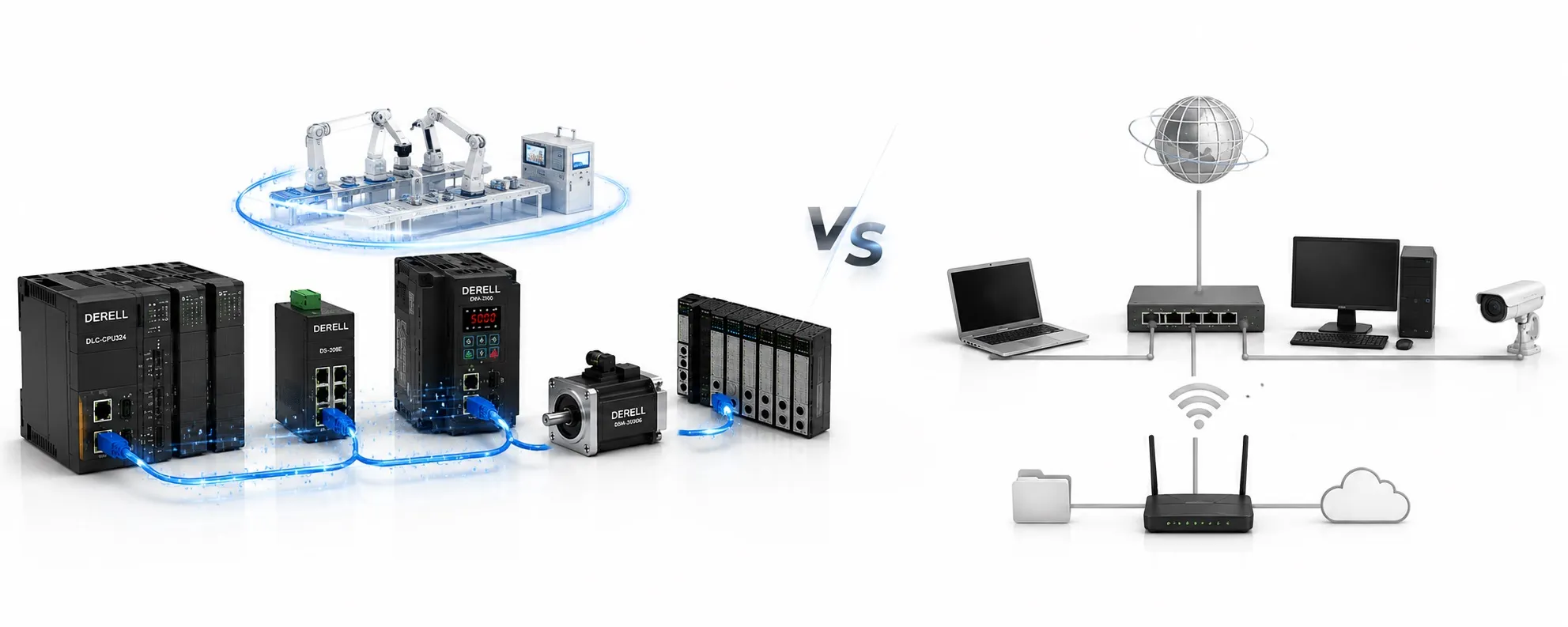
Different jobs on the same network infrastructure
Hello everyone. Ethernet provides the underlying network technology; EtherNet/IP uses that infrastructure and CIP to organize industrial device communication. They serve complementary roles. An Ethernet socket and an IP address do not establish EtherNet/IP support. In the EtherNet/IP name, IP stands for Industrial Protocol; the network also uses Internet Protocol.
Editor’s note: A successful ping or access to a drive’s web page does not prove that cyclic PLC communication works. These are separate functions. Check the supported application protocol, connection roles and data mapping together.
Physical connectivity and the application language
Standard Ethernet, covered by IEEE 802.3, defines the physical layer and the MAC portion of the data link layer. An Ethernet frame carries data across a local link; IP handles addressing and routing, while TCP or UDP provides transport. In terms of the OSI model, CIP supplies the upper-layer industrial data model and services.
Commands, status, parameters and fault information are exchanged through defined objects. CIP provides common objects and device profiles, while vendor-specific objects may also exist. IEEE develops Ethernet standards; ODVA maintains the EtherNet/IP and CIP specifications.
Reading a parameter and exchanging continuous I/O
In EtherNet/IP communication, explicit messaging normally uses TCP request/reply transactions for parameters, settings and diagnostics. Implicit messaging carries predefined I/O data over UDP, using unicast or multicast according to the connection. Cyclic control is a common application of this second mechanism.
Common port assignments include TCP 44818 for encapsulation and explicit communication, and UDP 2222 for implicit I/O. UDP 44818 can also serve functions such as discovery. Firewall rules should match the services actually used by the devices.
RPI, network speed and actual response time
RPI is the requested packet update interval. For a periodic stream, an RPI of 10 ms corresponds nominally to 100 updates per second; it does not guarantee that a motor responds within 10 ms. Assessing latency and bandwidth also requires sensor filtering, PLC task timing, network queues and output processing to be considered.
Increasing the Ethernet link speed alone cannot guarantee timing. Packet processing capacity, jitter and traffic load matter too. For applications requiring further capabilities, CIP Sync provides IEEE 1588-based clock synchronization. This capability is not mandatory in every EtherNet/IP device.
Interoperability requires more than matching sockets
For devices working together, a common I/O arrangement pairs a scanner/originator, which initiates the connection, with an adapter/target, which responds. Two adapter-only devices do not automatically establish an I/O connection with each other. Their supported CIP services and connection types must also match.
Configuration must account for Assembly instances, data lengths, data types, scaling and firmware compatibility. An EDS loaded into the engineering software describes device capabilities; it does not write the control logic or validate the data mapping automatically. Conformance testing supports interoperability without guaranteeing every application combination.
Cabling, switches and factory conditions
EtherNet/IP can use standard Ethernet infrastructure. However, switch selection, cables and connectors, temperature, EMC conditions and power reliability must suit the installation. Where multicast is used, IGMP snooping and an appropriate querier arrangement manage traffic. QoS provides prioritization; it does not create additional bandwidth.
Cable distance limits depend on the Ethernet physical layer. Common copper 100BASE-TX and 1000BASE-T links generally have a 100-metre channel limit; fibre and other physical layers have different limits. Calling a network “industrial Ethernet” does not automatically extend the range of the same copper link.
A practical drive connection
A PLC, drive and computer can share a switch. The computer may access the drive’s web interface while the PLC, where supported, exchanges a control word, speed reference and status data over EtherNet/IP. If the drive supports only Modbus TCP, the protocol difference between EtherNet/IP and Modbus TCP requires suitable PLC support or a gateway that maps the data. A shared cable does not establish a shared application protocol.
Cybersecurity and commissioning
Cybersecurity capabilities need separate assessment. Standard EtherNet/IP communication is not universally encrypted by default. CIP Security provides protection on supporting, configured endpoints; CIP Safety addresses functional safety. Network security measures should include access control, segmentation and controlled remote access.
During commissioning, check physical connectivity and IP conflicts first, followed by device roles, Assembly sizes and RPI. For fault diagnosis, examine port error counters, connection timeouts and PLC diagnostic records together. Finally, verify output behaviour following communication loss under controlled conditions. A successful ping alone does not establish operational readiness.
Related pages
Ethernet questions EtherNet/IP fundamentals How the protocol works Benefits and limitations Industrial applications
Sources
IEEE 802.3 Ethernet Working Group
ODVA: EtherNet/IP Technology Overview
ODVA: Common Industrial Protocol
Rockwell Automation: EtherNet/IP Network Devices User Manual
Schneider Electric: TeSys T Ethernet Communication Guide
Cisco: Networking and Security in Industrial Automation Environments