
What are the common industrial applications of servo systems?
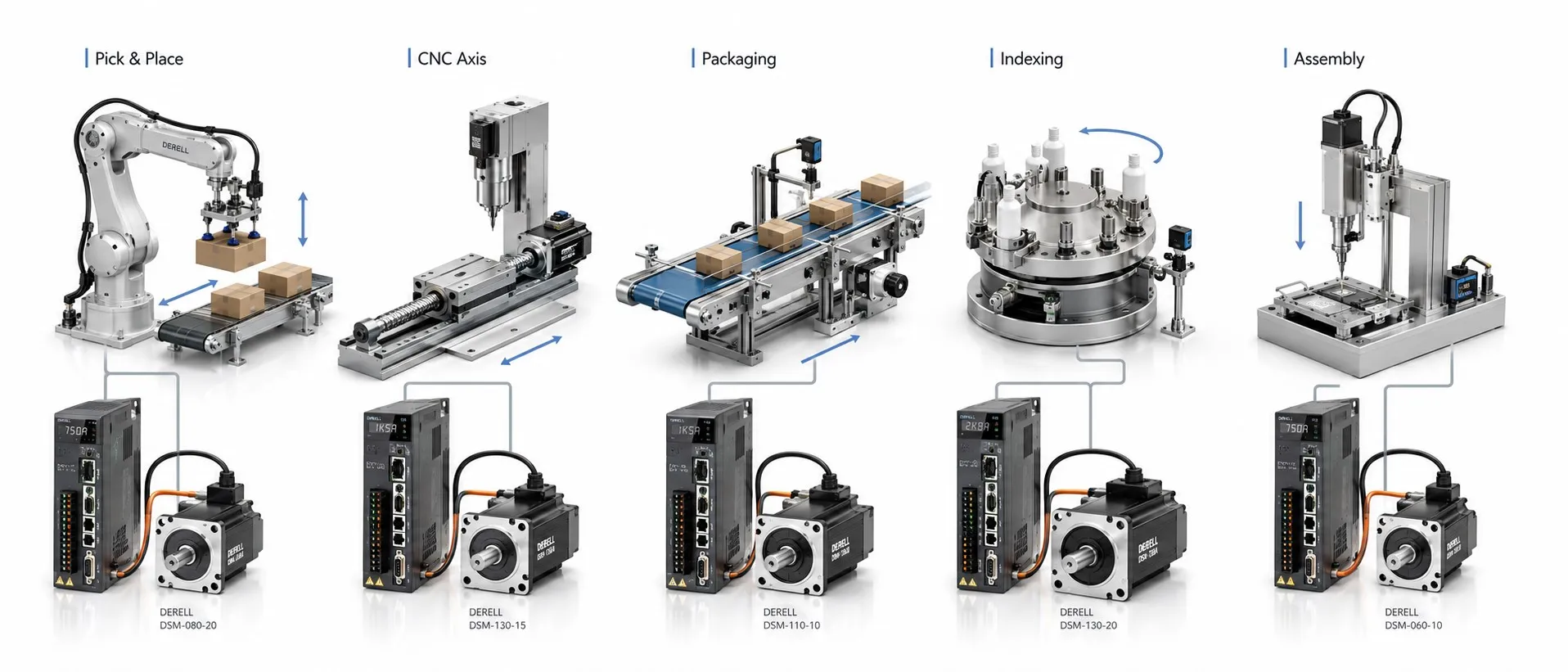
Where controlled motion makes a difference on the factory floor
A servo system earns its place when a machine must position a load, follow a changing speed command or regulate torque through a production cycle. Common applications include machine tools, packaging, robotics, printing, winding, injection molding and automated assembly. The motor, drive and feedback system work together to correct motion as conditions change. The useful question is which part of the process needs that control.
Machine tools: follow the path, not just the endpoint
In CNC machining, servo axes feed a cutting tool or move the workpiece. Milling, turning, grinding and laser cutting depend on contour accuracy as well as final position. Cutting a circle requires X and Y to stay coordinated throughout the move; reaching the right endpoints alone will not produce the right shape. Interpolation generates coordinated axis commands. A linear encoder can measure load position directly, while backlash, structural deflection and thermal effects remain part of the accuracy assessment.
Packaging: make each action happen at the right moment
Servos coordinate film feed, sealing jaws, cutters and product transfer. On a labeling line, the requirement is label placement relative to the product, even when line speed changes. Electronic gearing establishes a fixed movement ratio; electronic camming defines a relationship that changes over the machine cycle. Multi-axis synchronization and a suitable EtherCAT servo architecture can support these tasks. In an auger filler, the servo meters screw rotation. Actual fill quantity also depends on material behavior and, where required, weighing feedback.
Robotics and palletizing: move the real payload
Pick-and-place machines, loading robots and palletizers use servo-driven robot axes to control joints or linear mechanisms. Performance means repeatable placement with the payload fitted, within the required cycle and settling time. A larger motor is not a substitute for checking arm geometry, acceleration and load and transmission requirements. A planetary gearbox can provide a useful torque ratio, but gearbox backlash and stiffness affect the motion delivered at the tool.
Printing, winding and textiles: protect the material
Printing presses coordinate cylinder position so that successive colors register correctly. Rewinders handling paper, film, wire or fabric need controlled material tension. Servo torque control must account for the changing roll radius. For an ideal roll, T = F × r: maintaining 20 N of tension requires 1 Nm at a 0.05 m radius and 2 Nm at 0.10 m. These are roll-shaft values before friction and acceleration loads. Holding torque constant as the roll grows will change tension. A load cell or dancer can provide additional process feedback. Textile feed and cutting mechanisms also benefit from programmable speed, torque and position control.
Injection molding: match the drive to the machine architecture
All-electric molding machines can use servo drives for clamping, injection and ejection movements. A servo-hydraulic machine instead uses a servo motor to drive a pump and match hydraulic output to demand. These arrangements need different sizing and control decisions. Axis control must work with the pressure-control requirements of the process. Validate recipes, load profiles and drive configuration under production conditions rather than assuming a position command alone guarantees a good molded part.
Assembly and electronics: verify the result of the move
Bearing insertion, press fitting, screwdriving and component placement are typical servo applications. In an assembly press, a force-versus-displacement trace helps assess whether the joining process followed its expected profile. A motor torque limit is not a direct measurement of force at the part. Screw lead, friction and transmission efficiency influence the relationship; use appropriate measurement where force verification matters. Electronics assembly often combines short travel with rapid acceleration, making mechanical vibration and settling time just as relevant as top speed.
Testing and transfer: repeat a defined motion reliably
Servo systems can repeat motion profiles in endurance tests, stop an indexing table at a defined angle, or control product spacing between workstations. They are useful where these requirements justify closed-loop motion. A conveyor that only needs steady continuous speed may be served by another drive arrangement. Compare servo and stepper options and make the motor-and-drive selection around load, tolerance, speed and duty cycle.