
What are the advantages and disadvantages of DC drives?
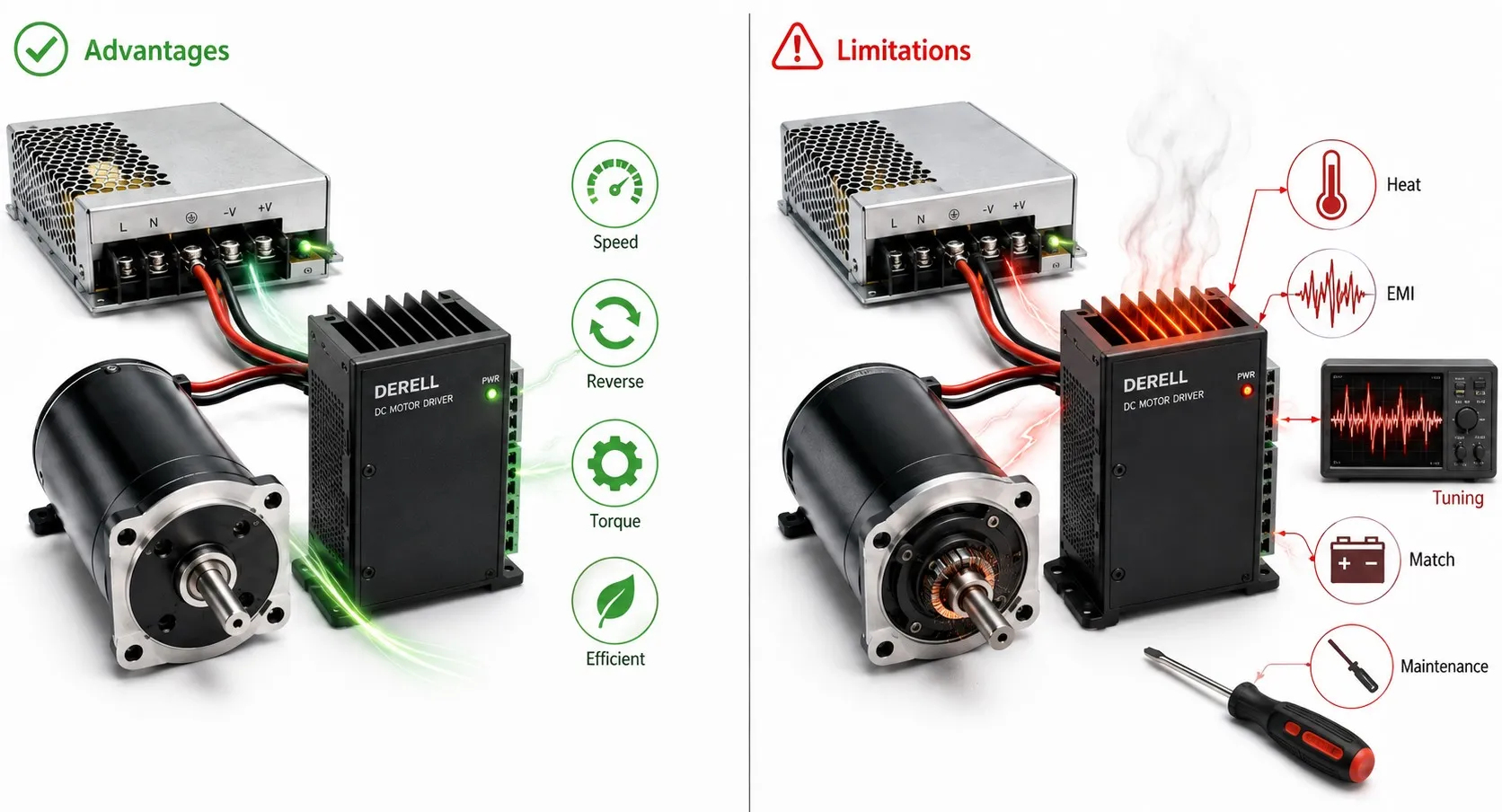
What are the advantages and disadvantages of DC drives?
A DC drive can be an effective choice for controlled torque, adjustable speed and the modernization of an existing machine. Its suitability depends on the complete installation, however. The electronic converter, motor, feedback device and mechanical transmission each contribute to performance and ownership cost.
This discussion focuses on conventional brushed DC motors and their DC drives. The main alternatives considered are an AC motor operated by a variable frequency drive and a servo system. These terms are not mutually exclusive classifications: servo describes feedback-controlled motion, and a suitably controlled DC motor can itself serve as a servo motor.
Where DC control offers a practical advantage
With approximately constant magnetic flux, a DC motor’s electromagnetic torque is approximately proportional to armature current. This makes the relationship between current and torque control relatively straightforward. The current controller regulates torque production, while the speed controller adjusts the demand needed to maintain the requested speed.
Combined with suitable feedback, this arrangement can provide stable operation under changing load. Performance still depends on the sensor, motor and speed-loop settings. Accurate control is a property of the engineered system, not an automatic consequence of using DC.
Modern vector-controlled VFDs can also provide demanding speed and torque control. Comparing a closed-loop DC installation only with a basic open-loop AC drive gives an incomplete picture of the available alternatives.
Low-speed torque and acceleration
A correctly selected DC motor can deliver substantial torque below base speed within its current and thermal limits. That can be useful for loaded starts, material feeding and winding machinery. Sustained low-speed operation may require independent motor cooling, particularly when the original fan is driven by the motor shaft.
Acceleration depends on the available torque relative to load inertia. Deceleration also requires somewhere for the recovered mechanical energy to go. Neither rapid starting nor rapid stopping is guaranteed simply by selecting a DC drive.
For repeated point-to-point movements, a matched servo motor and drive may offer useful dynamic performance and motion functions. The comparison should include settling time and following error, rather than acceleration time alone.
Keeping a serviceable machine in production
One strong reason to retain DC technology is an existing motor that remains mechanically sound and correctly sized. Replacing only the converter may preserve the shaft arrangement, mounting dimensions and transmission. This can reduce the disruption associated with a full motor conversion.
A replacement drive may also improve diagnostics, parameter management and PLC connectivity. The financial benefit depends on the motor’s condition, spare-part availability and expected service requirements.
For a new machine, the calculation changes. An AC inverter and suitable motor may be attractive because of their operating characteristics and reduced brush-related maintenance. A solution that makes sense for a retrofit is not necessarily the best starting point for a new design.
Regeneration is useful when the converter supports it
An appropriate four-quadrant DC system can motor and brake in either direction. A converter designed for regeneration can return braking energy to the mains when the required operating conditions are met. This can be valuable on equipment that decelerates frequently or is driven by an overhauling load.
Regeneration is a hardware capability, not a standard feature of every DC drive. The same distinction applies to VFD and servo equipment. A conventional AC drive does not necessarily return energy to the supply merely because its motor is braking.
A braking resistor dissipates energy as heat. Returning energy to the supply is a different function. Compare the complete braking arrangement, including its duty and thermal requirements.
The main maintenance disadvantage belongs to the motor
Brushes and the commutator are parts of the brushed DC motor, not the electronic drive. Brush wear, contact pressure, commutator condition and carbon deposits require attention. These items add work to the installation’s maintenance schedule and may create production downtime.
A worn brush is a replaceable component; it does not automatically mean the entire motor has reached the end of its useful life. Nevertheless, access, replacement intervals and service labor affect long-term cost.
A squirrel-cage induction motor operated by a frequency inverter, or a brushless servo motor, removes the brush-commutator maintenance task. Bearings, cooling equipment, connections and drive electronics still require appropriate care.
Commutation, interference and speed limits
Current transfer at the brush-commutator interface can produce sparking and electrical interference. It is not merely a consequence of brushes rubbing against a surface: load current, motor condition and commutation behavior also matter.
Noise-sensitive encoder signals and analog circuits require suitable cable routing and shielding. An appropriate EMC filter and correctly designed grounding arrangement may form part of the solution.
Brushless equipment is not interference-free. VFDs and servo drives also contain switching power electronics, so their installation needs EMC attention. Replacing a brushed motor eliminates one source of disturbance, not every possible source.
Maximum speed depends on mechanical construction and commutation limits. Field weakening can extend the operating range of suitable wound-field motors, but available torque may decrease. The permitted speed-torque envelope is more informative than a power rating by itself.
Efficiency and price require a whole-system comparison
DC motors are not automatically more efficient at low speed, and DC systems are not always cheaper. Motor losses, converter losses, excitation power, cooling and the load cycle all affect the result. At low speed, substantial current can still create copper losses while useful mechanical output is relatively small.
A meaningful energy-saving comparison uses the same production duty and operating hours. Where regeneration is available, the amount of recoverable energy also depends on how the machine actually runs.
Purchase price is only one part of ownership cost. Include commissioning, maintenance, downtime and spare parts. For a servo installation, feedback hardware, mechanical matching and loop-gain tuning also contribute to the work required to achieve the intended performance.
Choosing between DC, VFD and servo approaches
For an existing DC production machine: A compatible replacement DC drive can be attractive when preserving a healthy motor and avoiding mechanical changes has clear value. Verify motor condition and the required operating envelope before making the drive selection.
For continuously rotating process loads: A VFD and suitable AC motor deserve consideration for pumps, fans, conveyors and similar equipment. Basic V/f control and vector control offer different capabilities. Low-speed torque and speed regulation requirements determine which level of control is appropriate.
For precise, repeated or coordinated motion: Evaluate the required positioning and motion control, allowable following error and settling time. A servo system is often worth considering for indexing, cutting and coordinated axes. Some advanced VFDs also provide positioning functions, so the actual product capabilities should guide the comparison.