
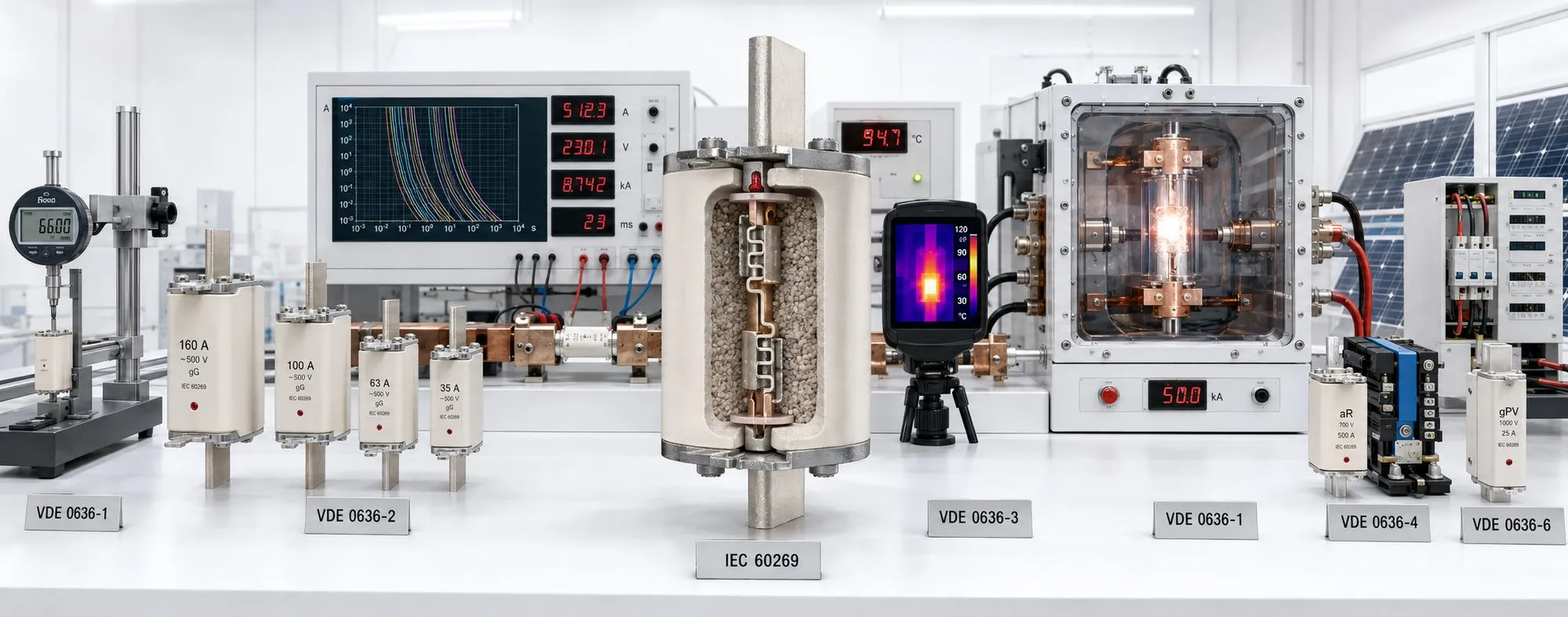
VDE 0636: What the Reference on a Fuse Datasheet Means
VDE 0636 identifies a German standards group for low-voltage fuses. It covers general requirements, application-specific characteristics and the tests used to assess fuse performance. For anyone specifying or replacing an electrical fuse, it provides useful context—but the product's actual ratings still determine whether it fits the job.
Much of the group is linked to the IEC 60269 family. European adoptions and German national supplements also form part of the picture. Check the complete designation and edition rather than assuming every VDE suffix has a matching IEC part number.
The General Scope
IEC 60269-1 addresses fuses with enclosed, current-limiting fuse-links and rated breaking capacities of at least 6 kA. Its general scope extends to power-frequency AC circuits up to 1,000 V and DC circuits up to 1,500 V. Application-specific parts must also be checked for their own scope.
These limits describe the standard's coverage. They do not turn every fuse into a 1,500 V DC device. A fuse marked 500 V AC must be assessed using its own published AC and DC ratings.
Which Part Applies to Which Application?
| VDE part | Related document | Subject |
|---|---|---|
| VDE 0636-1 | IEC 60269-1 | General requirements |
| VDE 0636-2 | IEC 60269-2 / HD 60269-2 | Fuse systems for use by electrically skilled or instructed persons, mainly in industrial applications |
| VDE 0636-21 | National supplement to Part 2 | NH fuses for special electrical systems, including aM, gB and gTr applications |
| VDE 0636-3 | IEC 60269-3 / HD 60269-3 | Fuse systems intended for operation by unskilled persons |
| VDE 0636-4 | IEC 60269-4 | Fuse-links for semiconductor protection |
| VDE 0636-5 | IEC TR 60269-5 | Application guidance for low-voltage fuses |
| VDE 0636-6 | IEC 60269-6 | Fuse-links for photovoltaic energy systems |
| VDE 0636-7 | IEC 60269-7 | Fuse-links for batteries and battery systems |
The distinction between IEC 60269-2 and IEC 60269-3 involves the intended users and fuse-system arrangements, not simply a division between high and low current. Semiconductor protection adds the requirements of IEC 60269-4.
Why VDE 0636-21 Needs a Separate Explanation
DIN VDE 0636-21 is a national supplement used with Part 2. It addresses special NH fuse applications: aM switchgear protection, gB mining-installation protection and gTr transformer protection. The “21” suffix should therefore not be read as a direct reference to “IEC 60269-21”.
Its mining and transformer provisions concern fuse protection. They do not replace the complete set of requirements for a mining installation or a transformer's overall protection scheme.
Read the Fuse Class Before Comparing Ampere Ratings
On industrial fuses, the class marking helps identify the intended protective function. The initial “g” indicates full-range breaking capability; “a” indicates partial-range capability. The following letter or letters identify the application.
gG is a general-purpose class covering overload and short-circuit protection.
aM provides short-circuit protection for motor circuits. Separate overload protection is required, potentially using a suitable motor overload relay.
aR and gR are associated with semiconductor protection fuses. aR is partial-range, while gR is full-range. Their protective duties differ even when their ampere ratings match.
NH identifies a fuse-system construction, so it does not specify the operating class on its own. Likewise, broad descriptions such as fast-acting or time-delay do not replace a class designation and the manufacturer's time-current data.
Five Checks That Make a Replacement Assessable
1. Rated current and operating characteristic. The fuse current rating must suit the load and service conditions. A 32 A fuse does not behave like a switch that opens immediately at 32.1 A. Its response depends on the magnitude and duration of the overcurrent.
2. Voltage and AC/DC suitability. Check the published rating for the circuit involved. For a DC fuse application, use the manufacturer's DC interruption data and stated circuit conditions. An AC marking alone is insufficient.
3. Breaking capacity. This is the maximum fault current the fuse can interrupt under specified conditions. It must meet the prospective short-circuit current at the installation point. It is a different quantity from the current carried during normal operation.
4. I²t and peak let-through current. These help assess the stress imposed on protected equipment during a fault. I²t is the time integral of current squared, expressed in A²s; it is not itself an energy value in joules. Pre-arcing I²t and total clearing I²t must also be distinguished.
5. Mechanical and thermal compatibility. Dimensions, contact arrangements, fuse-holder power-loss limits and ambient conditions belong in the fuse selection process. A replacement can fit the holder and still be unsuitable electrically or thermally.
A Drive Application Shows Why the Details Matter
The input fuse specified for a variable frequency drive may provide circuit protection or form part of a particular coordinated arrangement. Similar questions apply to a servo drive. Selecting a semiconductor fuse by current rating alone cannot guarantee that every internal power device will survive a fault.
Suppose an equipment manual specifies a particular 32 A gG fuse. Replacing it with a 32 A aR fuse changes the protection characteristics, including overload coverage. That substitution requires technical assessment; the word “faster” is not enough to justify it.
Use the equipment manufacturer's approved fuse references and coordination data. Where an alternative is proposed, compare the relevant curves and ratings under matching conditions.
Does a VDE Standards Reference Prove Certification?
A datasheet reference to VDE 0636 identifies the fuse standards being cited. Certification by VDE and permission to apply a VDE certification mark are separately verifiable matters. If certification is part of the specification, check the certificate number, covered product models and scope.
What Should Happen After a Fuse Operates?
Investigate why the fuse opened before fitting another. Increasing the ampere rating to prevent repeated operation can undermine the protection design. Follow appropriate fuse replacement precautions, including safe isolation and verification that the circuit is de-energized. NH fuse-links should not be manually withdrawn under load as a substitute for a suitable switching device.