
About Toshiba
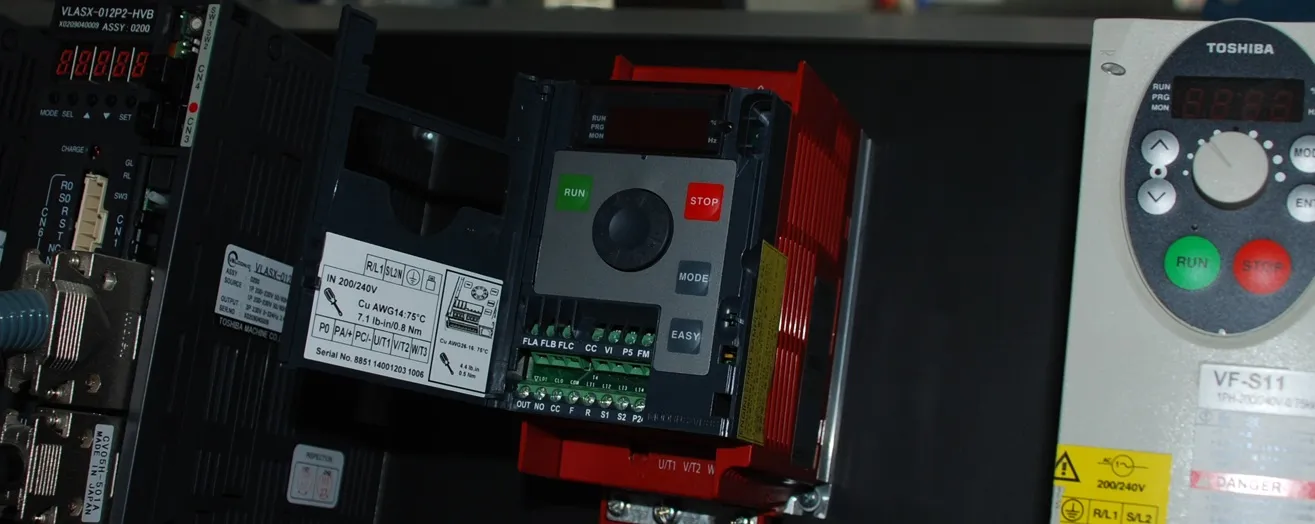
About Toshiba: Industrial Systems, Motor Technology and AC Drives
Toshiba Corporation is a Japanese technology and industrial company whose history spans electrical machinery, power generation, electronics and control systems. Its corporate headquarters are in Kawasaki, Kanagawa, Japan, as listed in Toshiba's corporate profile dated March 31, 2026.
For industrial users, Toshiba is more than an inverter brand. Its motor drives belong to a wider engineering portfolio that includes electric motors, power conversion, electrical distribution and automation equipment. Understanding the product family is therefore more useful than treating every Toshiba-labelled device as part of the same control platform.
How Toshiba Began
Toshiba traces its origins to two businesses. The first grew from a telegraph equipment factory established by Hisashige Tanaka in 1875 and later became Shibaura Engineering Works, a manufacturer of heavy electrical equipment.
The second was Hakunetsu-sha, established in 1890 by Ichisuke Fujioka and Shoichi Miyoshi to manufacture incandescent lamps. It subsequently became Tokyo Electric Company. The two businesses merged in 1939 to form Tokyo Shibaura Electric, the company widely known as Toshiba.
This combination of heavy electrical engineering and smaller electrical products helps explain the breadth of Toshiba's later activities. The original businesses and their merger are documented in Toshiba's official historical chronology.
A Motor-Engineering History That Predates Modern Electronics
Toshiba's industrial motor history reaches back to the nineteenth century. Its published chronology records a six-pole, 25-horsepower two-phase induction motor in 1895 and a four-pole, one-horsepower three-phase induction motor in 1897. These milestones appear in the manufacturer's motor and electrical-equipment history.
That background matters when examining Toshiba motor-control products: the development of electronic drives followed an established motor-manufacturing business rather than starting as an isolated electronics product line.
From Early Inverters to the TOSVERT Family
Toshiba's industrial-products chronology records the start of its general-purpose inverter manufacturing and sales in 1980. The VF PACK-A followed in 1982, and the IGBT-based, PWM-controlled TOSVERT-130H1 was introduced in 1986.
By 1989, the TOSVERT VF range included the general-purpose VF-S3, higher-function VF-A3 and fan/pump-oriented VF-P3. The VF-A5, introduced in 1993, added sensorless vector control and auto-tuning. These developments are recorded in Toshiba's 1980–1999 product history.
The progression illustrates how inverter control developed beyond basic frequency adjustment toward motor identification, improved low-speed behaviour and application-specific control.
Toshiba's Business Areas
Toshiba's published group structure identifies Energy Solutions, Digital Infrastructure Solutions, and Devices & Technology as its three business segments, alongside Retail & Printing Solutions. The manufacturer's business overview is the appropriate reference for the present corporate structure.
Within Devices & Technology, Toshiba lists power semiconductors, microcontrollers, analog integrated circuits, optocouplers, hard-disk drives and semiconductor-manufacturing equipment. These electronic components and technologies form a different product category from complete motor drives or industrial control systems. Their scope is described on Toshiba's Devices & Technology page.
Toshiba's historical product range should not be confused with its present organisation. An older appliance, computer, industrial controller and inverter may carry the same brand while requiring different documentation and support channels.
Toshiba America, TIC and TAES
Toshiba America, Inc. (TAI) was founded in 1965. It is a subsidiary of Toshiba Corporation and a holding company for Toshiba operating businesses in the Americas. Its role is different from that of a manufacturer-specific product division, as explained in the Toshiba Americas Group overview.
Toshiba International Corporation (TIC) provides industrial motors, drives, controls, power electronics and automation products. Its portfolio includes motor-control equipment, electrical switching and control equipment, UPS products and other power systems. Product information is available through the official Toshiba International Corporation website.
Toshiba America Energy Systems Corporation (TAES) focuses on power-generation equipment and services. Its activities include thermal, hydro, nuclear and renewable power applications, together with turbine-generator maintenance, retrofits and related engineering services. These are described on the TAES website.
For a maintenance engineer, the practical distinction is straightforward: a motor-drive inquiry, a turbine-generator service request and a semiconductor inquiry belong to different product and support organisations.
Industrial Automation Beyond the Motor Drive
Toshiba's industrial automation portfolio includes programmable logic controllers, distributed control systems, operator interfaces, loop controllers and process-measurement equipment. TIC also lists electromagnetic flow meters and microwave density analysers within its industrial automation range.
In a complete industrial automation project, the motor drive handles the motor while the wider control system manages sequences, interlocks, process measurements and operator commands. PC-based monitoring and supervisory control can provide another layer above the field equipment.
These functions should be distinguished when specifying a system. A drive with programmable inputs and an internal PID controller is not automatically a substitute for the complete machine-control system.
What a Toshiba Variable Frequency Drive Controls
A variable frequency drive converts incoming electrical power into a controlled output for an AC motor. By regulating output frequency and voltage, and managing current according to the selected control method, it controls motor operation rather than simply switching the motor on and off.
The distinction between speed control and torque control is important. Maintaining a conveyor speed, controlling pump pressure and limiting shaft torque are different tasks. The required function must be supported by the selected drive and configured for the connected motor.
Our AC drive and VFD information section explains the operating principles behind these functions. Model-specific wiring and parameter settings should always come from the relevant Toshiba manual.
Low-Voltage and Medium-Voltage Drive Systems
TIC separates its drive portfolio into low-voltage and medium-voltage drives, with additional categories for legacy products. Compact families such as NC3 and S15, the AS3 family and medium-voltage systems such as T300MV2 serve different applications within the official Toshiba drive range.
Power rating alone does not identify the voltage class. A high-power low-voltage inverter and a medium-voltage drive can differ substantially in their power circuit, motor requirements, installation and maintenance procedures.
For equipment selection, record the complete model number, input voltage, rated output current and motor data. Describing a unit only as a “large Toshiba inverter” is not enough to establish compatibility.
Toshiba Drive Generations and Existing Machinery
The Toshiba section on Otomasyon AVM includes VF-nC1, VF-nC3, VF-S11, VF-S15, VF-AS1 and VF-PS1 pages. These represent different generations and application classes, not interchangeable versions of one product.
For example, Toshiba's Japanese replacement guide lists the VF-S11 production period as 2003–2013 and recommends VF-S15 as its replacement family. The same guide identifies VF-nC3 as the recommended replacement for VF-nC1. The manufacturer's discontinued-product and replacement information is useful when planning an upgrade.
A recommended successor still requires an engineering comparison. Terminal assignments, analog scaling, braking arrangements, communication options and parameter functions should be checked before the replacement drive is connected to the machine.
Communication Protocols Depend on the Drive and Its Options
Toshiba drives do not all have the same industrial communication interfaces. On the VF-S15, RS485 with Modbus RTU and the Toshiba protocol is standard, while PROFIBUS DP, PROFINET, CANopen and other networks require the appropriate options. The distinction is stated in the manufacturer's VF-S15 specifications.
Before connecting a drive to a PLC, verify the physical interface, supported protocol, option-card model, command format and parameter addresses. A familiar protocol name does not guarantee that two drive generations use identical registers or control words.
Built-In Logic and Configuration Software
Some Toshiba drives provide internal logic functions. VF-S15, for example, includes My Function-S, which can perform selected tasks otherwise handled by external relay or PLC logic. Toshiba identifies PCL001Z as the dedicated software for setting these functions.
This does not mean that every Toshiba inverter contains a general-purpose PLC. Where an external controller is required, compatibility must be checked separately. That applies equally when considering a Toshiba controller or a DERELL PLC: digital I/O levels, analog references and communication support must match the proposed system.
Software should also be selected by drive family and task. Parameter configuration, internal logic programming and motor selection are different activities; one software package should not be assumed to support every Toshiba inverter.
Application Requirements and Energy Efficiency
Applications range from HVAC and pump and fan systems to conveyors and other industrial machinery. The drive must be matched to the load, not selected solely by brand or motor power.
Toshiba's VF-AS3 documentation illustrates this distinction through separate heavy-duty and normal-duty ratings: constant-torque applications such as conveyors and cranes are considered separately from variable-torque fan and pump loads. These ratings and application examples are described on the official VF-AS3 product page.
Adjusting fan or pump speed to actual demand can reduce energy consumption, and Toshiba offers motor energy-saving control functions on suitable drives. However, there is no single energy-saving percentage that applies to every installation. The result depends on the process, previous control method, load profile and operating hours.
For lifting or high-inertia machinery, low-speed torque and regenerative braking may be more important than energy-saving mode. For accurate position control, the feedback arrangement and motion-control capability must also be considered. A standard speed-control inverter is not automatically a replacement for a servo or motion-control system.
Selection principle: Confirm motor current, supply voltage, load duty, low-speed torque, braking energy, control interfaces and operating environment. A feature available on one Toshiba series should never be assumed to exist on every other series.
Toshiba Corporation and Toshiba Machine Are Different Companies
Older servo and machine-tool documentation may carry the Toshiba Machine name. That company changed its name to Shibaura Machine on April 1, 2020, as recorded in its official company announcement. This was not a name change of Toshiba Corporation.
For an older servo amplifier or motor, identify the manufacturer and complete model code before choosing a manual. Our Toshiba Servo Systems section covers this related but distinct equipment history.
Documentation and Technical Support
The purpose of this overview is to connect Toshiba's industrial background with the motor drives and control products encountered in machinery. For terminal wiring, parameter changes or fault diagnosis, use the manual for the exact equipment rather than a general brand description.
Before replacing an existing drive, record the motor and inverter nameplates, parameter settings, terminal functions and installed options. When reporting a fault, include the displayed code and whether it occurs at power-up, during acceleration, at steady speed or during deceleration.
Manufacturer support and documentation are organised by product and region. The contact page below is for Otomasyon AVM inquiries concerning Toshiba products; it should not be confused with the manufacturer's global support organisation.
Related Toshiba Pages
Toshiba Industrial Controls and AC Drives
Toshiba VFD Fault Codes and Troubleshooting