
What is Pt 1000?
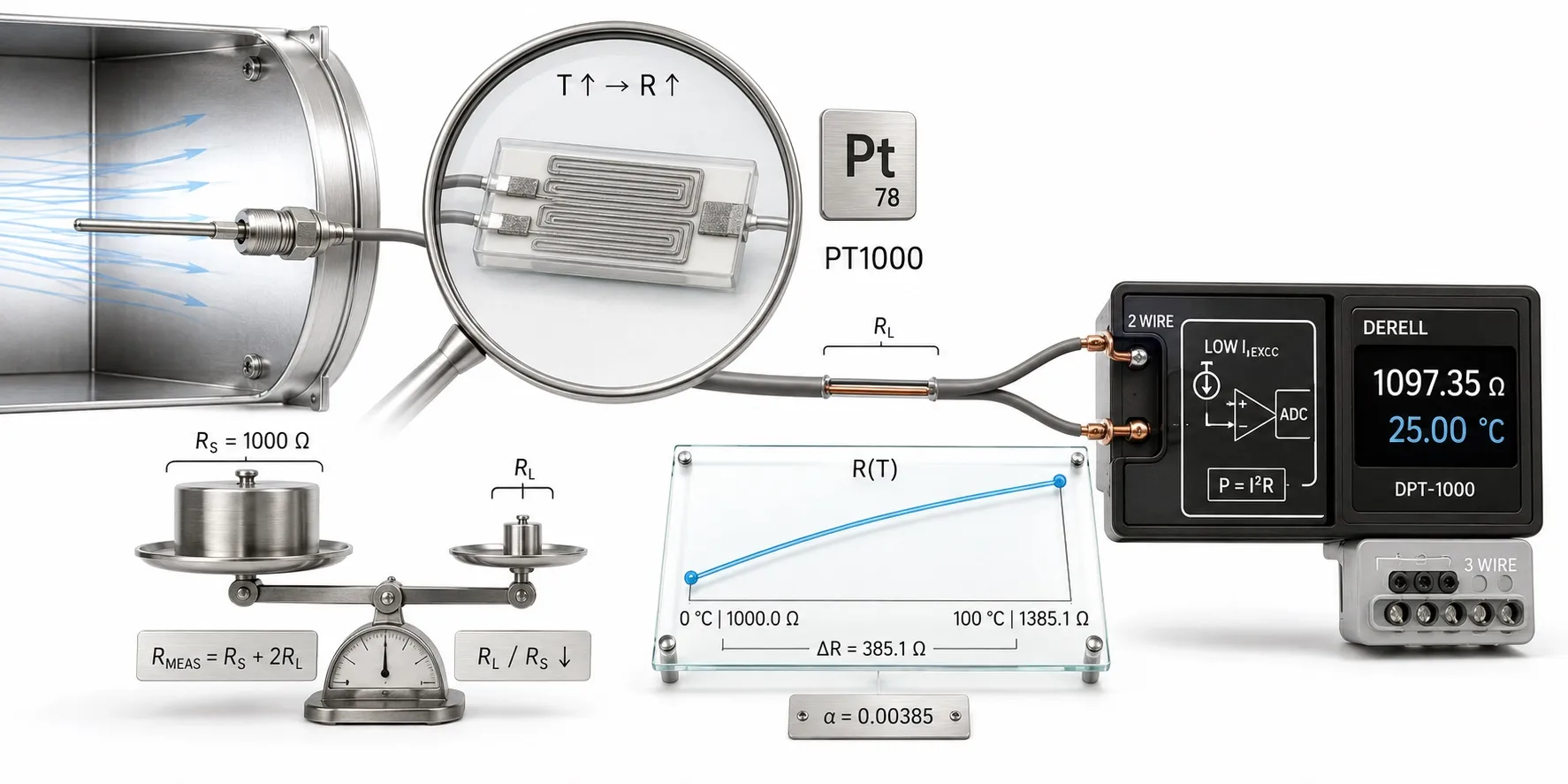
A Pt1000 is a platinum resistance temperature detector (RTD) with a nominal resistance of 1000 Ω at 0 °C. The letters “Pt” are the chemical symbol for platinum; they do not stand for “platinum thermometer.” The number 1000 identifies the nominal resistance at the ice point.
In simple terms: as the Pt1000 element becomes warmer, its electrical resistance increases in a predictable way. An RTD input, temperature controller, transmitter or PLC measures that resistance and converts it into temperature.
Pt1000 belongs to the same platinum RTD family as the much more familiar Pt100. When both follow the standard IEC platinum characteristic, their normalized temperature behaviour is essentially the same; the major electrical difference is that Pt1000 resistance is approximately ten times higher.
That higher resistance can be very useful in long cable runs and low-power electronic measurement systems because lead-wire resistance becomes a smaller percentage of the sensor resistance. However, Pt1000 should not automatically be described as more accurate, more sensitive or suitable for higher temperature than Pt100.
Quick technical navigation
How Pt1000 works · Resistance values · Pt1000 vs Pt100 · 2/3/4-wire wiring · Accuracy and IEC 60751 · Self-heating · PLC and transmitter connection · Compare sensor technologies · Selection guide
How does a Pt1000 temperature sensor work?
Platinum has a positive temperature coefficient of resistance. Within its specified operating region, its electrical resistance rises as temperature rises.
For a standard Pt1000:
0 °C → 1000.00 Ω
At 100 °C, an IEC-type α = 0.00385 Pt1000 has a resistance of approximately:
100 °C → 1385.06 Ω
The same normalized platinum characteristic is used by a standard Pt100 sensor, but the Pt100 resistance values are approximately one tenth as large.
What does α = 0.00385 mean?
The commonly used IEC platinum RTD characteristic has a nominal temperature coefficient of approximately:
α = 0.00385 °C-1
For Pt1000, this corresponds to an average resistance change of about 3.85 Ω per degree Celsius between 0 and 100 °C.
That does not mean resistance increases by exactly 3.85 Ω for every degree over the complete operating range. Platinum RTD behaviour is slightly nonlinear.
Pt1000 resistance–temperature equation
For an IEC-type platinum RTD, the resistance relationship can be represented by the Callendar–Van Dusen form.
For t ≥ 0 °C:
R(t) = R0[1 + At + Bt2]
For t < 0 °C:
R(t) = R0[1 + At + Bt2 + C(t − 100)t3]
Typical IEC coefficients are:
R0 = 1000 Ω
A = 3.9083 × 10⁻³
B = −5.775 × 10⁻⁷
C = −4.183 × 10⁻¹² for temperatures below 0 °C.
For this reason, a simple equation such as R = 1000 + 3.85t is useful for rough understanding but should not replace the proper RTD characteristic in accurate instrumentation.
Typical Pt1000 resistance values
| Temperature | Approx. Pt1000 resistance | Practical note |
| −100 °C | 602.56 Ω | Resistance is well below R0 |
| −50 °C | 803.06 Ω | Typical refrigeration / HVAC region |
| 0 °C | 1000.00 Ω | Nominal reference resistance |
| 20 °C | 1077.94 Ω | Typical room-temperature value |
| 50 °C | 1193.97 Ω | Common process range |
| 100 °C | 1385.06 Ω | Important reference point |
| 200 °C | 1758.56 Ω | Probe construction must be checked |
| 300 °C | 2120.52 Ω | Cable and element ratings matter |
These values describe the standard resistance characteristic. They do not guarantee that every assembled Pt1000 probe can physically operate over the same temperature range.
Interactive Pt1000 RTD demonstration
• Pt1000 is a platinum RTD with 1000 Ω at 0 °C.
• The R/T curve is not perfectly linear.
• At 100 °C the resistance is approximately 1385.06 Ω.
• An RTD input applies a small measuring current to the sensor.
• The simulation uses the Callendar–Van Dusen resistance relationship.
Pt1000 vs Pt100: what is the real difference?
The most obvious difference is nominal resistance:
Pt100 → 100 Ω at 0 °C
Pt1000 → 1000 Ω at 0 °C
Pt1000 therefore has ten times the nominal resistance of Pt100—not twice the resistance.
When both sensors use the standard α = 0.00385 platinum characteristic, their normalized temperature response is essentially the same.
For example:
Pt100 at 100 °C ≈ 138.51 Ω
Pt1000 at 100 °C ≈ 1385.06 Ω
The Pt1000 therefore provides a much larger absolute resistance change for the same temperature change.
For a broader comparison between platinum RTDs and another major industrial temperature technology, see Thermocouple vs Pt100.
Is Pt1000 more accurate than Pt100?
Not automatically.
The higher resistance of Pt1000 can make the electrical measurement easier in some circuits and can reduce the relative influence of cable resistance. That does not mean every Pt1000 element has a tighter temperature tolerance than every Pt100 element.
Actual performance depends on:
tolerance class · thin-film or wire-wound construction · operating temperature · calibration · excitation current · lead configuration · measuring electronics · mechanical installation.
A high-quality Pt100 and Pt1000 belonging to the same standardized tolerance class can therefore have comparable temperature tolerances.
Why can Pt1000 be attractive for long cable runs?
Lead-wire resistance is added to the measured resistance in a basic 2-wire RTD circuit.
Imagine that the total resistance of the two copper leads is 2 Ω.
Near 0 °C, the approximate sensitivity is:
Pt100 ≈ 0.385 Ω/°C
Pt1000 ≈ 3.85 Ω/°C
A 2 Ω lead error therefore corresponds roughly to:
Pt100 → about 5.2 °C
Pt1000 → about 0.52 °C
This simplified example shows why Pt1000 can be especially useful in building automation, HVAC and long 2-wire installations.
It does not remove the need for good wiring practice where high measurement accuracy is required.
Is Pt1000 a 2-wire, 3-wire or 4-wire sensor?
It can be any of them. Pt1000 is not inherently a three-wire sensor.
2-wire Pt1000: simplest connection. Lead resistance is included in the measured value, but its relative impact is smaller than with Pt100.
3-wire Pt1000: suitable RTD electronics estimate and compensate lead resistance, assuming the relevant lead resistances are closely matched.
4-wire Pt1000: uses separate current and voltage paths. This Kelvin measurement method provides the best rejection of lead-wire resistance for precision resistance measurement.
The correct configuration depends on cable length, required uncertainty and the capabilities of the PLC, transmitter or temperature controller.
What temperature range can a Pt1000 cover?
IEC-type Pt1000 measurement electronics can support a very broad platinum resistance characteristic, commonly extending to approximately −200…+850 °C.
This must not be interpreted as a guaranteed service range for every physical Pt1000 probe.
The finished temperature sensor may be limited by:
RTD element construction
thin-film or wire-wound design
lead insulation
probe sheath
potting or insulation materials
vibration
process pressure
mechanical installation
A Pt1000 with PVC cable, for example, cannot be assumed to survive the same temperature as the bare platinum measuring element.
Higher nominal resistance does not inherently give Pt1000 a higher maximum temperature than Pt100.
What is IEC 60751?
IEC 60751 is the key international standard for industrial platinum resistance thermometers and platinum temperature sensors.
It defines, among other requirements, the standardized relationship between temperature and platinum resistance. This common characteristic is what allows compatible RTD instruments from different manufacturers to interpret Pt100 and Pt1000 sensors consistently.
When selecting a Pt1000, check not only the “1000 Ω” designation but also the manufacturer's specified IEC 60751 characteristic, tolerance class and valid temperature range.
What do Pt1000 accuracy classes mean?
Industrial platinum RTDs are supplied in different tolerance classes. Finished thermometers are commonly described using designations such as AA, A, B and C, while current documentation may also use F/W class designations for particular element constructions.
Common temperature-tolerance expressions include:
AA: ±(0.10 + 0.0017 × |t|) °C
A: ±(0.15 + 0.002 × |t|) °C
B: ±(0.30 + 0.005 × |t|) °C
C: ±(0.60 + 0.010 × |t|) °C
The permitted temperature range for a class can depend on whether the sensing resistor is wire-wound or thin-film. Always use the actual sensor manufacturer's stated class range rather than applying one class formula outside its specified region.
Thin-film Pt1000 vs wire-wound Pt1000
“Pt1000” defines the nominal resistance; it does not define how the platinum element is physically constructed.
Thin-film RTD: a thin platinum layer is deposited on a ceramic substrate. The element can be compact, low-mass and well suited to high-volume industrial sensing.
Wire-wound RTD: fine platinum wire is wound or supported within an insulating structure. Depending on design, wire-wound elements can be attractive where wide range, stability or higher-grade measurement performance is required.
The probe housing, thermal coupling and installation can be just as important as the sensing-element technology.
What is self-heating in a Pt1000 sensor?
An RTD cannot be measured without passing a small electrical current through the resistance element.
The resulting power is:
P = I2R
This power heats the RTD slightly.
If the measuring current is too large, the sensor can become warmer than the medium being measured and indicate a temperature that is too high.
Because Pt1000 resistance is approximately ten times that of Pt100, the same measurement current would produce roughly ten times the electrical dissipation. Well-designed Pt1000 electronics therefore use an appropriate, usually lower, excitation current.
Self-heating is particularly important in still air and other environments with poor thermal transfer.
Can Pt1000 be connected directly to a PLC?
Yes, if the PLC module explicitly supports Pt1000 or configurable RTD resistance inputs.
An ordinary 0–10 V or 4–20 mA analog input does not directly measure an RTD resistance.
Look for PLC input specifications such as:
Pt1000
IEC 60751 RTD
2-/3-/4-wire resistance input
If the PLC does not have a suitable RTD input, use a compatible temperature transmitter or sensor converter.
Can Pt1000 be converted to 4–20 mA?
Yes. This is often an excellent solution for long industrial cable runs.
A Pt1000-compatible transmitter measures the RTD resistance, converts it to temperature and generates a standard process signal.
For example:
4 mA → −50 °C
20 mA → +150 °C
The PLC can then read the measurement through a standard 4–20 mA input.
This approach also moves the sensitive resistance measurement close to the sensor, while the longer cable carries a more robust industrial process signal.
Can Pt1000 be connected to a temperature controller?
Only when the temperature controller supports Pt1000 or a suitable configurable resistance input.
Some controllers support Pt100, J/K thermocouples and process inputs but do not support Pt1000. Never assume that “RTD input” automatically means every platinum resistance value is accepted.
Where Pt1000 is unsupported, a transmitter can convert the measurement to 4–20 mA or 0–10 V.
Can Pt1000 temperature be displayed on an HMI or SCADA system?
Yes. Pt1000 itself is only the field sensing element.
A typical automation chain may be:
Pt1000 → RTD input / transmitter → PLC → HMI → SCADA
The PLC converts or receives the temperature value, the HMI displays it to the operator, and SCADA can provide trending, alarm history and long-term process records.
Pt1000 vs thermocouple
Pt1000 and thermocouples measure temperature using completely different electrical principles.
Pt1000 is a resistance sensor. Measuring electronics apply a small excitation current and calculate temperature from resistance.
A thermocouple generates a small thermoelectric EMF through the Seebeck effect.
Pt1000 is especially attractive for stable low- and moderate-temperature measurement. Thermocouples offer a much broader choice for high and extreme temperatures and can be built into extremely small probes.
For a deeper engineering comparison, see Thermocouple vs Pt100; most of the RTD-versus-thermocouple principles apply equally well to Pt1000.
Pt1000 vs NTC thermistor
With Pt1000, resistance increases as temperature increases. With an NTC thermistor, resistance decreases as temperature increases.
NTC thermistors can provide a very large resistance change over a limited temperature region and are widely used in electronics, battery systems and compact temperature sensing.
Their R/T relationship is very different from the standardized platinum characteristic of Pt1000. For more background, see What Is an NTC Temperature Sensor?.
Pt1000 vs PTC thermistor
A Pt1000 physically has a positive temperature coefficient, but industrial terminology normally classifies it as a platinum RTD, not as a conventional PTC thermistor.
PTC thermistors are generally semiconductor devices and many are specifically designed to create a very steep resistance rise around a switching temperature.
That behaviour is useful for motor winding protection and over-temperature trips, whereas Pt1000 is normally used when the actual temperature value must be measured continuously.
The operating principle of switching PTCs is explained further in What Is a PTC Sensor?.
Pt1000 vs non-contact infrared measurement
Pt1000 must be thermally coupled to the material, air stream, liquid or surface being measured.
Where physical contact is impossible—for example on moving products, inaccessible surfaces or extremely hot targets—a non-contact temperature sensor or pyrometer may be more appropriate.
Infrared measurement introduces different error sources, including emissivity, optical spot size, viewing angle and reflected radiation.
For that reason, RTD and IR measurement should not be ranked as universally “better” or “more accurate.” They solve different measurement problems. See How Non-Contact Temperature Measurement Works.
Where are Pt1000 sensors used?
Depending on probe construction, Pt1000 is widely suited to:
HVAC and building automation
air duct temperature measurement
room and outdoor temperature sensing
water and hydronic systems
heating and cooling equipment
energy-management systems
industrial machinery
laboratory and test equipment
PLC-based process monitoring
In refrigeration or HVAC systems, the measured value may feed a