
Where does the technology for solar powered vehicles stand currently?
Where does solar vehicle technology stand today?
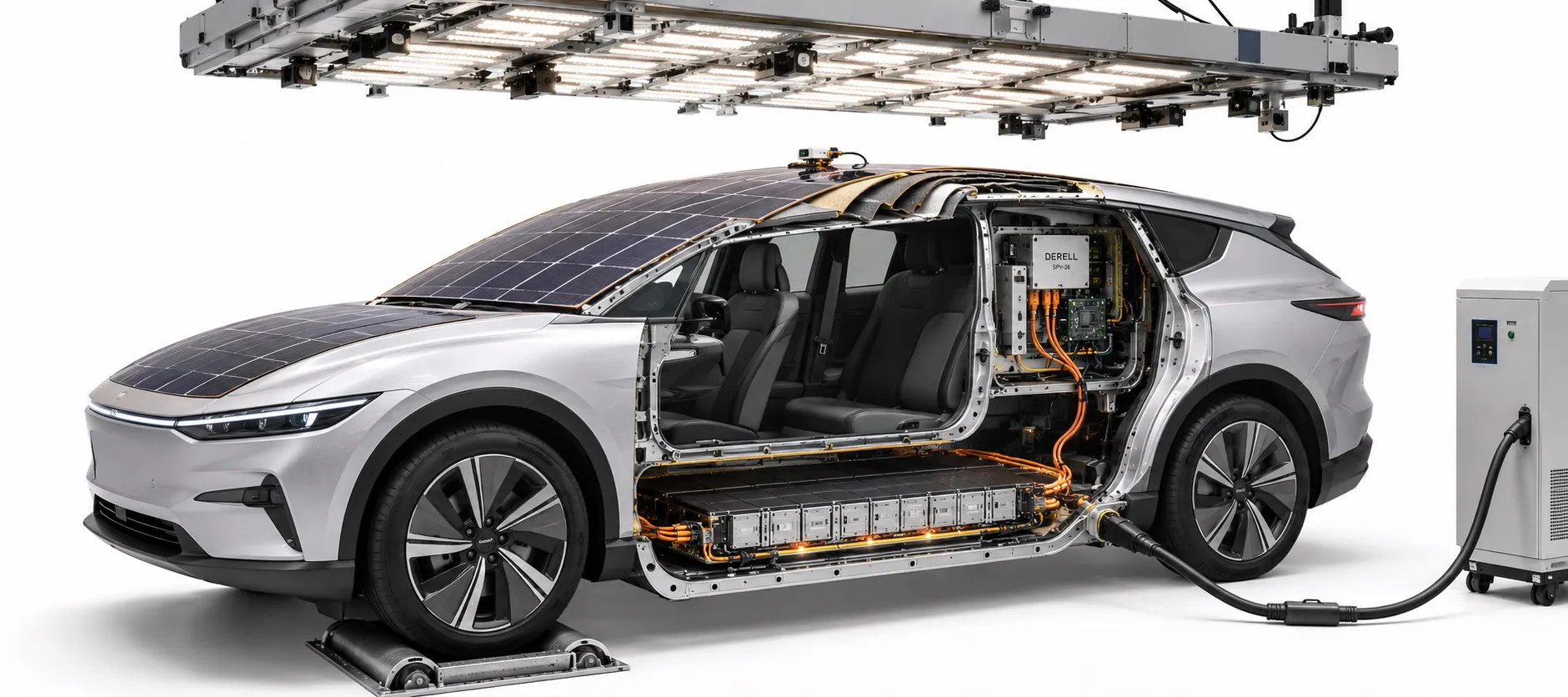
As of 2026, onboard solar generation is a working technology, but it is not a widespread solution that removes every car's need for external charging. Applications include solar roofs, panels powering auxiliary systems and research prototypes. The key question is how much useful energy the system contributes in everyday operation.
Within solar energy and vehicles, distinguish electricity generated on the vehicle from electricity supplied by a stationary solar installation. This helps explain the difference between electric and solar vehicles. Both approaches can support electric propulsion; the location of generation differs.
1. Solar roofs are used on real vehicles
The technology is not confined to laboratories or racing cars. In its 2025 Prius announcement, Toyota stated that solar charging could provide the equivalent of up to 8.7 km of electric driving range per day. This is a manufacturer-stated upper value, not a daily range guarantee for every climate or vehicle version.
This example shows a commercial application of solar assistance when comparing manufacturers and models. However, assessing industry growth requires separating prototypes, pre-orders, delivered vehicles and sustained series production. The impact on the automotive market cannot be measured through promotional videos alone.
2. Available energy remains limited
Usable surface area matters alongside solar panel efficiency. Weather conditions, geographic location and shading and panel orientation affect output. Panel power is not the same as the energy a vehicle needs throughout a day. Understanding the difference between kW and kWh is essential.
In a purely hypothetical example, 2 kWh of solar energy reaching the battery each day, with vehicle consumption of 15 kWh/100 km, represents roughly 13 km/day of driving energy. This is a calculation using two assumptions, not measured performance for a particular model. Keep range from a fully charged battery separate from the daily solar contribution.
3. Engineering development focuses on vehicle integration
Vehicle panels face different conditions from stationary rooftop panels. Curved surfaces, vibration, changing shadows, weight and body integration must be assessed together. In the vehicle design, panels, MPPT control and energy management must work together while respecting the battery's safe charging limits.
Safety and reliability require more than high panel efficiency. Long-term durability, repairability and maintenance costs matter. A functioning prototype is at a different stage from an affordable series-production vehicle with dependable servicing. Among the barriers to wider adoption is whether the benefit to the user justifies the added cost.
4. Stationary solar charging and commercial vehicles offer different opportunities
Roof-mounted and parking-canopy panels can be sized without relying on the vehicle body's limited area. Within charging infrastructure, match generation times to vehicle parking schedules. Plan the wallbox, grid supply and storage where needed together. A solar charging station is a separate application, rather than an advanced version of an onboard solar roof.
In public transport and other commercial applications, solar energy can contribute to auxiliary loads or battery charging. Its contribution depends on the vehicle and duty cycle. Assess battery life, payback and the carbon footprint using actual operating data. The presence of solar equipment alone does not establish an economic or environmental advantage.