
Solar energy and vehicles
Solar energy and vehicles: How far can sunlight take you?
Solar-powered transport can mean three different things: purpose-built vehicles drawing much of their energy from onboard panels, electric vehicles receiving supplementary onboard solar energy, and vehicles charged from stationary solar installations. Their available panel area, energy demand and operating conditions differ.
This section connects solar vehicle technology with range, batteries and charging infrastructure. “Electric” describes the propulsion system; “solar” describes an energy source. A comparison between electric and solar vehicles therefore needs to distinguish the source of electricity from the motor technology.
What can onboard panels do?
A solar panel generates electricity, which must be managed in a way that matches the vehicle's electrical system. MPPT helps capture available panel power but cannot remove the limits imposed by sunlight and panel area. Whether the panels support the traction battery or an auxiliary battery depends on the vehicle's design.
Solar vehicle design brings together panel area, weight, aerodynamics, electrical protection and battery management. Performance comparisons with fuel-powered vehicles should use equivalent vehicle classes, speeds, loads and operating conditions. Results from a lightweight racing prototype cannot be transferred directly to a family car.
Panel power is not daily driving range
W and kW describe instantaneous power; kWh describes energy generated or consumed over time. A solar range calculation uses energy reaching the battery and the vehicle's energy consumption per kilometre. A panel's rated power does not mean it produces that power all day.
A hypothetical example: Assume 0.8 kW of rated panel capacity and daily irradiation equivalent to 4 hours at full output. Before losses, that gives 0.8 × 4 = 3.2 kWh. If 80% becomes usable energy in the traction battery, 2.56 kWh remains. At an assumed consumption of 16 kWh/100 km, that corresponds to roughly 16 km. This is not a product rating or a daily range promise. Parking conditions, season, losses and consumption change the result.
Weather and geography affect production. Shading and panel angle matter too: panels in an enclosed garage cannot produce the same energy as panels in a sunny open space. Total battery range and additional range gained from that day's sunshine must be calculated separately.
Do the panels have to be on the vehicle?
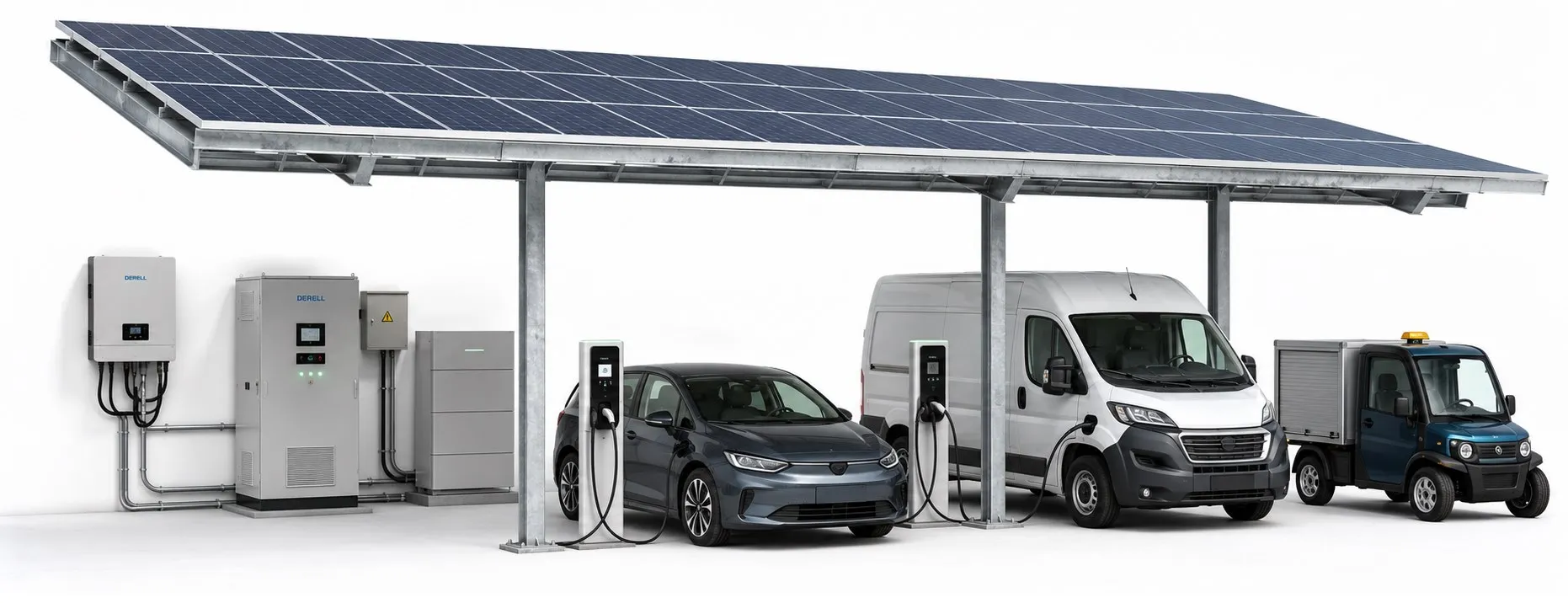
No. Stationary rooftop or carport panels can supply vehicle charging through suitable electrical and charging equipment. This avoids relying solely on the limited area of a vehicle body. Charging infrastructure planning should consider PV generation, building loads, vehicle demand and any storage together.
The wallbox, charging power and Type 2 or CCS connection must suit the vehicle and installation. A panel cable cannot simply be connected to the vehicle's charging inlet. Charging during solar production can increase self-consumption; using solar energy at night requires prior storage or an appropriate energy supply arrangement.
Can an aircraft fly on solar energy?
Solar Impulse 2 completed a fuel-free round-the-world journey in stages, starting in 2015 and finishing in 2016. The experimental single-seat aircraft had 17,248 solar cells, four electric motors and four batteries. Energy stored during the day supported flight at night.
The achievement demonstrates the importance of low weight and low energy demand. A single-seat experimental flight and scheduled passenger service have different requirements, however. Passenger and cargo capacity, speed, weather and energy reserves must be assessed before drawing conclusions about large airliners.
Batteries, maintenance and safety
Battery life and recycling depend on chemistry, temperature, use and service arrangements. Charging from sunlight does not prevent battery ageing. Maintenance costs should account for connections, mountings, weather sealing and the vehicle manufacturer's service requirements as well as panel surfaces.
Safety and reliability require attention to vibration, water, impact and secure panel mounting. Work on traction batteries and high-voltage systems requires suitable training and equipment. Adding panels may affect vehicle approval and warranty conditions, so follow arrangements permitted by the manufacturer.
Environmental impact and investment
Environmental impact and carbon footprint assessments should include panel, battery and vehicle production, service life and end-of-life treatment. Having no tailpipe emissions does not eliminate impacts across the full life cycle.
A payback calculation compares additional investment, solar energy actually used, maintenance and alternative charging costs. Incentives vary by country, date and eligibility; an old article is not a reliable basis for budgeting current support.
Public transport and the automotive market
For public transport, supporting auxiliary loads with onboard panels and supplying all propulsion energy are different objectives. Stationary PV at depots and around stops can also form part of the energy plan.
When assessing sector growth, long-term market impact and barriers to adoption, distinguish demonstration vehicles, series production and customer deliveries. In a manufacturer comparison, check sales regions, delivery status, technical documentation and service support rather than relying on announced targets.
Refine Search
- At what rate is the use of solar energy growing in the automotive sector?
- Does geography affect solar vehicle performance?
- How does the performance of solar powered vehicles compare to vehicles using traditional fuels?
- How does the production and use of solar powered vehicles impact energy consumption and carbon footprint?
- How far can a fully charged solar powered vehicle travel?
- How is a vehicle designed and built to operate using solar energy?
- How quickly can a solar powered vehicle pay for itself when compared to a traditional vehicle?
- In which weather conditions are solar powered vehicles effective and in which are they limited?
- What are the maintenance costs for solar powered vehicles?
- What factors might inhibit the wider adoption of solar powered vehicles in the future?
- What government incentives are available for using solar powered vehicles?
- What impact will solar powered vehicles have on the automobile market in the long term?
- What infrastructure needs exist for solar powered vehicles?
- What is known about the safety and reliability of solar powered vehicles?
- What is the battery life in a solar powered vehicle and how are batteries recycled?
- What is the environmental impact of solar powered vehicles?
- What is the potential of solar powered vehicles for mass transit?
- Where does the technology for solar powered vehicles stand currently?
- Which automobile manufacturers are leading in bringing solar powered vehicles to market and why?
- Which is more efficient, electric vehicles or solar powered vehicles, and why?