
Obtaining water from the sea with solar energy
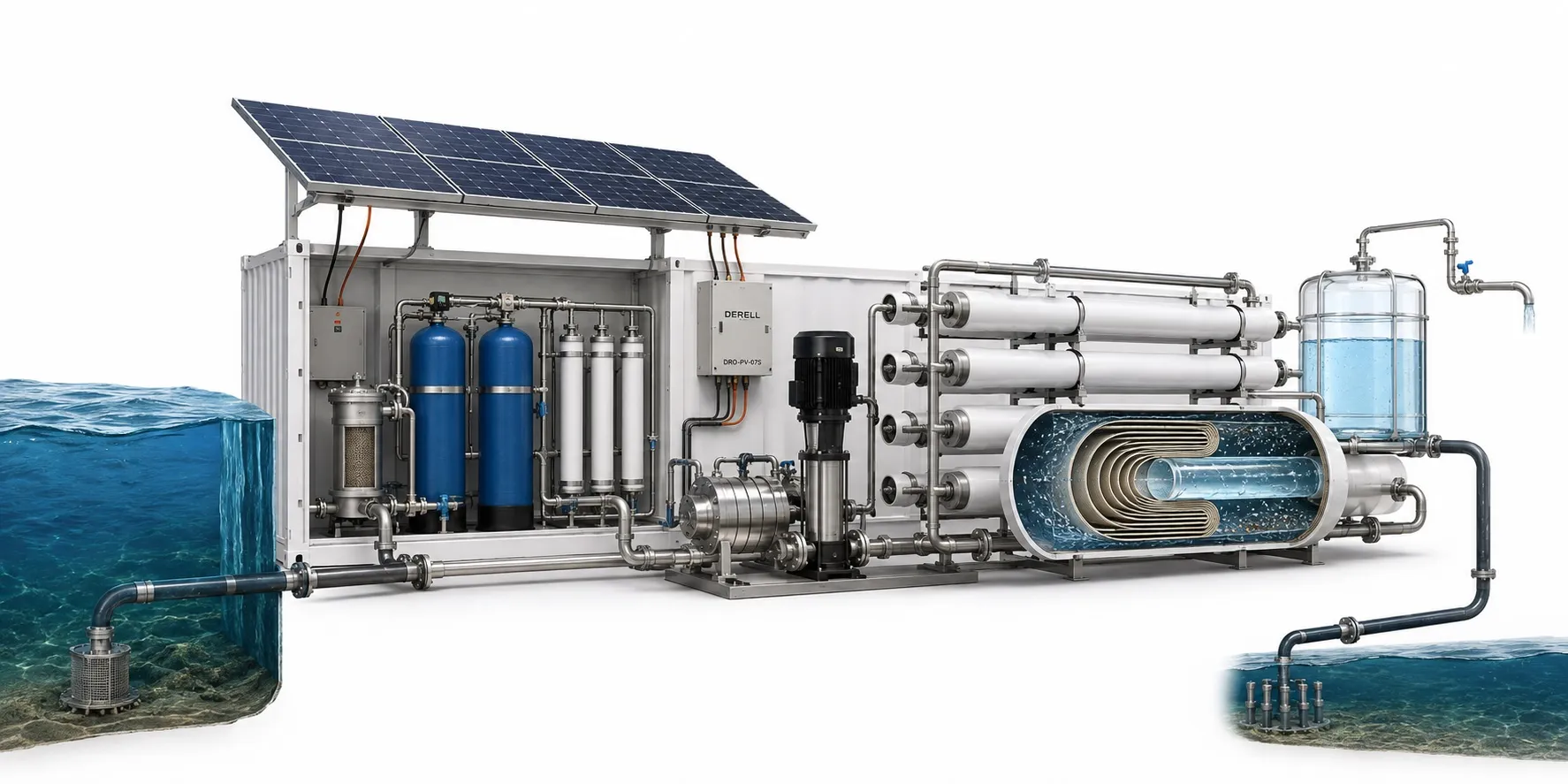
From sunlight to fresh water: designing energy and treatment together
Producing fresh water from seawater using solar energy is technically feasible. It can provide a valuable resource for water-stressed coastal communities and islands. However, it is not an unlimited, free solution to the global water crisis. Energy supply, treatment processes, water quality, environmental impacts and distribution infrastructure must be assessed together.
Solar electricity and solar heat are different approaches
Photovoltaics and reverse osmosis: A photovoltaic system generates electricity to power pumps and auxiliary equipment. In seawater reverse osmosis (SWRO), pressure drives water through a semipermeable membrane while most salts remain in the concentrate stream. The solar inverter converts electrical power; the membrane system performs the salt separation.
Solar-thermal treatment: Heat collected from the sun can support distillation, membrane distillation or other suitable thermal processes. Heat recovery and thermal storage are important in these arrangements. A simple solar still and a large thermal plant have different production rates and land requirements; electrical consumption and heat demand must be calculated separately.
How does a seawater reverse osmosis plant work?
Intake and pretreatment: Sand, suspended solids and biological loading in the intake water must be assessed. Filtration and any additional pretreatment are selected to protect the membranes. Inadequate pretreatment can reduce production through fouling, blockage and frequent cleaning.
Pressurisation and separation: A high-pressure pump establishes operating conditions that overcome osmotic pressure and system losses. The low-salinity water passing through the membrane is called permeate; the remaining saltier stream is the concentrate or brine. Feedwater temperature and salinity affect production and energy demand.
Post-treatment and storage: Product water receives treatment appropriate to its intended use and is then stored. Drinking water, industrial process water and irrigation water should not be assigned identical quality targets. Storage and distribution are functional parts of the overall installation.
Which energy consumption boundaries should be used?
Consumption should be expressed as kWh per cubic metre of product water. High-pressure pump consumption alone differs from a total including intake, pretreatment, post-treatment and distribution. Conveying water over long distances or pumping it to higher elevations can add significantly to overall demand.
Energy recovery devices return part of the pressure energy remaining in the concentrate to the process, reducing pump duty. This differs from electrical MPPT: MPPT manages the panel operating point, while pressure energy recovery concerns hydraulic energy use in treatment.
An example for 100 m³ of daily production
Assumptions: Suppose electricity consumption within the selected plant boundary is 4 kWh/m³ and the daily product-water target is 100 m³. Daily energy demand is then 100 × 4 = 400 kWh. This is an illustrative assumption, not a performance guarantee for every plant size or seawater source.
If the solar panels deliver 4 kWh of usable daily energy per installed kWp after losses during the selected period, the initial energy calculation gives 400 / 4 = 100 kWp. Actual sizing must examine seasonality, shading, temperature, soiling and the hourly balance between production and consumption. Matching daily energy totals does not establish continuous operation.
If production is limited to six hours per day, average product flow must be approximately 16.7 m³/h, with average electrical demand of approximately 66.7 kW under the same consumption assumption. Membrane and pump capacity must therefore match the operating window. Available instantaneous solar power requires separate verification.
Does supplying water at night require a large battery?
Storing treated water can be more suitable in some projects than storing enough electricity to operate the plant all night. Water can be produced during the day and supplied from a tank at night. Tank capacity, hygiene, distribution pressure and reserves for low-production days still need planning. Using solar energy at night involves considering water storage alongside electrical storage.
Grid support, batteries or hybrid supplies depend on operational requirements. Energy for controls, flushing and safe shutdown must also be included. Instead of allowing uncontrolled stops and starts whenever solar power falls, the process must follow the equipment’s permitted operating range and shutdown sequence.
Why do pump control and automation matter?
Pressure sensing and flow measurement monitor production and hydraulic conditions. Filter pressure loss can be tracked through differential pressure measurement, while tank status can use suitable level sensing or a liquid level relay. Conductivity measurement is also useful for monitoring changes in product water.
PID control or PID implemented in a PLC can regulate pump operation with a suitable variable frequency drive. Minimum crossflow, pressure limits and product quality must still be maintained. A solar pump drive does not automatically provide every control and protection function required by an RO plant.
What happens to the concentrate?
The recovery ratio is product-water flow divided by feedwater flow. At an illustrative 40% recovery, producing 100 m³ of product water requires approximately 250 m³ of feedwater and generates 150 m³ of concentrate. This simplified balance excludes backwashing, flushing and other auxiliary streams.
Concentrate can affect the receiving environment through elevated salinity and process-dependent chemical residues. Impacts of the intake on marine organisms must also be assessed. Discharge location, mixing conditions and monitoring require site-specific design. Using solar electricity does not automatically eliminate marine impacts.
Salt or mineral recovery can be considered for some projects, but not every concentrate stream becomes an economically valuable product. Approaches such as zero liquid discharge also require additional energy, equipment and management of solid residues.
Removing salt alone does not establish drinking-water safety
Drinking-water production requires management of the source, treatment process, storage and distribution together. Membrane performance, specific constituents such as boron, microbiological safety and disinfection must be assessed. Low conductivity or low total dissolved solids alone does not demonstrate compliance with every drinking-water requirement.
Low mineral content and potentially corrosive behaviour require stabilisation, remineralisation where appropriate, and pH adjustment. This concerns more than taste: compatibility with distribution materials and safe delivery to users also matter. Quality targets must follow applicable drinking-water requirements and a water safety plan.
Its realistic role in the global water crisis
This approach can diversify water supplies, particularly near the coast where solar resources are suitable. Investment, membrane and filter replacement, maintenance, staffing, chemicals, discharge and distribution costs remain. Comparisons should use the lifecycle cost of suitable-quality water delivered to users.
For inland locations, seawater conveyance and pumping to higher elevations can change the economics. Desalination should therefore be assessed alongside leakage reduction, efficient irrigation, appropriate wastewater reuse and protection of existing sources. Its strongest contribution is as part of a water management plan suited to local conditions.
Editor’s note: Pumping water from a well and desalinating seawater are different pump applications. An RO system must maintain pressure, membrane flow, recovery ratio and product-water quality together. Working panels and a running drive do not, by themselves, demonstrate correct treatment performance.
Related solar energy topics
Explore solar energy frequently asked questions, solar panels, panel production at night and in cloudy weather, solar farms and the future of solar energy.
Related pumping, measurement and control categories
Pumps, pump controllers, pressure sensors, PLCs and accessories and HMIs and operator panels address different functions within the installation.
Return to the solar energy systems category.
Sources
U.S. Department of Energy: desalination basics
U.S. Department of Energy: solar-thermal desalination
IRENA and IEA-ETSAP: renewable desalination, 2012 technology brief
DuPont: reverse osmosis configurations and pressure energy recovery
World Health Organization: managing risks in desalinated drinking-water
World Health Organization: 2026 drinking-water guidelines, section 6.5
UNEP: sustainable desalination and brine management
World Bank: the role of desalination in a water-scarce world