
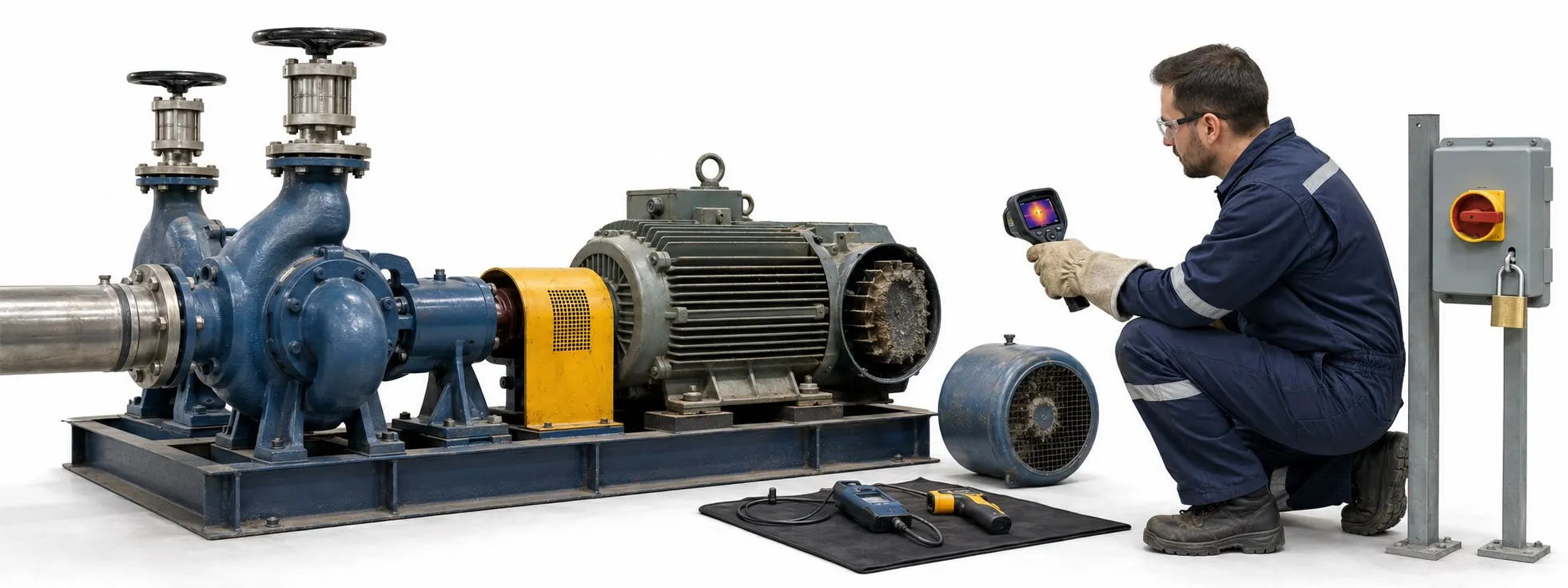
Find the cause of pump heating before restarting
Unexpected overheating calls for a safe shutdown and an investigation—not repeated cool-down and restart cycles. In a pumping system, the hot component may be the motor, casing, bearing assembly or shaft-seal area. Identifying that location is the first useful diagnostic step.
Make the equipment safe to inspect
Do not keep running a unit with a burning smell, smoke, a protection trip, rapidly rising temperature, serious leakage or abnormal vibration. Follow the installation's shutdown procedure, then isolate energy sources and prevent an unexpected restart before inspection. Some pumps can restart after a thermal device cools or when the controller issues a new demand.
Do not open a filling plug, vent screw or casing while the pump is hot and pressurised. Before opening the pump, release pressure completely through the prescribed procedure and allow it to reach a safe temperature. Avoid pouring cold water over the casing to force a rapid cool-down. Use the manufacturer's instructions and the site's isolation procedure for maintenance work. Save the alarm code and operating conditions before beginning a fault investigation.
Establish whether the temperature is abnormal
A pump carrying hot liquid will have a hot casing. Some motors also run at surface temperatures that cannot sensibly be judged by touch. “Too hot to hold” is not a complete diagnosis. Identify the relevant pump components and measure casing, motor and bearing-area temperature with suitable equipment. Compare the results with liquid temperature, ambient conditions and the manufacturer's limits. Previous readings at the same duty help reveal a developing problem.
If the casing is heating, check the hydraulic conditions
In a centrifugal pump, inadequate liquid supply, trapped air or dry running can deprive wetted components of cooling. Check tank level, suction-line integrity and the required initial fill. Understanding how the pump works matters here: in many designs, the handled liquid helps cool and lubricate components as well as being the product delivered.
A closed discharge, blockage or operation below permitted minimum flow can heat the liquid inside the casing. This does not make “open the valve fully” a universal remedy. Compare valve positions and the actual duty with the limits used in pump selection, and check any minimum-flow arrangement. The pump type matters: a blocked positive displacement pump can also generate dangerous overpressure.
A submersible pump does not automatically have adequate cooling just because it is underwater. Its motor may need a specified liquid flow past its surface. Check the installation geometry, liquid level and required cooling flow; a suitable cooling sleeve may be needed.
If the motor is heating, separate supply problems from cooling problems
Qualified electrical personnel should assess phase voltages, individual phase currents and connection conditions against the motor data and instructions. Phase loss, supply imbalance, an unsuitable supply or excessive mechanical loading can contribute to heating. Where a motor uses PTC temperature sensing, include the sensor and protection circuit in the checks. Increasing an overload setting or bypassing protection to avoid trips does not fix the fault.
Inspect the fan, air passages and surrounding conditions too. Frequent starts, insufficient cooling at low speed or unsuitable operating settings warrant a review of pump control. Unstable feedback or poor PID tuning can produce unnecessary speed changes, but controller adjustments cannot replace temperature and current measurements.
Check friction, seals and changes in the pumped liquid
Damaged bearings, misalignment, impeller rubbing and incorrect lubrication can increase mechanical losses. Check any seal-flush and cooling arrangements. Adding grease indiscriminately or tightening a seal further can make matters worse. If the application has changed from water to oil or a denser liquid, reconsider the effects of viscosity and density on loading.
Assess noise and vibration alongside the location of the temperature rise. Cavitation, dry running and a bearing defect are different diagnoses. Combine measurements with inspection rather than drawing a firm conclusion from sound alone. Correcting the operating conditions is part of protecting pump service life.
Restart only after correcting the cause
Confirm liquid supply, venting, valve positions, cooling and protection settings before returning the pump to service. Cooling does not reverse damage from severe dry running, burning, bearing distress or leakage; a service inspection may be necessary. Once suitable conditions are restored, qualified personnel should monitor current, flow, pressure and the temperature trend during a controlled trial. If heating returns, stop again rather than repeatedly resetting the unit.
The lasting fix also supports lower energy consumption and better control of ownership costs. A useful service record includes pump and motor models, liquid details, measured temperatures, phase currents, flow/pressure, drive frequency, alarm code and elapsed time before heating occurs.