
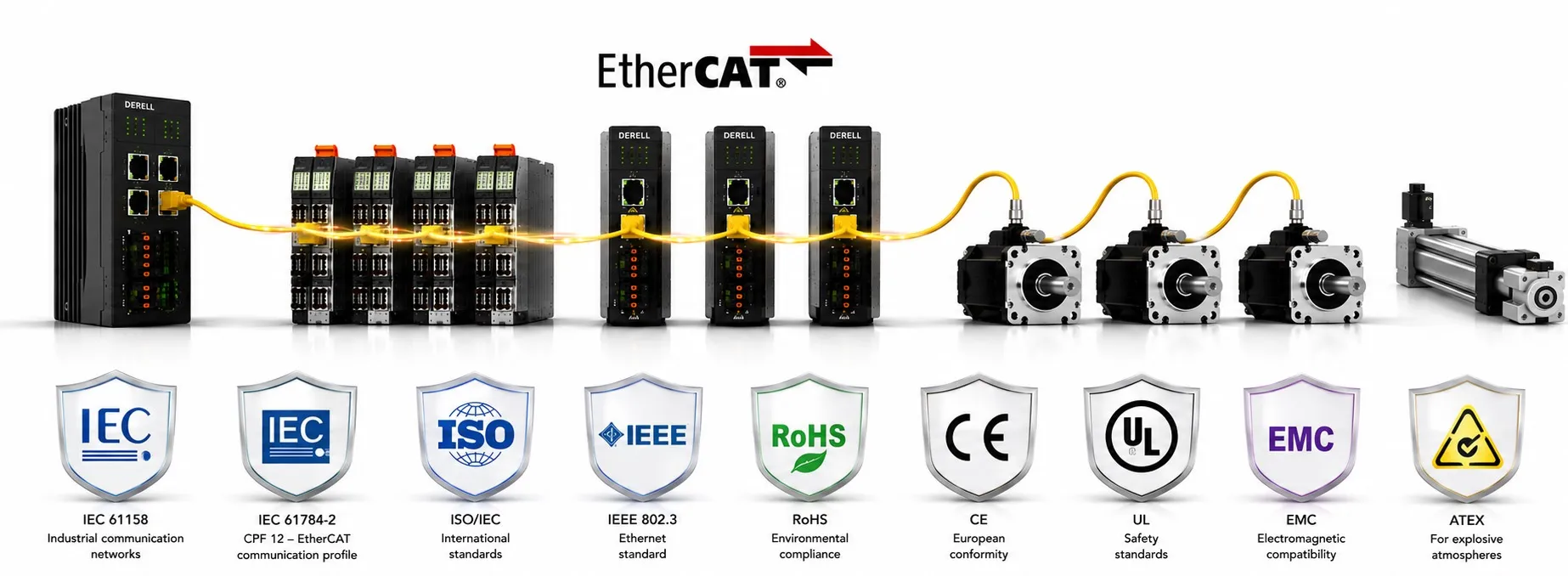
How does EtherCAT comply with industry standards?
The useful answer starts by separating three different kinds of compliance. EtherCAT itself is internationally standardized as an industrial communication technology; a particular device may then be tested for conformance to the EtherCAT specifications; and the finished product or machine still has to meet whatever electrical, EMC, functional-safety or market requirements apply to that application. Those three layers are related, but they are not interchangeable.[1]
At protocol level, EtherCAT is represented in the IEC 61158 family as Type 12 and in the IEC 61784 real-time Ethernet profiles as Communication Profile Family 12 (CPF 12). That gives the technology a common international technical reference. It does not mean that every product carrying an EtherCAT port has identical PDOs, profiles, timing modes or safety functions. For that, the actual device description and supported features still matter.
Read the picture carefully: the image above places IEC/ISO/IEEE references next to RoHS, CE, UL, EMC and ATEX. They are not all “EtherCAT standards.” IEC 61158 / IEC 61784 and the Ethernet base describe the communication environment; CE, UL, RoHS, EMC and ATEX belong to different product, regulatory or application domains. Treat the picture as a reminder to separate the layers—not as a certificate matrix.
1. The core standards position: IEC 61158 Type 12 and IEC 61784 CPF 12
The EtherCAT Technology Group states that EtherCAT and Safety over EtherCAT are incorporated into IEC standards. The protocol is represented through the Type 12 parts of IEC 61158. One current example is IEC 61158-6-12:2019, covering the Type 12 application-layer protocol. The more focused real-time Ethernet reference is IEC 61784-2-12:2023, which defines CPF 12 and relates it to IEC 61158 Type 12 and ISO/IEC/IEEE 8802-3 network technology.[2][3]
For an engineer, this means EtherCAT is not merely a vendor label. It has an international standards framework. But protocol standardization is only the foundation. Device revision, ESI data, supported PDOs, mailbox services, profiles and synchronization capabilities still have to be checked. The EtherCAT technical specifications page covers those implementation details.
2. Standard Ethernet is the base, not a claim of universal Ethernet compatibility
EtherCAT uses Ethernet framing and physical-layer technology, and IEC 61784-2-12 places CPF 12 among real-time Ethernet profiles based on ISO/IEC/IEEE 8802-3. That does not turn an ordinary Ethernet endpoint into an EtherCAT SubDevice. A familiar connector, Ethernet PHY or cable can be part of the physical implementation while the field device still requires EtherCAT-specific processing. The distinction is easier to see in how EtherCAT works.[4]
3. Installation has its own profile: IEC 61784-5-12
Protocol compliance does not automatically prove that the installation is correct. IEC 61784-5-12:2024 specifies the installation profile for CPF 12 (EtherCAT) and is intended to be read with IEC 61918. This is an important practical distinction: network behavior, cable installation, connectors, environment and EMC-related installation practice are separate engineering layers.[5]
So “we use EtherCAT” is not a substitute for checking routing, shielding, connector suitability or the installation environment. The limits and constraints of EtherCAT should therefore be read separately from the protocol standard itself.
4. Device profiles matter, especially in motion systems
Standardization becomes more useful when devices share defined behavior as well as a transport mechanism. ETG notes that the IEC work around EtherCAT also reaches application layers and device profiles. In drive systems, the CiA 402 family of behavior is mapped through the IEC 61800-7 framework; IEC 61800-7-301:2015 covers the mapping of profile type 1 to network technologies. This is why “EtherCAT drive” and “supports the motion profile and modes required by my controller” are two different statements.[6]
For a servo application, verify the real PDO map, control modes, timing functions and ESI revision rather than relying on the port name alone. The broader drive-standard context is covered in the IEC 61800 guide.
5. FSoE is the functional-safety communication layer—not proof that the whole machine is SIL 3
Safety over EtherCAT (FSoE) is a separate safety communication protocol. It was standardized in the IEC 61784-3 framework as FSCP 12. ETG reported that TÜV SÜD also confirmed compliance with the extended requirements introduced in IEC 61784-3:2021, and the protocol is used for applications up to SIL 3 when the rest of the safety design meets the required conditions.[7]
The boundary matters. FSoE can provide a qualified way to transport safety-related information; it does not by itself assign a SIL or PL to the complete machine. Risk assessment, the sensor–logic–actuator architecture and the relevant SIL or machinery-safety requirements remain separate. The machinery safety standards guide covers that wider design context. Functional safety is also different from cybersecurity, which is why EtherCAT security is treated as a separate topic.
6. What does EtherCAT conformance testing actually prove?
International standards are useful only if implementations behave consistently. ETG therefore maintains the Conformance Test Tool (CTT), interoperability events and accredited EtherCAT Test Centers. ETG's current guidance states that device vendors must successfully apply the current CTT in-house. An official EtherCAT conformance certificate, however, requires the device to pass the official conformance and interoperability testing at an EtherCAT Test Center.[8]
That certificate is strong evidence about the EtherCAT implementation, but it is not an application guarantee. The machine builder must still verify ESI revision, process-data mapping, supported profile, Distributed Clocks mode, controller capability and the function expected from the device. That is why device selection belongs with the device and sensor integration work rather than being reduced to a logo check.[9]
7. ISO 15745 and SEMI E54.20 show that “standardization” can exist at different layers
EtherCAT also appears outside the core IEC references. ISO 15745-4:2003, still listed by ISO as current after its 2021 review, defines profile-description rules for Ethernet-based control systems. In semiconductor manufacturing, SEMI E54.20 defines Sensor/Actuator Network communications based on EtherCAT; the current SEMI store record includes the 2024 technical revision.[10][11]
These examples are useful because they show why a bare standards number can be misleading. One document may describe the fieldbus protocol, another an installation profile, another a device profile, and another an industry-specific interoperability model.
8. EtherCAT compliance is not CE, UL, RoHS, EMC or ATEX compliance
| Layer being checked | Typical reference | What it tells you | What it does not automatically tell you |
|---|---|---|---|
| EtherCAT protocol | IEC 61158 Type 12 / IEC 61784 CPF 12 | Communication technology and profiles | CE, UL, ATEX or machine safety |
| EtherCAT device conformance | ETG CTT / official conformance test | Implementation against the EtherCAT specifications | Correct configuration of every application feature |
| Safety communication | FSoE / IEC 61784-3 | Qualified transport of safety-related data | The final SIL/PL of the complete machine function |
| Product / regulatory compliance | CE, EMC, RoHS, UL, ATEX where applicable | Compliance within that product or regulatory scope | EtherCAT protocol conformance |
For example, a remote I/O block can have an official EtherCAT conformance certificate and also carry separate product approvals required for its market. Those are independent pieces of evidence. Likewise, RoHS addresses restrictions on hazardous substances; it does not test whether the EtherCAT state machine or process-data exchange is correct.
9. Worked example: adding an EtherCAT servo drive to a packaging machine
Suppose a new EtherCAT servo drive is added to a packaging line. First, the engineer checks the exact ESI file, product code and revision, then the PDOs and the motion profile expected by the MainDevice. If synchronized motion is required, Distributed Clocks capability and the supported operating mode are verified. If the machine needs safety-related motion or safe torque functions, the engineer then checks the real safety functions and FSoE capability rather than assuming that an EtherCAT port provides them.
The finished machine still requires its own risk assessment, electrical design and applicable machinery or product compliance work. One project can therefore contain four different checks: communication conformance, device-profile compatibility, functional safety and product/machine compliance. EtherCAT addresses the first one directly and can carry qualified safety communication through FSoE; it does not remove the other engineering obligations.
10. A better way to read “EtherCAT compatible”
When a datasheet says only EtherCAT compatible, ask four follow-up questions: (1) which EtherCAT services and device profiles are implemented, (2) which ESI/product revision applies, (3) whether ETG conformance testing or an official certificate is available, and (4) which separate product, EMC, safety or market approvals the application requires. That turns a logo into engineering evidence.
For the selection side, continue with why EtherCAT is used in industrial automation; for protocol details see technical specifications; and for technology generations see EtherCAT versions and extensions.
Related EtherCAT and standards guides
• What is EtherCAT?
• What are the technical specifications of EtherCAT?
• How is security ensured in EtherCAT?
• Which devices and sensors can be integrated with EtherCAT?
• What are the limits and constraints of EtherCAT?
• Industrial standards
• IEC standards
• SIL
• IEC 61800
Technical references
[1] EtherCAT Technology Group — International Standardization / EtherCAT Technology. ethercat.org
[2] IEC — IEC 61158-6-12:2019, Type 12 application-layer protocol. IEC Webstore
[3] IEC — IEC 61784-2-12:2023, CPF 12 real-time Ethernet profiles. IEC Webstore
[4] EtherCAT Technology Group — Technology and international standardization overview. ETG Organisation
[5] IEC — IEC 61784-5-12:2024, installation profile for CPF 12 (EtherCAT). IEC Webstore
[6] IEC — IEC 61800-7-301:2015, mapping of drive profile type 1 to network technologies. IEC Webstore
[7] EtherCAT Technology Group / TÜV SÜD — FSoE and IEC 61784-3:2021 requirements. ETG technical release
[8] EtherCAT Technology Group — Conformance Test Tool and conformance process. CTT / Conformance
[9] EtherCAT Technology Group — Official conformance tested products and guidance for users/OEMs. Device User / OEM
[10] ISO — ISO 15745-4:2003, profile framework for Ethernet-based control systems; ISO lists the standard as current after the 2021 review. ISO
[11] SEMI — SEMI E54.20, Sensor/Actuator Network Communications for EtherCAT; the current store record includes the 2024 technical revision. SEMI