
In which industries are dataloggers used?
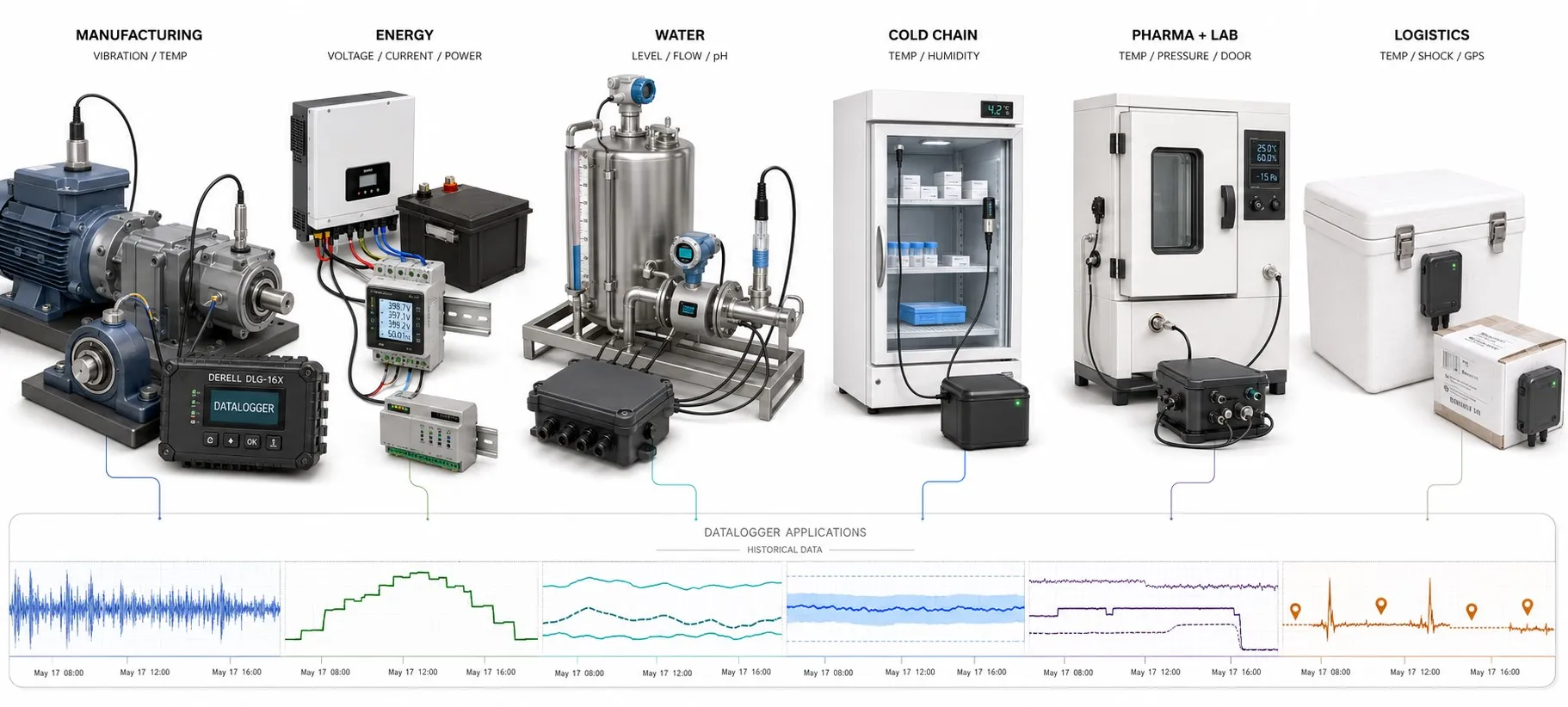
Match the recording system to the industry's task
Data loggers serve food and beverage, pharmaceuticals, automotive, manufacturing, chemicals, energy, water and environmental services, agriculture, logistics, building operations, mining and construction. Across these industries, they preserve measurements with time information for later investigation. A logger application crosses industry boundaries: temperature recording matters in both a pharmaceutical warehouse and a motor test, but their timing, accuracy and reporting requirements differ.
Food and beverage: connect conditions to the batch
Cooling, drying, cooking and storage processes can record temperature and, where relevant, humidity, pressure and flow. Link the measurements to batch identification and process timing to support quality investigations. In refrigeration, compare changes with door openings or defrost cycles. A temperature plot alone does not establish food safety or product condition. Interpretation also requires the product's acceptance criteria and appropriate probe placement.
Pharmaceuticals, biotechnology and laboratories: preserve traceability
Warehouses, cold rooms, storage cabinets and test chambers record temperature and humidity histories. Important requirements include device identification, calibration information, user permissions, change history and traceable reports. Check measurement accuracy separately from the software's record-integrity features. Not every logger supplies these capabilities, and an acceptable recorded temperature does not by itself verify every storage requirement.
Automotive and battery production: coordinate many channels
Motor, power-electronics and battery testing may record voltage, current and temperatures at multiple locations. A current sensor and a thermocouple need different input arrangements. Channel isolation, common-mode voltage capability and timing alignment influence equipment selection. Slow temperature trends and fast electrical transients require different recording capabilities. A high-speed acquisition or waveform recorder may be needed for the latter.
Machinery, metals, plastics and textiles: investigate consistency
Furnaces, moulding processes and dryers benefit from records of the measurement, setpoint and machine step. A Pt100 channel, state information from an inductive sensor through a suitable interface, and PLC data can be aligned on one timeline. These records help investigate changes in temperature control or pressure control. The recording system should not be assumed to take over machine control.
Chemicals and process plants: record related variables
Suitable sensors and transmitters provide temperature, pressure, level, flow and pH records. Flow-meter data can be compared with the conditions produced by the process. When investigating settling time or oscillation in PID control, the control output provides useful context. Match the sensor output and logger input, and select measurement equipment for the chemical environment and installation conditions.
The recording task matters more than the industry label
| Recording task | Main requirement | Details to check |
|---|---|---|
| Document warehouse conditions | Long recording duration and traceability | Calibration, clock, reports and user roles |
| Test battery cells | Many channels with suitable electrical isolation | Input limits and channel timing |
| Capture a brief process disturbance | Sufficient measurement speed | Sensor response and the data saved |
| Operate a remote field station | Power, local storage and durability | Energy budget and outage behaviour |
The description “industrial logger” does not establish all these capabilities. Set the sampling and logging schedule and channel count for the actual task. Configuring the device to save only averages can discard the detail needed to investigate a short peak.
Energy and renewables: put performance in context
Record consumption, power and energy from suitable analysers; solar installations can also record irradiance and module temperature. Interpret output or consumption alongside load and environmental conditions. Verify units and scaling for values read through Modbus. SCADA or industrial IoT can collect records centrally. Current measurements alone do not establish accurate energy consumption.
Water, environmental services and agriculture: keep a field history
Treatment plants and environmental stations can monitor water level, flow, temperature and water quality using appropriate sensors. Agriculture adds soil moisture and weather measurements. The records support investigation of seasonal changes, irrigation response and operating events. Power, storage capacity and environmental durability are central to long deployments. Where wireless communication is used, assess coverage and interruption behaviour too.
Logistics and warehousing: retain the shipment history
Sensitive cargo can be monitored for temperature and humidity, with specialised devices also recording shock or vibration. Associate each file with shipment identification and start and finish times. Retrieving a file after delivery is different from providing live monitoring. For remote access, verify the complete phone, gateway and server route. A wireless sensor does not automatically provide an internet connection.
Buildings, construction and mining: track conditions and movement
Building operations use records of indoor conditions and HVAC operating hours. Construction and infrastructure projects can monitor strain, displacement or crack opening; mining can monitor slope movement and water conditions using suitable systems. Slow movement and fast vibration impose different recording-rate requirements. Interpretation relies on the engineering criteria for the application. A single plot cannot establish the overall condition of a structure or operation.
Translate the need into a specification
Define inputs, measurement range, recording speed and retention first. For a cloud service or edge-processing system, establish where records live and how they can be exported. Analysis and reporting requirements affect file formats and stored fields. Include backup power where continuity matters, calibration and sensor checks in the maintenance plan, and software and communication in the total cost.
Technical references: Onset — pharmaceutical storage and logistics · Onset — storage and refrigeration · HIOKI — automotive and battery testing · Campbell Scientific — water quality · Campbell Scientific — mining · Campbell Scientific — structural monitoring