
In which application areas is Ethernet/IP used?
Identify the device's task before choosing by industry
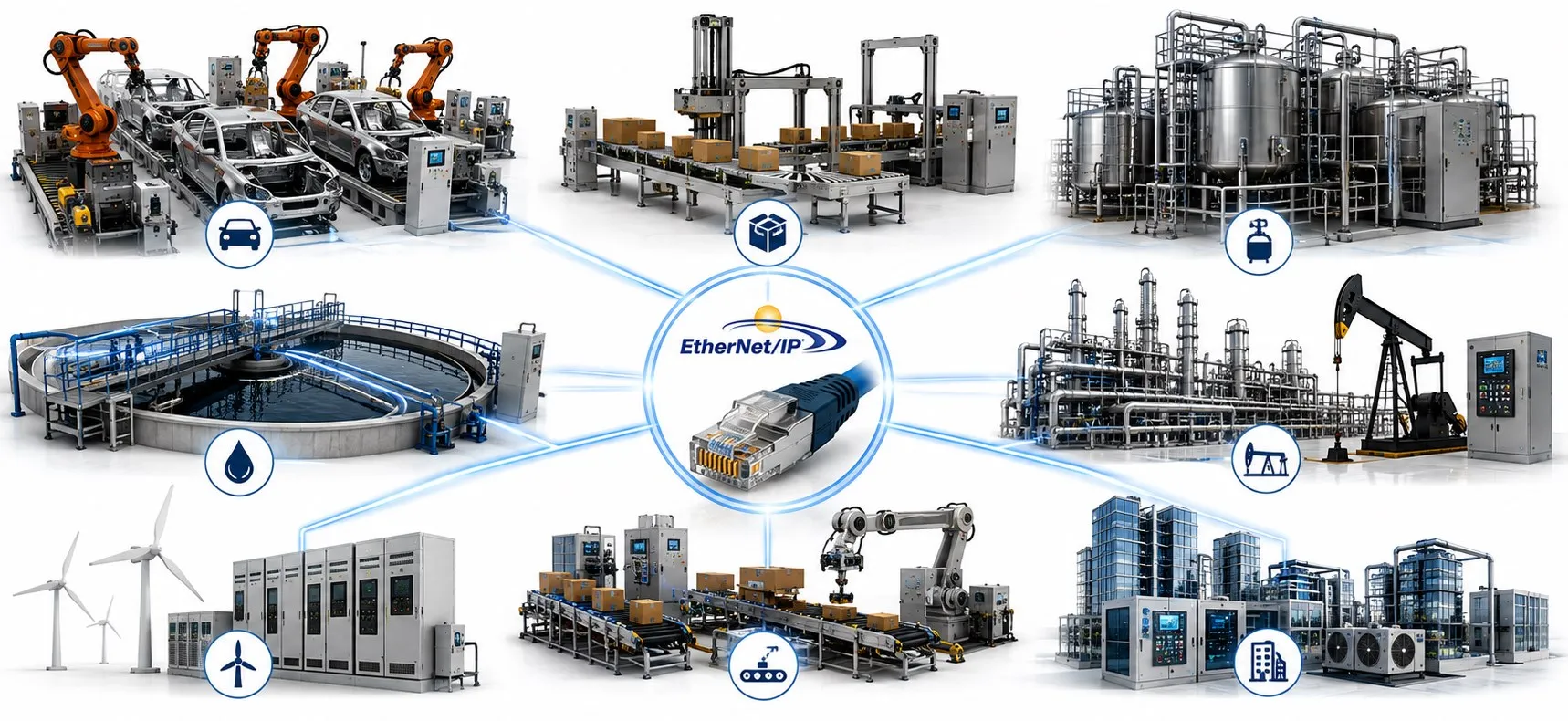
Hello friends, EtherNet/IP can carry control, measurement and status information in discrete manufacturing, packaging, food production, water treatment and process plants. However, devices in the same industry do not necessarily use the same communication system. Understanding EtherNet/IP fundamentals is as important as identifying each device's task and supported interface. Industrial automation implementations range from PLC–I/O exchanges and drive control to valve terminals and production data collection.
Editor's note: Use in an industry does not establish suitability for every device or safety function in that industry. Verify EtherNet/IP device support, scanner/adapter roles, data profiles and environmental requirements together. Even a single product family may offer different communication options.
Discrete manufacturing, assembly and automotive lines
On assembly and production lines handling individual parts, PLC controllers, remote I/O, drives and auxiliary equipment can exchange start commands, ready states, part detection and fault information. For example, an assembly station can detect a correctly positioned part and report completion to the next machine. The communication mechanisms determine which device produces the information and which devices consume it.
Pneumatic valve terminals can join this architecture too. Festo's CTEU-EP interface is a concrete example of EtherNet/IP connectivity for suitable valve terminals and IO-Link devices. Bringing sensors and pneumatic equipment onto the network therefore does not require every component to have its own Ethernet socket.
Packaging, printing and coordinated motion
Packaging machines can coordinate infeed conveyors, product counters, cutting units and labelers. Simple machines may exchange command and status bits, while synchronized axes can require supported services such as CIP Motion and CIP Sync. Matching printing or cutting position to product movement is a more demanding task than transmitting an ordinary speed reference.
An EtherNet/IP label does not make every drive a synchronized servo axis. Verify the controller, drive and software motion capabilities, then assess latency, update intervals and jitter against the application. A robot exchanging ready/start/fault signals with a cell PLC is also performing a different task from direct control of its axes.
Food, beverage and hygienic processes
Filling, mixing and transfer lines can use flow, totalized quantity, temperature and device status for process control. For example, Endress+Hauser offers digital communication options including EtherNet/IP within its hygienic Promag H family. Check the selected flowmeter variant's interface and available data separately.
Communication support is a separate consideration from hygienic design, wetted materials and cleaning conditions. EtherNet/IP support alone does not establish hygienic suitability. Pharmaceutical or similarly controlled production also requires separate consideration of records, traceability and software validation requirements.
Water, wastewater and pumping stations
Pump speeds, flow, level and equipment alarms can be brought together under a PLC or plant monitoring system. Endress+Hauser's Promag W 500 documentation provides a concrete example of an EtherNet/IP option for water and wastewater applications. Variable frequency drives can exchange commands and status through suitable interfaces; ABB's connectivity offering likewise uses different EtherNet/IP adapters depending on the drive type.
At a pumping station, monitor measurement validity and communication status alongside running indications. Pump control, sensor selection and the response to communication loss must be designed separately from the network protocol itself.
Chemical, oil, gas and other process plants
Compatible devices can send process measurements, valve states and equipment diagnostics to the control system. Measurement quality, device profiles and the plant control architecture matter alongside the communication interval. EtherNet/IP does not require every existing field interface to be replaced at once; different interfaces can coexist through suitable system components.
Select cables and connectors for temperature, chemical exposure and physical distance. Where hazardous areas are involved, assess the device and installation protection requirements separately. The protocol name alone does not establish environmental suitability.
Warehouses, distribution and material handling
Conveyors, sorters, palletizers and transfer stations are applications for compatible EtherNet/IP control equipment. Suitable sensors and drives can track product movement within a warehouse. Airport baggage handling or auxiliary port handling equipment can be considered as similar machine tasks; that does not mean every system at a transport facility uses the same protocol.
During network configuration and data mapping, define station-to-station permissives and occupancy information. Do not assume general EtherNet/IP suitability for tasks with separate safety requirements, such as railway signaling.
Energy monitoring and plant utilities
Power, energy and operating-time information from supporting meters and drives can help assess plant performance. CIP Energy provides common energy information and management objects and services in supporting products. It is not implemented in every EtherNet/IP product.
Establishing communication does not itself save energy. When comparing kWh between production periods, account for output quantity, product type and idle operating time. Assess advantages and limitations by separating access to information from the process improvements achieved with it.
Where building automation and HVAC overlap
A factory's fan, pump or auxiliary cooling unit can join an EtherNet/IP network through compatible PLCs and drives. However, building automation and machine automation have different communication requirements. BACnet is a separate protocol designed for building-system communication; BACnet/IP and EtherNet/IP are different protocols.
Check both interfaces and any required gateway support when connecting an existing building management system. The same principle applies to integration with other protocols such as Modbus TCP: shared Ethernet cabling does not imply a shared data model.
Maintenance, machine safety and production information
Diagnostics and maintenance can use device alarms, fault codes, operating hours and supported measurements. These inputs support maintenance decisions; protocol support alone does not create a predictive maintenance system. Trend analysis requires adequate data quality, historical records and a suitable evaluation method.
CIP Safety can provide functional safety communication with suitable safety devices. Cybersecurity capabilities serve a different purpose; assess CIP Security and network-specific security measures separately. Ordinary command exchanges do not establish that a complete machine is safe.
Production counts and downtime information can reach SCADA or supervisory systems through appropriate software, drivers or data-collection layers. EtherNet/IP support does not automatically provide MES, ERP or cloud connectivity; manage access between control and supervisory networks as well.
How should you assess application suitability?
Consider device roles, data profiles, timing, environmental conditions and fault behavior together. Conformance and testing matter, but they do not automatically validate every choice for a particular machine. Network infrastructure is a common transport foundation for these applications; capacity and physical connectivity still require design for long distances or large device counts.
The right choice follows the task's requirements rather than the industry name alone. Basic I/O, synchronized motion, process measurement and production reporting can share a network technology while needing different data and timing arrangements.
Related topics
EtherNet/IP fundamentals
Use in industrial automation
Configuration and commissioning
Diagnostics and fault detection
Ethernet questions
Sources
ODVA: EtherNet/IP and industry coverage
ABB: EtherNet/IP connectivity for drives
Festo: valve terminal and IO-Link device connectivity
Endress+Hauser: Promag H and hygienic processes
Endress+Hauser: Promag W 500 and water applications
ODVA: CIP Motion and time synchronization