
IEC 60269-2
Reading an industrial fuse from its label to its application
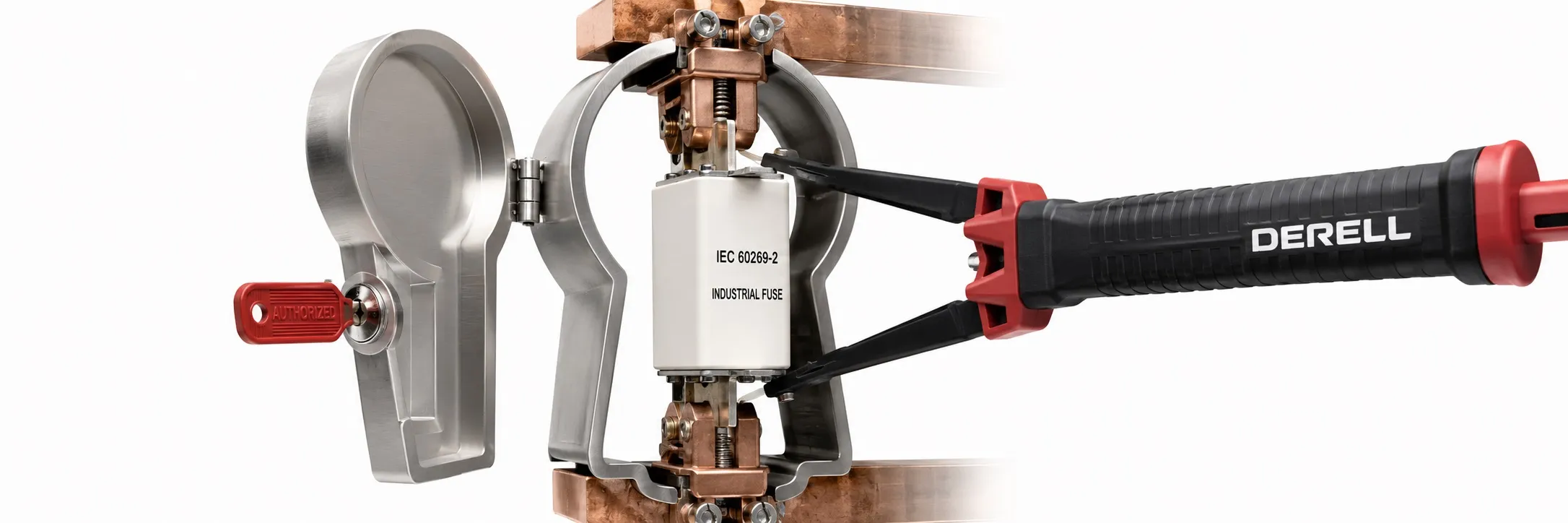
Hello everyone. IEC 60269-2 provides supplementary requirements for low-voltage fuses intended for use by authorized persons, mainly in industrial applications. Factory distribution boards, motor feeders and power distribution in commercial facilities are typical settings. The key distinction is not simply the size of the installation: fuse-links are generally accessible to, and replaceable by, authorized persons only. When assessing industrial fuses, this part is considered together with the general requirements of IEC 60269-1.
The standard does not change the basic fuse operating principle. Alongside the response of the fusible element to overcurrent, it addresses the dimensions, connection arrangements and electrical characteristics of different standardized fuse systems. The description “industrial” does not make these high-voltage fuses.
Editor's note: An aM fuse does not provide complete motor protection on its own. The aM category provides partial-range short-circuit protection for motor circuits; overload protection must be supplied by another suitable device. A gG link and an aM link with the same current rating do not have identical protective characteristics, even if they fit the same holder.
Which edition and amendments should be considered?
In the IEC catalogue check dated 17 October 2026, the consolidated publication is listed as IEC 60269-2:2013+AMD1:2016+AMD2:2024 CSV, edition 5.2. IEC also states that this copy incorporates Corrigendum 1 from June 2025. Referring only to the “2013 edition” can therefore overlook subsequent changes. A corrigendum is a correction; it does not rename the standard “IEC 60269-2:2025.”
Purchasing specifications, test reports and manufacturers' declarations should identify the edition and amendments being used. An older training document may explain the operating principles, but it does not replace the applicable current normative requirements.
The scope extends beyond NH blade-contact fuses
The standard covers standardized fuse systems A to K. These include NH blade-contact arrangements, NH links with strikers, fuse-rails, busbar-mounted bases, bolted connections and cylindrical contact-cap designs. For example, system A concerns NH blade-contact fuses, system E the BS bolted system and system F the NF cylindrical system.
These system letters are different from utilization categories such as gG and aM. A system describes the standardized construction, while a utilization category identifies the breaking range and application. When comparing fuse types, neither the body shape nor the ampere rating alone is sufficient.
What do gG and aM mean?
gG: This is a general-purpose, full-range breaking category, used for overload and short-circuit protection when correctly selected. It is common in cable and feeder protection. However, “full-range” does not mean that the fuse opens instantly whenever current slightly exceeds its rating. Operating time depends on overcurrent magnitude and the product's time-current curve. The fuse current rating must be assessed against both the load and the conductor being protected.
aM: This is a partial-range breaking category for motor circuits. It is not selected to interrupt small, sustained overloads on its own. A suitable overload protective device is also required, and starting current, starting duration and operating frequency must be considered. The codes gG and aM cannot simply be translated as “fast” and “slow.”
Why do holder, size and thermal compatibility matter?
The fuse-link, base or holder and any fuse-switch-disconnector must be assessed together. A link physically fitting a holder does not establish electrical or thermal compatibility. Contact arrangement, size, current rating, voltage, link power dissipation and the holder's acceptable power dissipation must be compatible.
A loose or oxidized contact can cause local overheating even at normal load. Enclosure temperature, adjacent mounting and ventilation may also affect current-carrying capability. When selecting a fuse, follow the manufacturer's installation instructions and any necessary derating requirements, rather than comparing ampere ratings alone.
Separate current rating from breaking capacity
An NH fuse data sheet may list 500 A, 500 V AC and a 120 kA breaking capacity. Here, 500 A is the current rating associated with normal service, while 120 kA concerns fault interruption under specified test and voltage conditions. This example does not mean that every IEC 60269-2 fuse has these ratings.
The installation's prospective short-circuit current must not exceed the selected product's breaking capacity at the applicable voltage. AC and DC ratings are not interchangeable. Current limitation and I²t data also matter. I²t is used to assess the thermal effect of current passing during interruption; asking only “at what amperage does it blow?” does not adequately describe the protection.
Selectivity and a motor-circuit example
Selectivity aims to clear a fault in a downstream circuit with that circuit's own protective device wherever possible. Simply choosing different upstream and downstream fuse ratings does not guarantee selectivity at every fault level. Time-current curves, pre-arcing and total clearing I²t values, and the manufacturer's coordination tables must be considered together.
Example: A motor rated at 30 A does not, by that number alone, determine the correct aM fuse rating. Starting method, starting duration, cable and contactor data, and suitable overload protection must be assessed together. A fuse repeatedly opening during starting does not automatically justify installing a higher-rated link. Investigate possible jamming, prolonged acceleration, incorrect selection or connection problems.
Tests, markings and document checks
IEC 60269-1 and the supplementary rules for the relevant system provide the basis for verifying temperature rise, power dissipation, operating characteristics, breaking capability and applicable construction requirements. Detailed procedures and acceptance limits must be read for the relevant system and product group. Describing the standard only as requiring a “stronger body and better arc suppression” is inadequate.
Check selection information such as manufacturer, type code, current, voltage and utilization category on the product and in its documentation; also verify breaking capacity and characteristic curves. A standard number does not replace an independent certificate or test report. Where such evidence is required, check its product coverage, ratings and referenced edition. A reference to IEC fuse standards alone does not establish automatic acceptance in every country or suitability for every application.
Preserve the protective characteristics when replacing a link
When a fuse needs replacement, check not only amperage but also utilization category, suitable voltage and breaking capacity, system dimensions and holder compatibility. Where an indicator or striker is used, verify compatibility with the associated assembly. Safe fuse replacement requires authorized personnel to isolate energy sources, verify the absence of voltage and follow the equipment instructions. A replaceable link is not necessarily suitable for withdrawal under load.
For semiconductor circuits, also consider the scope of IEC 60269-4 and the protective device specified by the equipment manufacturer. An industrial fuse is not automatically suitable for protecting every drive or power semiconductor.
Related fuse and standards topics
Explore IEC 60269 for the series structure, IEC 60269-3 for the distinction involving use by unskilled persons, semiconductor fast fuses for power electronic circuits, DC fuses for supply-type considerations and fast and slow-blow fuses for operating characteristics.
Consider the other panel components
Relevant topics include contactors for motor switching, thermal overload relays for overload monitoring and thermal-magnetic circuit breakers as a different protective solution. Evaluate cable current-carrying capacity by cross-section when establishing the protected circuit's limits. Grounding is another fundamental topic when assessing fault-current paths and protection against electric shock.
Fuse guidance and the product category
Use which type of fuse to choose, fuse standards and the main fuse product category to explore related explanations and products.