
IEC 60269-1
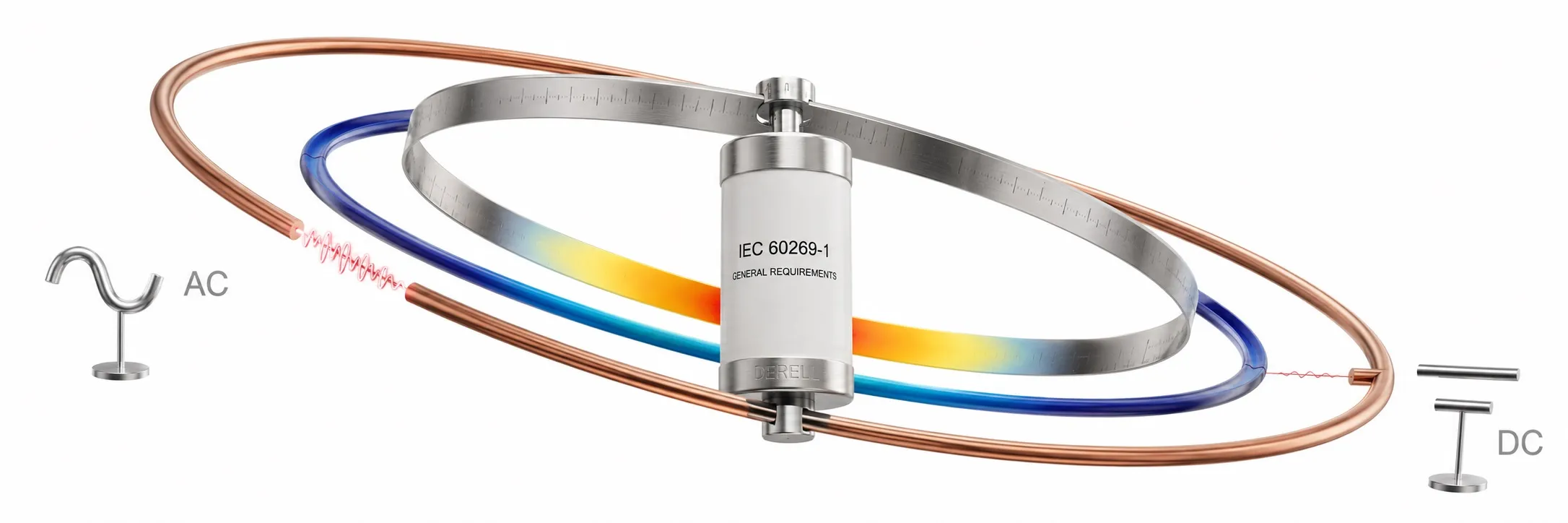
The common foundation for safe interruption in low-voltage fuses
Hello everyone. IEC 60269-1 defines the general requirements of the IEC 60269 series. It explains why assessing a fusible-link fuse involves more than asking about its ampere rating: the product must carry current, interrupt the circuit safely when required and operate correctly with its connections under specified conditions. The central purpose is to define overcurrent protection through comparable characteristics and tests.
Editor's note: Two fuses marked IEC 60269-1 are not automatically interchangeable, even with identical ampere ratings. Check AC/DC suitability, utilization class, breaking capacity, dimensions and the manufacturer's curves together. The voltage limit in the standard's scope does not mean every product can operate at that voltage.
Which fuses fall within its scope?
The IEC's fifth edition, published on 9 August 2024, covers fuses incorporating enclosed current-limiting fuse-links with a rated breaking capacity of at least 6 kA. Its scope includes nominal circuit voltages up to 1,000 V AC at power frequency or 1,500 V DC. These are scope limits; the selected product's own ratings must also suit the application.
The document should therefore not be treated as a common standard for every low-voltage protective device. Miniature fusible-link fuses are covered by the IEC 60127 family. Circuit breakers also have separate standards. For industrial fuses, the general requirements are supplemented by those applying to the particular fuse system and application.
Current, voltage and breaking capacity mean different things
The rated current is a carrying rating under specified conditions, not an instantaneous opening threshold. Actual operating behaviour is assessed using the time-current curve. When determining the fuse current rating, consider initial energisation pulses and duty cycle alongside continuous load current. Fast-acting and time-delay behaviour cannot be identified from the ampere marking alone.
The voltage rating relates to interruption under the specified circuit conditions. Breaking capacity identifies the prospective short-circuit current the fuse can safely interrupt under those conditions. For example, Eaton specifies its 63NHG00B as 63 A, 500 V AC, gG and 120 kA. Its 63 A current rating and 120 kA breaking capacity are not interchangeable quantities. AC ratings do not automatically establish DC suitability for the same product.
Why the distinction between gG and aM matters
gG is a general-purpose, full-range protection class used for overload and short-circuit protection when correctly selected. aM is a partial-range class intended for motor circuits and provides short-circuit protection. An aM fuse requires a separate suitable device for motor overload protection. The contactor, overload protection and fuse must be coordinated as a combination.
Describing equal-rated gG and aM fuses simply as “fast” and “slow” misses the distinction: their protected current ranges and application purposes differ. Semiconductor protection fuses also have specific utilization classes and coordination requirements. Choosing the appropriate fuse type therefore involves more than fitting any cartridge that matches the holder.
What do tests and technical documents establish?
Characteristics addressed by the standard include insulation, normal-service temperature rise, power dissipation, time-current behaviour, breaking capacity and current limitation. Type tests verify these characteristics under defined conditions. Markings support product identification and correct application. A test result does not, however, establish identical performance at every temperature, in every holder or in every circuit.
For purchasing or replacement assessment, examine the complete product reference, data sheet, applicable fuse standards and any relevant conformity documentation together. Finding a standard number in a catalogue does not complete all the application-specific selection checks.
Current limitation, I²t and selectivity
Under sufficiently high short-circuit conditions, a current-limiting fuse can interrupt current before it reaches the prospective peak that would occur without limitation. Both peak let-through current and I2t data matter. I2t is expressed in A2s; it is neither directly an energy value in joules nor simply an opening time. Pre-arcing I2t and total clearing I2t are also different quantities.
Selectivity aims to have the protective device closest to the faulty branch operate first. Comparing upstream and downstream ampere ratings alone may be insufficient; assess curves and the manufacturer's selectivity tables. Fuse-combination units also involve the equipment requirements of IEC 60947-3. A suitable fuse does not automatically establish the suitability of the complete combination.
How it relates to the other parts
IEC 60269-2 addresses supplementary requirements for fuse systems used by authorized persons, mainly in industrial applications. IEC 60269-3 focuses on systems for operation by unskilled persons, mainly in household and similar applications. IEC 60269-4 covers supplementary requirements for fuse-links protecting semiconductor devices. Read the editions and amendments referenced by the applicable part together.
Applying the requirements in panels and installations
Begin fuse selection by identifying the load and the circuit being protected. With variable frequency drives, consider the manufacturer's input-protection requirements; with power supplies, consider energisation current. In UPS systems, selection depends on whether the fuse protects an AC input, bypass or DC power path. A simple calculation based only on power divided by voltage cannot resolve these requirements.
Also check fuseholder condition, connection tightness, conductors and enclosure temperature. If a fuse repeatedly opens, identify the cause before increasing its ampere rating. An operated fusible-link fuse cannot be reused. Preserve equivalent characteristics when assessing a replacement and apply the appropriate safe replacement procedures, including energy isolation.
Related topics
Within the standards family, explore the IEC 60269 framework, IEC 60269-2, IEC 60269-3, IEC 60269-4 and IEC fuse standards. For the wider application, related subjects include fuse-combination switching and isolation devices, contactors, motor drives, power supplies and UPS systems.
Browse products in the fuses category, or explore the technical differences between industrial fuses, semiconductor protection fuses and DC fuses.