
Does geography affect solar vehicle performance?
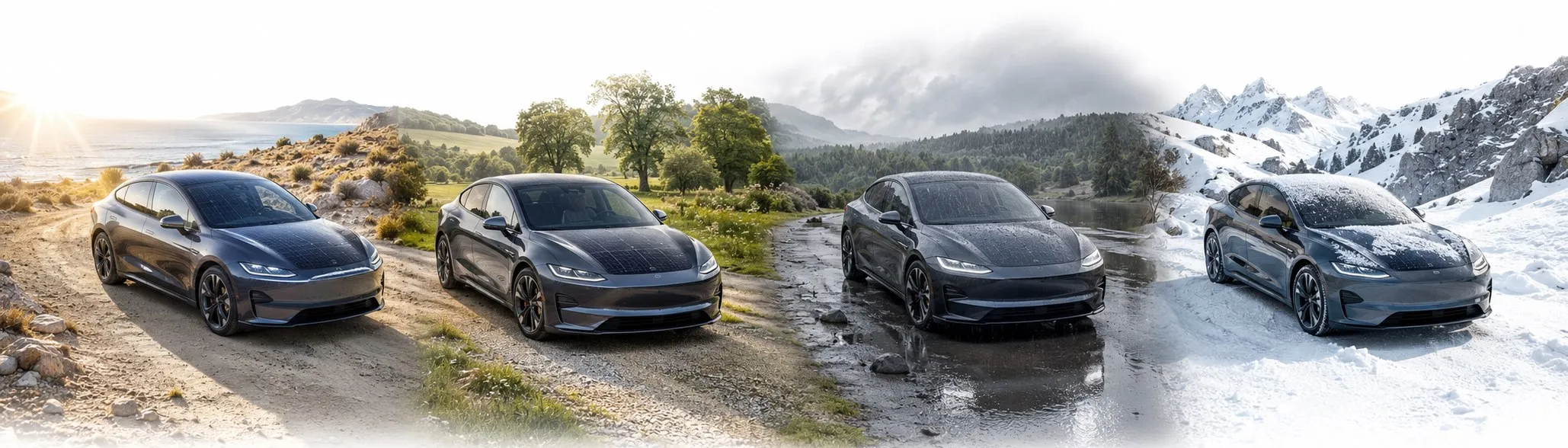
How geography affects solar-assisted vehicles
Geography affects both the electricity solar-assisted vehicles collect and the energy they use on the road. Local weather, terrain and parking habits all shape the result. A charged battery-electric car can travel at night or in rain; sunshine determines the panels' contribution, rather than the availability of stored energy.
Sunlight is not driving range
Start by separating solar output from driving range. Panels collect energy; the car then uses that energy at a rate shaped by speed, terrain, temperature and other demands. Weather conditions affect both processes, sometimes in different ways.
The equator is not automatically the best place for solar generation. Clouds, wet-season weather and local shade can outweigh a location’s latitude. Nor are daylight hours equivalent to peak sun hours: a long day includes periods when sunlight is weak, whereas peak sun hours express the day’s total solar energy as equivalent hours at a standard intensity.
Hot, dry regions
Clear desert skies can offer strong sunlight, but heat and dust complicate the picture. Hot solar panels generally produce less power than cooler panels under the same sunlight, particularly with crystalline silicon cells. Dust can also reduce the light reaching them, making cleaning and maintenance part of the local calculation.
Cooling the cabin uses energy too. That is why vehicle design and how the car is used matter alongside regional sunshine. A high solar yield does not necessarily translate into an equally large increase in driving range.
The humid tropics
Tropical locations can receive abundant sunlight, yet cloud cover and rainy seasons make output uneven. Bright periods may provide useful energy; prolonged overcast weather will provide less. Claims about what solar vehicle technology can deliver should reflect those seasonal patterns. An annual total can also hide months when the panels contribute little.
Northern climates
Long northern summer days provide more time to collect sunlight, but short winter days can sharply reduce the opportunity. Clear, cool weather can favour panel performance. Cold has a different effect on the battery: it can reduce driving range, slow charging and increase the energy needed to heat the cabin and condition the battery. Better panel efficiency in cool air does not guarantee better overall vehicle efficiency. Snow covering the panels can also block the light.
Mountains and cities
Higher elevation does not automatically bring a net gain. Local clouds and mountain shadows still matter. Climbing consumes energy, and regenerative braking recovers only part of it on the way down.
In cities, shade and panel angle can matter more than the regional average. Buildings, trees and covered parking limit collection. These practical barriers to adoption make the car’s usual parking spot worth checking. Access to charging infrastructure remains important for vehicles equipped to charge externally, especially when solar generation is low.
Turning solar energy into extra kilometres
Keep kW and kWh separate: kW describes power, while kWh measures energy. In a hypothetical example, 3 kWh of net solar energy available for driving would support 20 km at a total driving consumption of 15 kWh/100 km. At 20 kWh/100 km, the same energy supports 15 km. These figures illustrate the calculation; they are not measured results or a daily range guarantee.
A stationary rooftop model cannot directly predict output from curved panels on a moving car. Orientation, shade and how solar charging is managed affect what reaches the battery. Assess energy efficiency and financial payback using usable annual energy from the specific vehicle and conditions that resemble your routine.
The regional electricity mix also matters when assessing lifecycle emissions and a vehicle’s carbon footprint. Solar kilometres alone cannot capture the impact of making and using the car.