
How do I identify a water pump failure and what should be done?
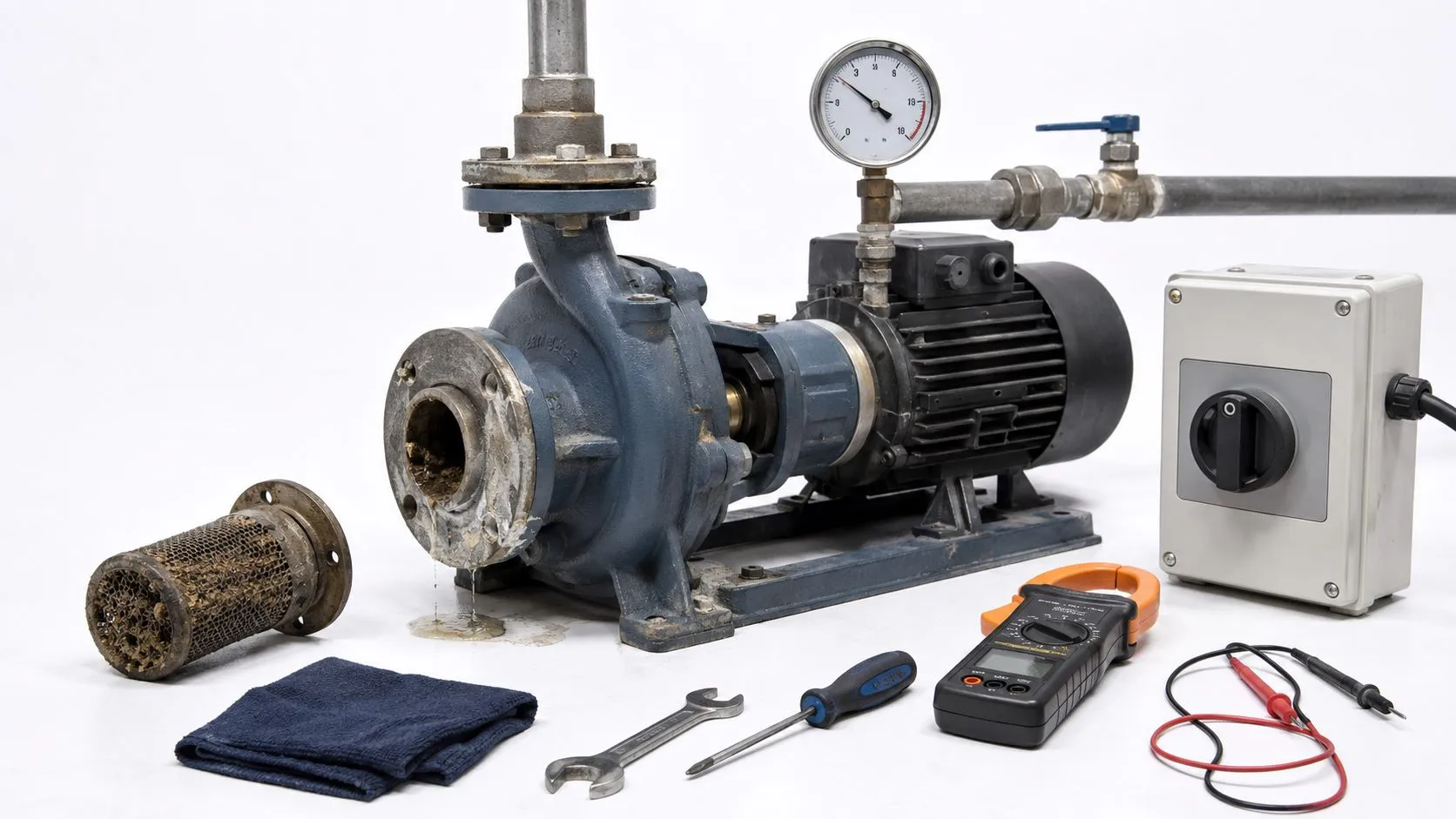
How can you identify a water pump fault, and what should you do?
A water pump fault may appear as failure to start, no water delivery, low flow, loss of pressure, unusual noise, leakage or repeated stopping and restarting. The same symptoms can also come from a blocked pipe, an inadequate water supply or a control problem. A sound diagnosis considers both how the pump works and its main components.
This guide covers domestic water pumps and booster systems, irrigation pumps and industrial water pumping applications. Submersible, surface and booster systems require different checks; a remedy for one pump type should not be applied automatically to another.
When should the pump be stopped immediately?
Stop the pump if there is a burning smell, smoke, severe vibration, metallic rubbing, water reaching electrical connections or repeated protective trips. Disconnect power only from a safe, dry location; do not touch a wet plug, cable or casing. Stay out of water around the pump if there is an electric shock hazard.
A pump that is running dry, or humming without turning, should also be stopped. Fitting a larger fuse, increasing the overload setting or bypassing protection is not a remedy. Maintain the protective earthing and protection required by the equipment. Before intervention, isolate the supply and prevent an unexpected restart; safely release pressure from a pressurised system.
Symptoms and possible causes
1. The pump does not start: Possible causes include loss of power, a protective trip, a missing run command or a control fault. A submersible pump may have a stuck float switch; a booster may have a pressure-switch or electronic-control problem. A liquid level relay and panel contactors may also be part of the operating circuit. A pump with no demand to run may be stopping normally. Record indicators and fault codes; internal panel checks require qualified personnel.
2. The motor hums but does not turn: On capacitor-equipped single-phase models, a faulty capacitor is one possibility. A jammed impeller, low voltage or motor damage can produce similar symptoms. Capacitor condition must be assessed through appropriate testing, rather than the sound alone. On three-phase motors, check for phase loss and the state of the phase protection relay. Never try to turn the impeller by hand with power connected.
3. The motor runs but no water is delivered: The source may be empty, the suction line may admit air, the strainer may be blocked or a check valve may be stuck. Surface centrifugal pumps need the correct priming and venting conditions. With portable pumps, also consider collapsed hoses and leaking suction connections. For submersible models, assess water level, inlet blockage and the discharge line. Stop the pump if there is no delivery and dry running is possible.
4. Water is delivered, but flow or pressure is low: Possible causes include a blocked filter, partly closed valve, pipe leakage, poor suction conditions or impeller wear. Incorrect rotation on three-phase models, or a low speed command on a drive-controlled system, also needs consideration. Pressure on a gauge and the volume flowing from a tap are different measurements. Normal indicated pressure with low flow can point to a restriction downstream of the measuring point.
5. There is gravel-like noise, rubbing or vibration: A gravel-like sound can suggest cavitation. Low local pressure allows vapour bubbles to form in the liquid; their collapse can damage pump components. This differs from air entering through a leaking suction line. Bearing damage, foreign material, loose mountings or misalignment can also increase pump noise. Sound alone does not establish a diagnosis.
6. Water is leaking around the pump: Establish whether the water comes from a fitting, casing joint, pipe or shaft area. On mechanical-seal models, persistent shaft-area leakage may indicate seal damage. However, a puddle beside the pump does not automatically establish seal failure. Pump maintenance should identify the actual source; stop operation if leakage reaches electrical equipment.
7. The booster starts and stops frequently: Investigate small system leaks, a leaking check valve, incorrect tank precharge, diaphragm problems or unsuitable control settings. Whether the system has a pressure tank, and how pump control operates, both matter. Electronic systems may also require checking the pressure sensor reading. There is no universal tank air-pressure setting for every system. Check precharge using the manufacturer's procedure.
8. The pump overheats or trips its overload: Dry running, inadequate cooling, mechanical blockage, excessive load or a supply problem may be responsible. Assess voltage drop in long cables and phase imbalance on three-phase systems where relevant. Pump overheating cannot be diagnosed simply by touching the casing; assess current, temperature and permitted operating conditions. Restarting after cooling does not prove the problem has been resolved.
A safe initial assessment
Identify the equipment first: Record the model, motor power, supply voltage, phase configuration and any drive fault code. Note when the problem began: after a power outage, following maintenance or when the water level dropped? The conditions surrounding the first occurrence are useful diagnostic evidence.
Then assess the water path: Under safe conditions, check source level, visible leakage, valve positions and the external condition of pump accessories. Before removing a filter, strainer or cover, isolate power and release system pressure. Prime a surface pump according to its own manual; do not run it dry as a test.
Record the symptoms: Note available pressure readings, displayed faults, operating time and starting frequency. A recording of noise or leakage, taken from a safe distance, can help the service technician. Repeatedly resetting a protective trip does not explain its cause.
What should a service technician measure?
Electrical checks: Qualified personnel assess voltage under operating conditions, motor current using suitable current-measuring equipment and phase conditions on three-phase systems. Capacitor, winding and insulation tests may be needed. Where a variable frequency drive is installed, review alarm history, speed commands and motor data. Insulation testing must follow a manufacturer-approved procedure that protects connected electronics.
Hydraulic and mechanical checks: Assess flow, inlet and outlet pressure, suction conditions, impeller, bearings and sealing components. Compare measurements with the pump curve at the actual operating point. For a pressure-control problem, verify the sensor and pipework before changing PID settings. Control tuning cannot repair a blocked pipe or a leaking suction line.
Repair or replace the pump?
Repair may be sensible when the fault can be resolved with a hose, seal, control component or suitable spare part. If the motor, impeller and casing are all seriously damaged, compare repair and replacement costs. Consider the pump's age and operating history, spare-part availability and downtime costs. Not every fault requires a complete replacement.
After repair, verify leakage, operating current, pressure, flow and protective functions under appropriate conditions. Address the underlying cause as well: replacing a seal alone will not provide a lasting remedy if dry running continues.
Reducing the risk of further faults
Water-level monitoring, clean filters, suitable suction pipework, correct protection settings and the manufacturer's maintenance schedule are basic preventive measures. Recording normal flow, pressure and current helps reveal later changes. Eliminating unnecessary starts can also help reduce energy consumption. Lasting energy efficiency requires considering the pump and system together.
This article provides general fault-assessment guidance. For a specific pump, safe inspection and repair must follow its manufacturer's manual, operating limits and protection requirements.
Technical sources: Honda: pump troubleshooting · Grundfos: frequent starting and stopping · Xylem: cavitation · Tsurumi: electrical safety and inspection instructions.