
IEC 60068-2-78:2025 Steady-State Damp Heat Test — Test Cab
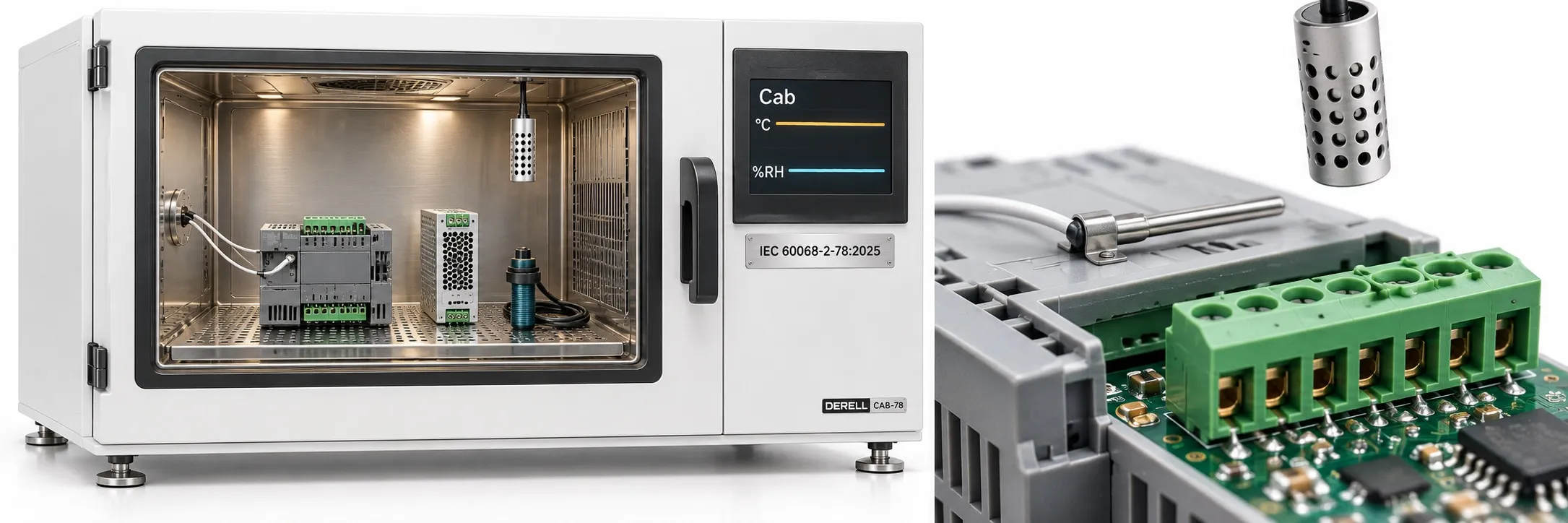
Testing humidity resistance without wetting the specimen
IEC 60068-2-78:2025 defines Test Cab: exposure to high relative humidity at constant temperature, with no condensation on the specimen. It assesses components and equipment for humid conditions during transport, storage and use. This method belongs to the IEC 60068 environmental testing family.
What changed in the current edition?
The third edition, published on 6 August 2025, replaces the 2012 edition. Changes cover chamber requirements, severities, temperature limits, dew-point information, a defined preconditioning procedure and reporting. When comparing reports, check the edition actually used. An earlier test does not automatically demonstrate that the revised procedure was followed.
Why a dry-looking product can still need humidity testing
High humidity is a property of the air; condensation occurs when conditions at a surface allow water vapour to become liquid. Relative humidity depends on temperature, so the air reading and the specimen temperature belong together. A humidity sensor does not establish the temperature of a cold enclosure. A separate temperature measurement may be needed to understand that surface.
Illustrative calculation: Air held at exactly 40 °C and 93% RH has a dew point of approximately 38.6 °C. Put a 25 °C metal housing into that air and condensation becomes a concern. Once its surface reaches 40 °C, it sits above the dew point for those fixed air conditions. This explains the physics; it is not a complete conformity check.
| Surface | Relation to the dew point |
|---|---|
| 25 °C | Below 38.6 °C; condensation is a risk. |
| 40 °C | Above 38.6 °C; condensation is not expected under the stated fixed conditions. |
Specify the exposure before starting the chamber
Temperature, relative humidity and duration define the severity together. As one example, Method IV uses 38–42 °C and 90–96% RH. These are not universal settings for every product. Unless otherwise specified, preconditioning takes place at the selected test temperature, at 30% RH or less for 24 hours; more time is needed if the specimen has not warmed sufficiently. Use the complete standard and product specification to establish transitions and measurement stages.
The chamber display cannot describe every point around a specimen. Chamber performance confirmation, loading and airflow all matter. A Pt100 measuring air and a probe attached to a housing serve different purposes. Consider the choice between an RTD and a thermocouple for the intended measurement. PID humidity control helps regulate a process; reliable exposure evidence also requires suitable measurements and records.
Turn “passed” into a measurable statement
Practical assessment example: For a PLC or smart relay, a test plan might track unintended restarts, lost communication or unexpected output changes. For a sensor, it might track measurement drift or detection stability. An inductive sensor and a capacitive sensor need checks appropriate to their own functions. These examples are engineering choices for a test plan, not a mandatory checklist imposed on every product.
Operating throughout an exposure and working again after recovery are different claims. Record the power state, load, measurement times and recovery conditions. Decide the acceptance limits before reviewing the results. An enclosure that looks undamaged may still contain a device whose measurement performance has changed. Test hours alone also provide no direct conversion into years of field service.
Keep IP protection and damp heat evidence separate
An IP rating describes enclosure protection against solid objects and water ingress. A declaration of IP65/IP66 or IP67 does not establish resistance to every humidity exposure. Test Cab maintains non-condensing conditions. Cyclic damp heat combines changing temperature with high humidity and generally produces surface condensation. Substituting one method for another changes what the evidence means.
When reviewing a supplier’s report: identify the specimen and hardware version, standard edition, chosen method, actual climatic records, exposure duration and power state. Then match the measured results to the agreed limits. A bare “IEC 60068 compliant” statement leaves too much unanswered for a meaningful comparison.
Related reading
References and sources
IEC 60068-2-78:2025 — scope, edition and technical changes
IEC publication sample — exposure conditions and preconditioning
IEC 60068-2-30:2025 — scope of cyclic damp heat testing
Vaisala — humidity measurement in test chambers
Sources checked: 11 October 2026. This explanation supports reading test evidence; laboratory work requires the complete applicable standard and product specification.