
UL 60947-4-1
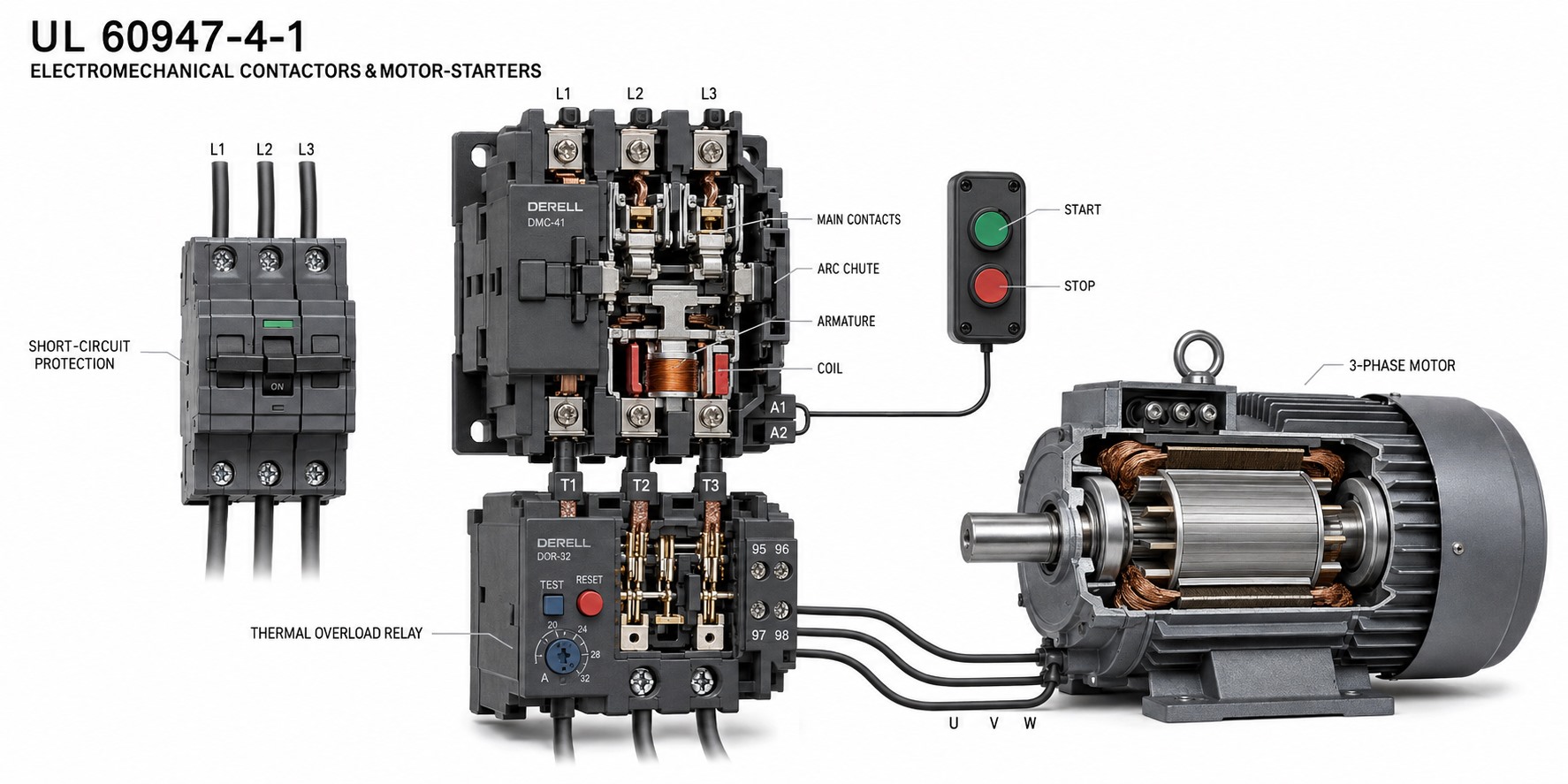
Coordinating switching and protection in motor circuits
In a motor circuit, a contactor switches the supply in response to a control command. UL 60947-4-1 addresses product requirements for electromechanical contactors and motor starters. Selection involves more than an ampere rating: load characteristics, operating voltage, switching frequency and compatibility with protective devices all matter.
How do the UL and IEC documents differ?
UL 60947-4-1 adopts IEC text with US national differences. The official catalogue lists the fourth edition, revised on May 29, 2026. Within the IEC standards system, IEC 60947-4-1:2023 is the fifth edition and includes a March 2026 correction. A matching part number does not establish the same edition or certification requirements.
The scope extends to 1000 V AC and 1500 V DC. These limits do not establish the ratings of an individual contactor; its own marked ratings apply. US installations must also account for NEC requirements. When reviewing a UL 60947 family document, match the complete standard designation and edition to the product's certification scope.
Editor's note: A UL 60947-4-1 marking does not establish that a contactor alone provides overload, short-circuit and phase-loss protection. Protection depends on the selected equipment and circuit arrangement. An opening command to the contactor does not, by itself, establish safe isolation for maintenance.
Contactors, overload relays and short-circuit protection
A thermal or electronic overload relay is selected for the motor's rated current and operating conditions. When it detects an overload, it can cause the contactor to open through the control circuit. Short-circuit protection requires a suitable fuse or circuit breaker. Ordinary contactors and starters covered by the standard are not normally designed to interrupt short-circuit current themselves.
The monitoring functions of a phase-protection relay differ from motor overload protection. Check the product documentation for phase sequence, voltage imbalance and phase-loss functions. The presence of a thermal-magnetic circuit breaker alone does not demonstrate that every motor-protection requirement has been met.
Why do AC-1, AC-3 and AC-4 ratings matter?
AC-1 concerns non-inductive or slightly inductive loads. AC-3 concerns starting squirrel-cage motors and switching them off while running normally. AC-4 covers more demanding duties such as inching and plugging. The permissible current or motor power of the same contactor can differ between categories.
For example, a pump's normal start-and-stop duty differs from repeatedly jogging a mechanism. A high current rating for a resistive load cannot simply be applied to a motor load of the same current. For North American selection, also check the specified horsepower, voltage and number of phases. DC loads require their own DC switching ratings.
SCCR and short-circuit coordination
SCCR is the short-circuit current rating, not the normal operating current or a circuit breaker's interrupting rating. A high SCCR can depend on a specified fuse class, breaker model, maximum protective-device rating and operating voltage. Compare the installation's available fault current with the applicable SCCR. Knowing the circuit-breaker standard does not replace checking the equipment combination.
Type 1 coordination can require repair or replacement of the contactor or starter after a short circuit. Type 2 coordination provides for further use under the specified conditions; light contact welding may be permitted if the contacts can be easily separated. Type 2 does not authorize restarting after a fault without inspection. The assessment applies to the specified combination with its protective device, rather than to the contactor alone.
Coil voltage and main-circuit voltage are separate
A suitably rated contactor switching a 400 V AC motor circuit can have a 24 V DC coil. Main-contact load ratings and the coil's control supply are selected separately. Check AC/DC compatibility, frequency for an AC coil and the permitted voltage range. The power supply and control output must meet the coil's pickup and holding requirements.
Auxiliary contacts can support interlocking and status indication; their load ratings must not be assumed to match the main contacts. Start and stop pushbuttons and controller outputs must also suit the control circuit. In a reversing starter, for example, mechanical and electrical interlocking are designed to prevent unintended simultaneous closure of both contactors.
Isolation, endurance and enclosure conditions
An open contactor does not automatically provide the lockable disconnecting function needed for maintenance. Select appropriate switching and disconnecting equipment and separately verify the conditions for work with the circuit de-energized. A component's compliance with its product standard does not certify every safety function of the complete panel or machine.
Mechanical endurance and electrical endurance under load are different. Contacts wear over time; frequent switching and demanding load duty affect service life. Assess enclosure temperature, mounting clearances, conductor size, terminal torque and enclosure conditions against the manufacturer's instructions. Compliance of an open-type device does not make it suitable for unprotected use in every dusty or damp environment.
What should the product documentation establish?
Review the complete model code, utilization category, rated voltage and current, motor power, coil supply, overload setting and short-circuit combination together. Where older catalogues reference UL 508, account for the applicable product category's transition to UL 60947-4-1 and use the current certification record. A general description displaying only a standard number does not establish all these selection details.
Related standards topics: UL 60947-1 general rules, IEC 60947-4-1 contactors and starters, UL 60947-5-1 control-circuit devices, IEC 60947-4-2 semiconductor motor control and UL 60947-7-1 terminal blocks.
Related products and applications: Consider contactors, overload relays, fuses, phase protection and control power supplies alongside the motor circuit's switching, protection and supply requirements.
Sources and technical references
UL Standards & Engagement: scope, national differences and revision record
IEC: IEC 60947-4-1:2023 and its 2026 correction
Schneider Electric: contactor utilization categories
ABB: motor protection and Type 1 / Type 2 coordination
Eaton: product example of coil, motor-load and conditional SCCR ratings
UL Solutions: transition from UL 508 for industrial control equipment