
What role do real-time operating systems (RTOS) play in Servo systems?
Keeping motion commands on schedule
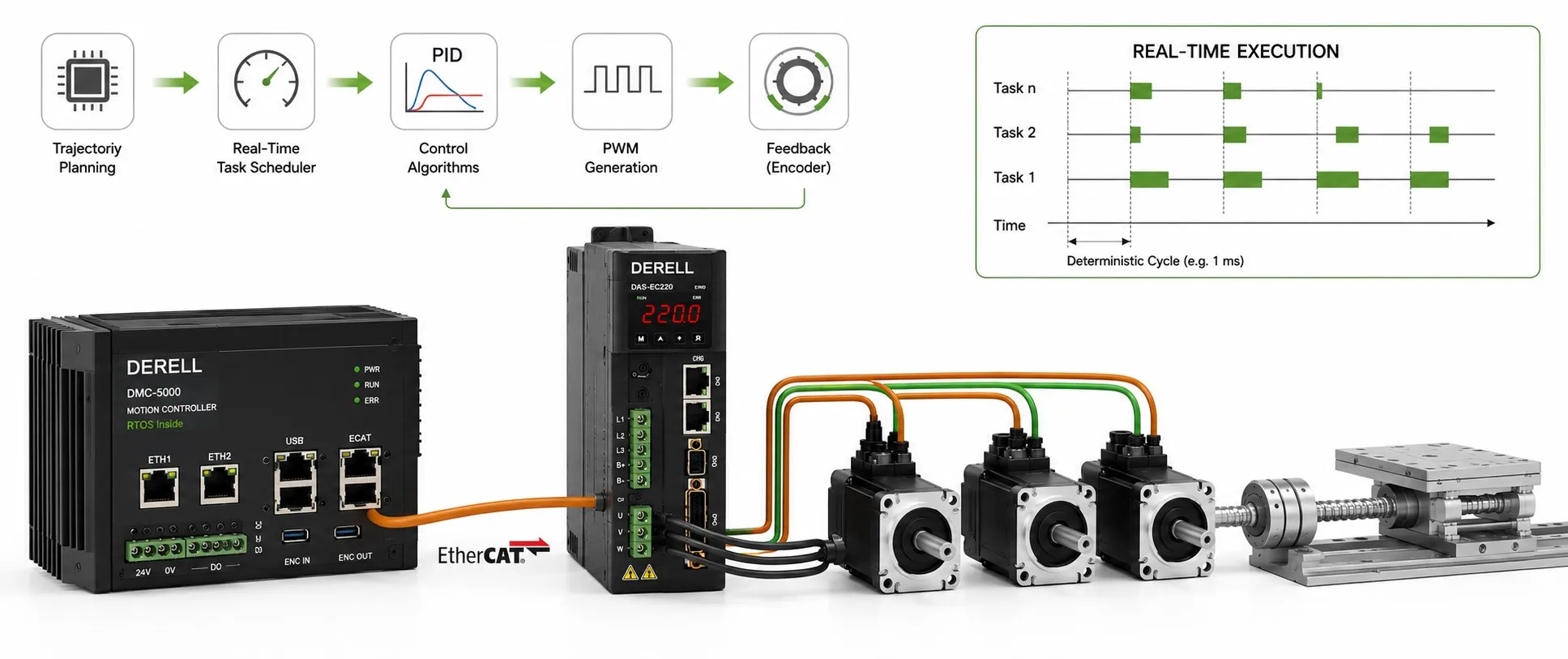
A servo system needs a sound control calculation and a predictable delivery time. A real-time operating system (RTOS) schedules processor work so time-critical results can be ready before their deadlines. “Real-time” describes a timing requirement, not simply a fast computer. Meeting that requirement depends on the application, hardware and communication path as well as the operating system.
What does the RTOS actually schedule?
A control task may collect feedback, calculate the next command and update outputs. Its cycle period is the interval between repetitions; its execution time is the processor time needed to do the work. The deadline sets when the result must be available and need not always equal the cycle period. Latency is the delay from an event to a response. Jitter is variation in that timing.
For speed, torque and position control, a scheduler can give critical work priority over display updates and logging. With preemptive priority scheduling, a ready higher-priority task can interrupt lower-priority work. The RTOS supplies execution services; it does not choose the gains or design the PID controller. A stable schedule and a suitable control algorithm are separate requirements.
Where the control loops run matters
The current loop for a servo motor normally runs inside the servo drive; the velocity loop commonly does too. The position loop can reside in the drive or the motion controller, depending on the operating mode. An upper-level controller may handle axis control, trajectory generation and interpolation. Fast inner loops may use interrupt-driven code, a DSP or an FPGA rather than ordinary RTOS tasks.
An RTOS is not mandatory for every servo. A carefully designed bare-metal system can also meet timing requirements. A computer with a real-time extension can be another valid architecture. When selecting a motor and drive, assess the controller by its timing performance under the intended workload, rather than treating an operating-system label as proof of deterministic operation.
Why a small timing variation can matter
Irregular updates to speed and torque commands can disturb the sampling assumptions used by a control loop. To put timing into perspective, an axis moving at 1 m/s travels 0.04 mm in 40 µs. This is a distance-over-time example, not a prediction of servo following error. Drive interpolation, feedback processing and mechanics all influence the actual response.
An encoder measurement also needs a known sampling instant and an acceptable data age. Combining measurements taken at different times as though they were simultaneous can affect velocity estimates. Consistent timing supports dynamic models and high dynamic performance. Signal filtering can reduce unwanted signal components, but it cannot make a late sample arrive on time.
Scheduling and clock synchronization solve different problems
Coordinated multi-axis motion requires axes to share a meaningful time reference. EtherCAT Distributed Clocks synchronizes device clocks so sampling and output events can follow that reference. The RTOS helps prepare command data in time. A shared clock does not rescue a late command: the telegram still has to arrive before the scheduled output event. That distinction matters in electronic gearing as well as other coordinated motion.
High priority does not remove every source of delay
A high-priority task can still wait for a file operation, network reply or locked resource. Priority inversion can occur when critical work needs a lock held by a lower-priority task. Priority inheritance helps address this case, but does not eliminate all blocking. Keep interrupt handlers short, bound resource waits and move logging away from the critical control path. Check worst-case execution and blocking rather than relying on average processor load.
What should commissioning demonstrate?
During drive and controller configuration, test with the actual axis count, communication traffic, display activity and logging enabled. Record maximum execution time, maximum jitter, missed deadlines and end-to-end latency, including the age of feedback and commands. Define the response to an exceeded timing limit through appropriate monitoring and timeout handling.
Compare the results with the required precision and accuracy. Consistent scheduling cannot compensate for unsuitable load and transmission sizing or poor servo tuning. Keep a commissioning baseline: during maintenance, it can help distinguish the effect of a software or workload change from a mechanical problem.