
Electronic Fuses
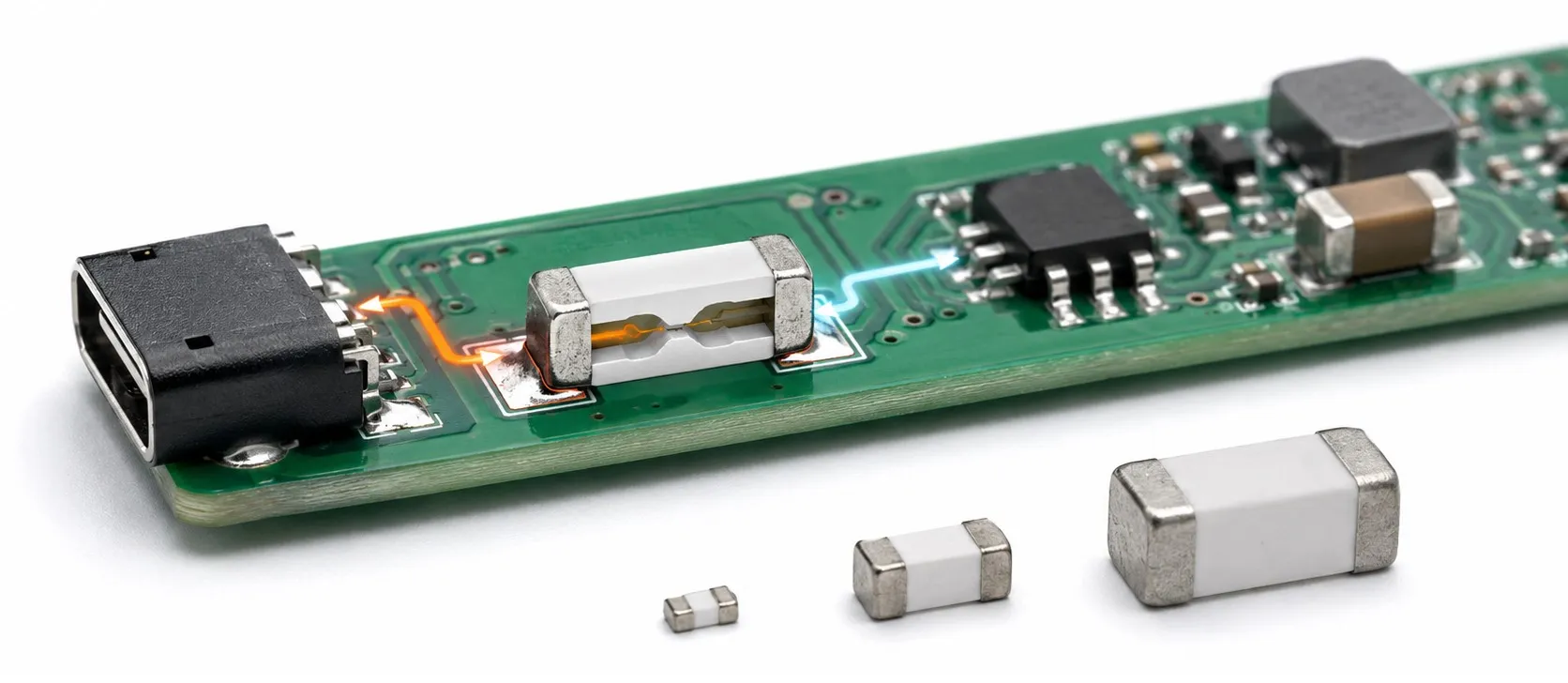
Fuses for electronic circuits provide overcurrent protection at power supply inputs and on circuit board power rails. Glass or ceramic cartridge, leaded and SMD types differ in package size, mounting method and operating characteristic. Suitability depends on matching the circuit requirements to the product’s technical data sheet.
Fuse types and how they differ
Fusible-element fuses must be replaced after operating. Fast-acting and time-delay fuses have different time–current characteristics. Brief pulses, such as the initial charging current of a power supply input capacitor, matter when selecting a fuse; compare the required pulse withstand capability with the manufacturer’s curves.
Resettable PPTC fuses increase their resistance during an overcurrent event to limit current; they do not behave like a fuse that opens the circuit. Returning to a low-resistance state depends on fault removal and cooling conditions. An active eFuse is an electronic protection circuit; its functions and restart behaviour depend on the model.
DC fuses must be assessed for the interruption conditions of the DC circuit. When selecting semiconductor protection fuses for power electronics, check the I²t rating against the protected component’s withstand capability; the word “fast” alone is insufficient. Thermal fuses respond to temperature and should not be treated as direct replacements for overcurrent fuses.
Choosing a fuse for electronics
Rated current: Consider normal load current, startup pulses and the manufacturer’s operating conditions together; a fuse does not open immediately when its current rating is exceeded. Voltage and AC/DC suitability: The documented voltage rating must cover the maximum circuit voltage; check AC and DC ratings separately.
Operating characteristic: Select a fast-acting or time-delay type using the manufacturer’s time–current curve and pulse withstand data. Breaking capacity: This is the fault current the fuse can safely interrupt at the specified voltage; it must cover the prospective short-circuit current.
Dimensions and mounting: Check cartridge size, lead spacing, SMD package and fuseholder compatibility. SMD describes a mounting format; it does not, by itself, specify operating speed or reset behaviour. Operating temperature: Account for the temperature inside the equipment, nearby heat-producing components and the manufacturer’s current derating curve; one correction factor does not apply to every series.
Compare fuse models and check price, availability and sales terms in the relevant product listing. If the required option is not shown, give the relevant seller the original part number or a legible marking photo, together with the circuit voltage, AC/DC type, normal current, startup pulse and package dimensions.
Selection guides
Which type of fuse should I choose? · Fuse types and operating principles · Fuse standards
Complementary product categories
Explore power supplies and DIN rail power supplies for the supply side, plus PLCs and modules, sensors, relays and sockets and solid-state relays for control and field circuits. Select protection for each circuit separately using the relevant equipment manufacturer’s data.