
Does amperage change over time?
Does amperage change over time?
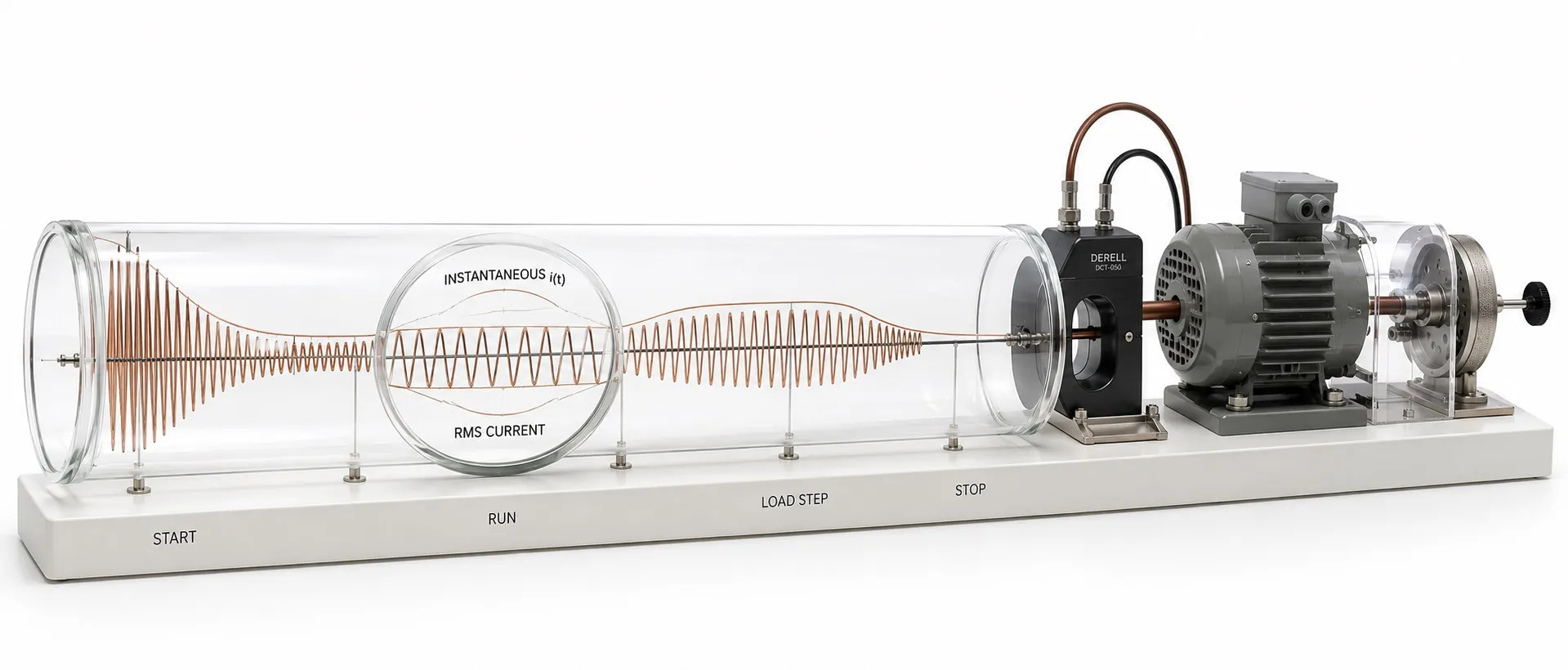
A motor can draw a brief starting surge and then settle to a lower running current. A regulated source can hold current nearly constant. Both are normal behaviors. Current can change with time, but it does not always have to. The ampere is the unit; electric current is the physical quantity being measured.
Before diagnosing a fluctuating reading, identify what the instrument reports and what the load is doing. A changing number is not a fault diagnosis by itself. Duration, operating state and the event that triggered the change matter.
A steady display can hide a changing waveform
Instantaneous, average, peak and RMS current answer different questions. A multimeter can display a steady RMS value while current varies throughout every cycle. A negative current indication can simply reflect the measurement reference direction. Select the quantity relevant to the effect of current you are assessing.
A 50 Hz sine wave completes one cycle in 20 ms. With a 2 A peak and no DC component, its RMS current is about 1.41 A and its full-cycle average is zero. Zero average does not mean zero heating. RMS current describes the equivalent heating effect in a resistance.
The measurement method must suit the waveform and timing. True RMS helps with distorted waveforms, within the instrument's bandwidth, crest-factor and mode limits. A brief starting surge may be missed by an ordinary display update. An appropriate inrush function or recording system may be needed.
DC does not necessarily mean constant magnitude
Direct current retains its direction, but its magnitude can vary. Pulsating current can remain unidirectional throughout. Alternating current changes direction and need not be a perfect sine wave. Direction and steadiness are separate waveform properties.
The load determines how voltage changes affect current
For a fixed ohmic resistance, I = V/R. A 12 Ω resistor draws 1 A at 12 V and 2 A at 24 V. Here, increasing voltage increases current. This is not a universal model for every electronic load. The voltage–current distinction needs to be paired with an understanding of the device.
An ideal DC load maintaining 24 W would instead draw 2 A at 12 V and 1 A at 24 V. Real devices add efficiency losses and operating limits. The relationship between voltage and power explains this behavior. A constant-current controller can hold current steady as voltage changes within its regulation range.
Temperature adds another dependency. Many metal conductors become more resistive as they warm, reducing current under fixed voltage. Semiconductor devices and temperature-sensitive components may behave differently. The direction of a thermal current change depends on the circuit.
Starting, switching and charging create time-dependent behavior
A motor starting, a load switching on or a capacitor charging can produce a transient current. In an ideal series RC circuit, charging an initially uncharged capacitor produces a current that decays over time. An inductor also influences how quickly current changes. Stored energy affects the transition between operating states.
Diodes and switching devices can conduct in pulses. A smooth supply voltage therefore does not guarantee smooth current. During battery charging, current can change between charging stages. A device's rated amperage should not be treated as a reading that must appear at every instant.