
CSA Standards for Fuses
Where does selecting the right fuse standard begin?
Hello, friends. A CSA standard reference or certification mark on a fuse does not establish suitability for every application. Start with the purpose of the protected circuit, then check the fuse class and ratings, followed by the holder and certification conditions. The fuse, its holder and the completed panel are separate assessment subjects.
Editor's note: C22.2 No. 142 concerns process control equipment, not fuseholders. No. 39 addresses fuseholder assemblies, while No. 106 addresses particular HRC fuses. “Small-bodied fuse” does not, by itself, identify a standard class. The standard reference must match the product's actual function.
The 248 series: requirements for the fuse itself
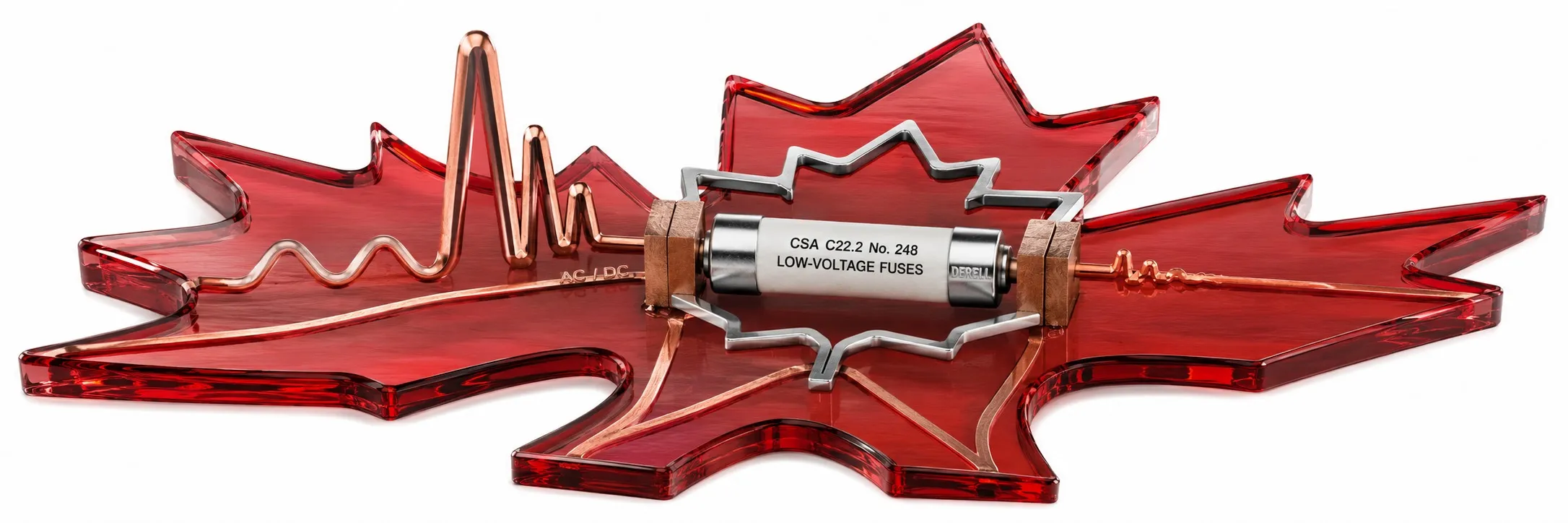
The CSA C22.2 No. 248 series contains general and class-specific requirements for low-voltage fuses. Part 248.1 provides the general requirements, which the relevant subsequent part supplements or modifies. Classes such as CC, J and R, semiconductor fuses and supplemental fuses are not assessed for identical duties. Read the general part together with the correct product part.
The general scope of 248.1:22 specifies fuses rated 1000 V or less, AC and/or DC, with interrupting ratings up to 300 kA; the stated limit for Mexico is 200 kA. Describing the entire series as applying only up to 750 V is therefore incorrect. The class-specific part and individual product ratings must also be checked. This scope does not give every fuse a 1000 V or 300 kA rating.
This family is harmonized with UL 248-1 and the relevant ANCE standards. A shared technical text does not automatically grant every national approval to a product. IEC 60269 is a different framework. For example, when assessing semiconductor fuses under IEC 60269-4, verify the CSA or UL approval from the product documentation.
The 4248 series and No. 39: separate holder requirements
C22.2 No. 4248.1 addresses general fuseholder requirements and is used with the appropriate class-specific part. C22.2 No. 39 applies to fuseholder assemblies and accessories within its own scope. Describing No. 39 as a standard for small fuses is incorrect.
The holder must match the permitted fuse class, voltage, current, connection arrangement and conditions of use. A fuse physically fitting into a holder is insufficient. Contact surfaces, conductor connections and tightening requirements also matter. A holder's ability to carry a fuse does not establish that it is suitable for making or breaking normal load current.
No. 106: particular HRC fuses
C22.2 No. 106 is titled HRC-Miscellaneous fuses and covers HRCI-MISC and HRCII-MISC types. This does not mean every HRC product falls under the same standard, or that No. 106 is the general standard for Classes H and K. Read the HRC designation, form or class information and certified standard together.
Supplemental fuses do not replace branch-circuit protection
Supplemental fuses under 248.14 cover supplementary overcurrent protection applications rated 60 A or less; they are not intended for branch-circuit or equivalent applications. A fuse protecting a circuit board or an internal subcircuit may perform a different duty from a device protecting an installation's outgoing circuit. Similar body dimensions and ampere ratings do not establish equivalent protection duties.
Which ratings must be considered together?
Current rating and interrupting rating: Selecting amperes for the load and safely interrupting the available short-circuit current are different matters. Two products marked 32 A can have different interrupting ratings and protection characteristics. Ambient temperature and starting current also affect selection.
AC/DC voltage: An AC rating cannot simply be applied to DC. Time-current curves and I²t: Withstanding normal inrush, clearing faults and achieving selectivity between upstream and downstream devices must be considered together. Pre-arcing and total clearing I²t are different values. Fuse selection requires more than an ampere rating; the manufacturer's specified protection arrangement becomes particularly important in high-power applications.
Panel SCCR: Installing a fuse with a high interrupting rating does not automatically give the panel the same SCCR. In an industrial control panel, components, protection arrangements and permitted combinations are assessed at panel level.
A practical comparison
Imagine replacing the selected fuse for a panel's outgoing branch circuit with a supplemental fuse intended for internal equipment protection, both having the same ampere rating. The amperes remain unchanged, but the protection duty may differ. An unsuitable holder, incorrect AC/DC rating or inadequate interrupting capacity would add further problems. Checking only for a CSA reference is insufficient. Compare the complete model, class, electrical ratings and conditions of use.
Standard references, product certification and maintenance
A standard defines technical requirements. A certificate or listing record identifies the particular model and conditions evaluated. Check the country covered by the product mark, the complete model code and the certification scope. A standard number printed in a catalogue does not, by itself, establish certification of that model.
When a fuse opens repeatedly, investigate the cause first. For replacement, use a suitable replacement product and follow the manufacturer's safety instructions. Holder and connection maintenance also matters: increasing the fuse's ampere rating does not correct heating caused by a loose contact.
Related topics
Sources
CSA / ANSI: C22.2 No. 248.1:22, general fuse requirements and scope
CSA / ANSI: C22.2 No. 4248.1:22, fuseholders
CSA / ANSI: C22.2 No. 39, fuseholder assemblies and scope distinctions
CSA / ANSI: C22.2 No. 106, HRC-Miscellaneous fuses
ULSE: UL 248-14, limits on supplemental fuse applications
CSA Group: the process control equipment context of No. 142
Eaton: fuse ratings, AC/DC suitability and selection