
Types crane
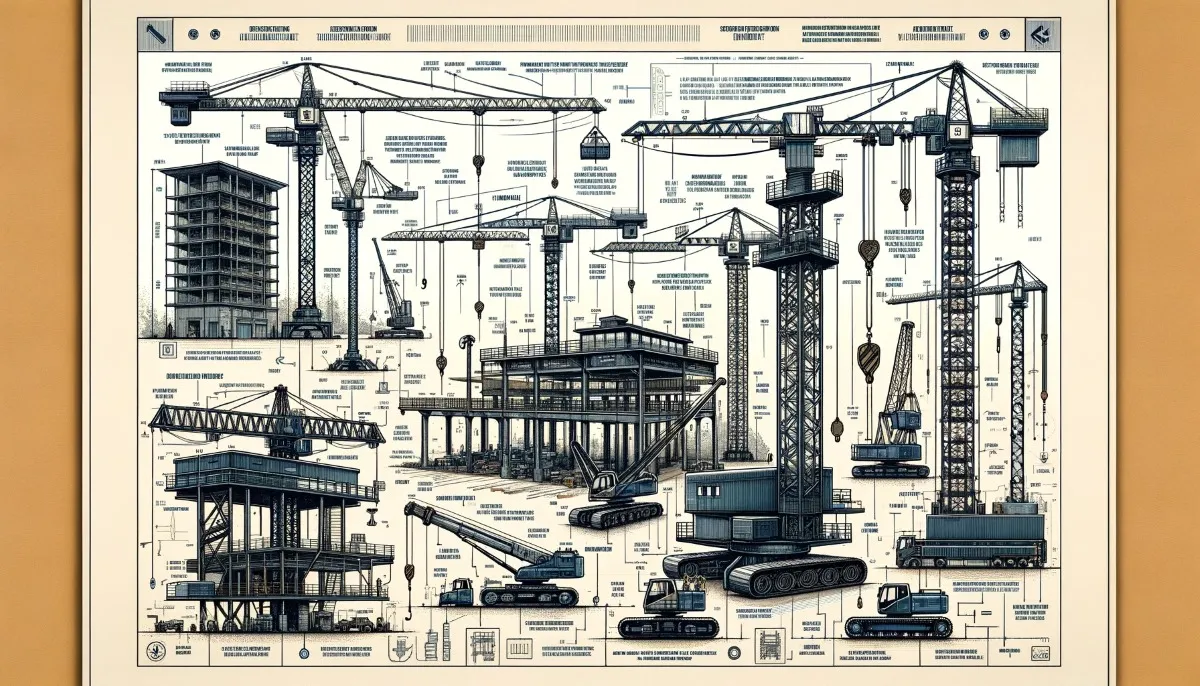
Choosing the lifting arrangement for the working area
A crane is defined by more than the weight it can lift. Its supporting structure, boom or bridge arrangement, working envelope and operating environment also matter. An overhead crane moving loads around a factory and a mobile crane travelling between sites serve different needs, even with the same rated capacity.
Editor’s note: These names are not always mutually exclusive. Telescopic describes the boom, while crawler describes the undercarriage; one machine can be a telescopic crawler crane. The maximum tonnage on a nameplate does not apply at every position, particularly for boom cranes. Actual lifting capacity must be assessed from the manufacturer’s load chart for the configuration and operating radius involved.
Tower crane
A vertical tower and rotating jib serve tall buildings and extensive construction sites. On horizontal-jib designs, a trolley travelling along the jib changes the hook’s reach; this is not a personnel basket. A luffing-jib design changes the jib angle to adjust its working radius. Foundations, anchorage and any required ties to the building are determined by the crane’s engineered arrangement.
Mobile crane
This is a broad group of cranes that can be relocated between working areas. Truck-mounted and purpose-built wheeled machines are used for machinery placement, steel erection and maintenance. Setup space, outrigger deployment and transport access matter alongside capacity. Being able to travel on a road does not mean the crane can travel with a suspended load.
Telescopic-boom crane
Nested boom sections extend and retract to change reach. The boom can be mounted on a wheeled or tracked carrier, so telescopic and mobile are not necessarily opposing categories. This arrangement suits work requiring variable reach and relatively quick setup. Boom length, boom angle and operating radius all form part of the capacity assessment.
Crawler crane
A tracked undercarriage supports either a lattice or telescopic boom. Major assembly work, energy projects and longer construction assignments are common applications. Tracks help distribute loads to the ground; they do not make every surface safe to work on. Travel with a suspended load must be assessed only within the manufacturer’s permitted configurations and conditions. Ground bearing capacity is a fundamental crane safety consideration.
Rough-terrain and all-terrain cranes
Rough-terrain cranes use large tyres and an off-road drivetrain primarily for movement around construction sites. All-terrain cranes combine road travel with site access and typically use multi-axle carriers. Similar names do not imply identical transport, road-use or setup capabilities. Cab count alone does not define the distinction.
Overhead bridge crane
A bridge travels along two elevated parallel runways. A trolley moves across the bridge and the hoist moves the load vertically, covering the working area. These cranes serve factories, warehouses and production lines and may be single-girder or double-girder. A hoist can be the lifting mechanism within the system; it is not the entire crane. Suitable crane drives help control electrically powered motions.
Gantry and semi-gantry crane
The bridge is supported by legs extending to ground level. A full gantry has legs on both sides; a semi-gantry has one side supported by an elevated runway and the other by a leg running at ground level. Applications include storage yards, shipyards and production areas. Designs may run on rails or tyres; gantry cranes are not limited to outdoor use.
Jib crane
A rotating arm attached to a column or wall serves a defined workstation. Applications include feeding machine tools, changing dies and handling parts in assembly cells. The hoist may travel along the arm. Coverage depends on arm length, rotation angle and mounting arrangement. Not every jib crane rotates through 360°.
Truck-mounted loader crane
This arrangement is used to load and unload a vehicle and is commonly hydraulic with an articulated boom. A folding arm occupies less space during transport. Straight-boom loader cranes also exist, so the whole category cannot be reduced to one geometry. Hooks, grapples, forks and other crane accessories must match the machine’s approved applications and load chart.
Floating crane
A lifting system operates on a barge, pontoon or suitable vessel platform. Applications include harbour construction, marine installation, heavy component transfer and salvage. Assessment includes platform stability, heel, waves and mooring conditions as well as lifting capacity. A land-based crane’s load chart cannot simply be applied unchanged when the crane is placed on a floating platform.
Which arrangement suits which job?
Consider an overhead bridge crane for repeated movement across a factory area, a gantry where a bridge arrangement independent of the building structure is required, a jib crane around one workstation, a mobile crane for changing sites, and a tower crane for distributing materials around tall construction work. These are initial matches. Crane selection must consider load weight and centre of gravity, reach, lifting height, operating frequency and environment together.
A few lifts a day and intensive shift work do not demand the same duty classification. Assess the relevant crane standards, manufacturer’s data and maintenance requirements. Installation, operation and operator requirements also vary with the machine and the task.
Crane type alone does not define the control system
For electrically powered hoisting and travel motions, crane drives must be considered alongside motor control and mechanical brake coordination. A braking resistor does not replace the mechanical load-holding brake. Limit switches monitor travel limits; a single switch cannot provide every safety function. Drive selection requires more than checking the motor’s kW rating.
Related decision: Should you buy or hire a crane?