
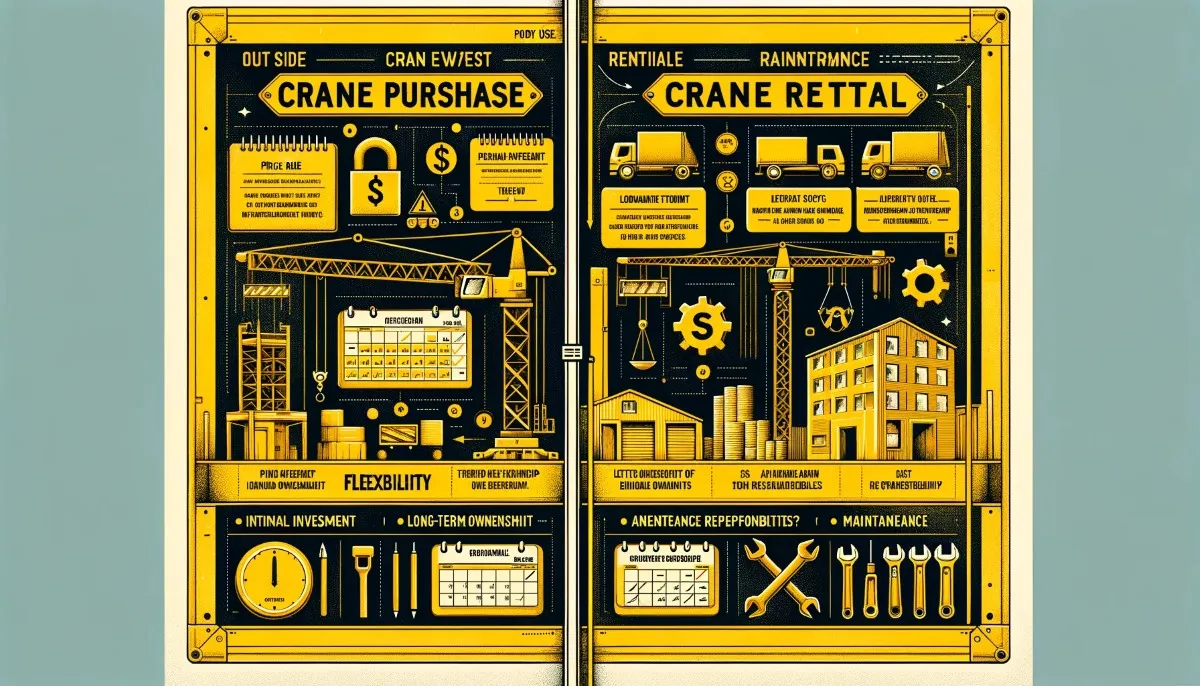
Buy or rent a crane? Start with the work it must do
The decision depends on the lifting task, expected utilisation and the full cost of delivering the work. Hiring a mobile crane for an occasional lift is a different proposition from installing an overhead crane in a busy factory. Compare solutions that meet the same technical requirement before comparing their prices. An understanding of crane operation and crane types helps define that requirement.
Make the two options technically comparable
Specify load weight, lift height, working radius, travel route and daily lifting cycles. The capacity assessment must match the intended configuration. Crane selection also needs to address ground support, building dimensions and the operating environment.
For an overhead crane, establish whether runways, supporting structure, electrical supply, installation and commissioning are included. For a mobile crane, transport, setup and site access can be significant. A lower equipment price may simply exclude work that another quotation includes.
Rental suits some kinds of uncertainty
Occasional lifts, short projects, changing reach requirements and uncertain workloads can favour rental. It provides access to different equipment without committing capital to every crane you might need. However, rental is not necessarily free of upfront costs. Deposits, advance payments, mobilisation and site preparation may still be required.
Check minimum hire periods, overtime, standby charges, cancellation, weather delays and delivery commitments. Establish who provides maintenance, breakdown response and replacement equipment. “Maintenance included” does not mean every kind of damage or interruption is covered without charge.
Ownership needs a dependable workload
Buying deserves consideration when utilisation is predictable, immediate availability matters and the lifting requirement is likely to remain similar. It also brings commitments for finance, maintenance and repair, inspections, spare parts, storage and training. Some ownership costs continue while the crane is idle.
A used crane needs more than a demonstration that it runs. Have competent people assess machine identity, service history, technical documentation, maintenance records and existing defects. Allow for a future resale value, but do not treat it as guaranteed. Ownership does not remove the operating limits imposed by the manufacturer or applicable standards.
Compare total cost over the same period
For ownership, account for acquisition and installation, financing or the cost of capital, fixed overheads, usage-related expenses and residual value. For rental, include hire charges, transport, setup, personnel, fuel or electricity, standby and excluded services. Avoid counting a cost separately when it is already included in a package.
Illustrative calculation — these are not market prices: assume annual fixed ownership costs of 600,000 currency units (CU), variable operating costs of 5,000 CU per day and an equivalent rental service costing 15,000 CU per day. The fixed figure represents an annual economic allowance for the investment plus fixed operating expenses; it is not the purchase price. This example assumes no additional mobilisation, standby or tax differences.
Annual ownership cost = 600,000 + 5,000 × days.
Annual rental cost = 15,000 × days.
The costs meet at 600,000 ÷ (15,000 − 5,000) = 60 days per year.
At 30 days: ownership costs 750,000 CU and rental costs 450,000 CU.
At 60 days: both cost 900,000 CU.
At 90 days: ownership costs 1,050,000 CU and rental costs 1,350,000 CU.
Sixty days is not a universal buying threshold. Actual contracts may charge by calendar day, working day, hour or monthly package. Use equivalent time units on both sides. A longer investment assessment must also account for payment timing, financing and resale proceeds; this simple comparison is only a starting point.
A supplied operator does not define the whole service
Hiring a crane with an operator can have a different scope from buying a managed lifting service that includes planning, rigging, signalling and supervision. Define the duties of the operator, signal person and lift planner in writing. Rental does not automatically transfer every site safety responsibility to the supplier. Safe lifting remains essential under either arrangement.
Ask about insurance cover, exclusions, deductibles, damage reporting, breakdown response times and replacement equipment. Contractual allocation of duties does not replace applicable legal requirements.
Specify the equipment behind the quotation
Are slings and lifting beams, radio controls, a crane scale or load cell included? Measurement and control equipment do not, by themselves, establish a validated overload protection function. Define the supplied equipment, documentation, acceptance checks and user training.
For an industrial crane purchase, describe the crane drive, drive and brake arrangement, braking resistor, encoder feedback, movement limits and PLC control where the specification requires them. A brand name or motor rating alone does not make two offers equivalent. Check spare-part availability and the scope of technical support.
Consider a mixed approach
Owning the crane used routinely and renting specialist or larger equipment occasionally can be a practical arrangement. Assess technical suitability, real utilisation, cash requirements, availability and the effect of downtime together. The lowest quotation is not necessarily the solution that completes the work safely and on schedule.