
C22.2 No. 106 standard
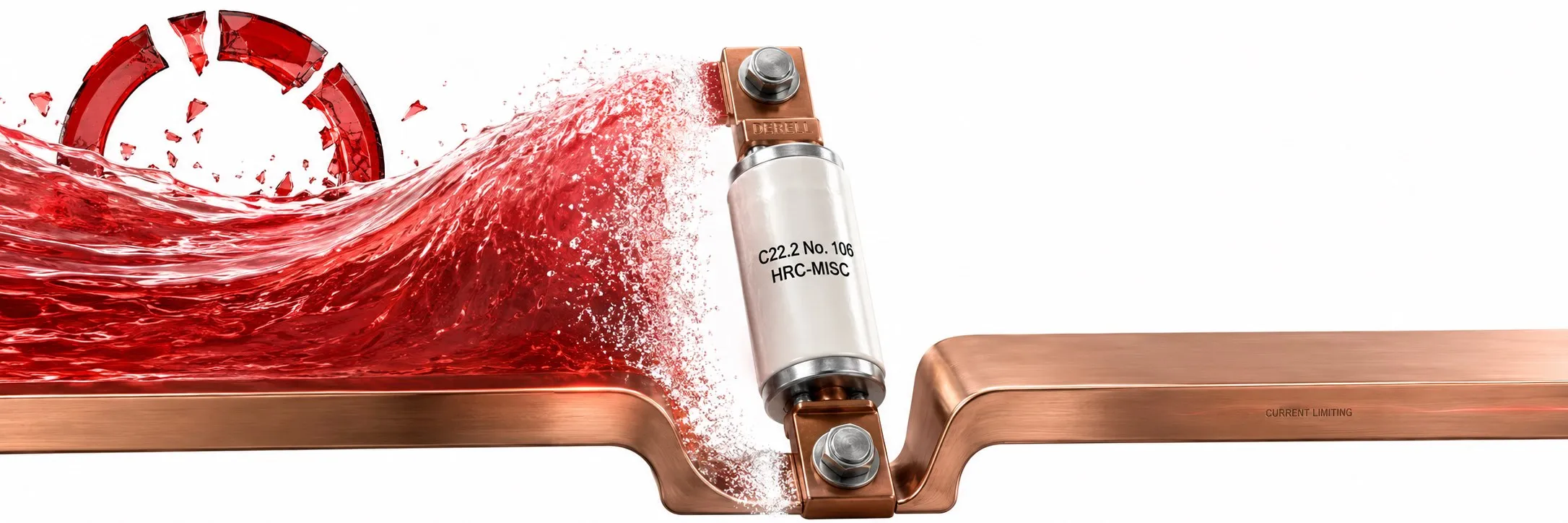
HRC fuses: understanding the scope and selecting the right protection
Hello, friends. CSA C22.2 No. 106, titled HRC-Miscellaneous fuses, covers particular high-rupturing-capacity fuses. The key is to assess current rating, interrupting rating and protection characteristics separately.
Editor's note: This is not a general standard for motor starters, variable frequency drives or soft starters. Describing it as the standard for “Class H and K fuses” is also incorrect; those classes are addressed by the relevant parts of the CSA C22.2 No. 248 series. Fuseholder assemblies are assessed under C22.2 No. 39 or the applicable 4248 part, depending on scope.
The HRCI-MISC and HRCII-MISC scope
The scope of the 106:05 edition covers non-renewable cartridge current-limiting fuses. It specifies limits of 600 A and 600 V AC for HRCI-MISC, Form I, and 1200 A and 600 V AC for HRCII-MISC, Form II. These are scope limits; the individual fuse's own ratings govern its application.
The standard defines HRC in terms of an interrupting rating of at least 100 kA RMS symmetrical. This is not the normal load current.
Current rating and interrupting rating are different
The current rating relates to normal current carrying and operating behaviour under specified conditions. The interrupting rating identifies the fault current that can be interrupted safely at the rated voltage. Expressing both kinds of current in amperes does not make them interchangeable. Assessing the fuse rating against the load also requires consideration of the cable, load, ambient temperature and starting conditions.
Example: Suppose a 400 V AC panel has an available short-circuit current of 48 kA. Assuming its voltage rating is suitable, a 32 A, 100 kA fuse satisfies that interrupting-capacity requirement; a 32 A, 10 kA device does not. This comparison does not complete the selection. A 100 kA fuse does not automatically give the panel a 100 kA SCCR; the panel assessment remains a separate task.
Read AC and DC voltage ratings separately
The fuse's voltage rating must suit the highest relevant circuit voltage. Extinguishing the arc during interruption is crucial. A 600 V AC marking does not automatically establish suitability for 600 V DC. DC use requires the manufacturer's explicit DC rating and any conditions such as circuit time constant. Matching the body size and ampere rating does not establish this suitability.
Why do time-current curves and I²t matter?
Different fuse types can have different opening times at the same overcurrent. Temporary currents, such as motor or transformer inrush, should not cause unwanted opening, while faults still need to be cleared promptly. Selecting protection for high-power loads solely from watts or motor kW overlooks this distinction.
The time-current curve describes operating behaviour; peak let-through current describes the peak current passed during a fault; and I²t is the time integral of current squared. Its unit is A²s, not joules. Pre-arcing I²t and total clearing I²t must not be confused. Current limitation also does not mean holding normal load current at a constant value: it describes behaviour within a specified fault-current range.
A motor-circuit fuse may require separate overload protection
Mersen describes its HRCII-MISC-certified FES range as providing short-circuit protection only, with a separate overload relay providing overload protection in motor applications. This is a practical reason why an HRC fuse does not establish complete motor protection. The manufacturer also states that this family is not dimensionally or electrically interchangeable with other North American fuses. Read the selected series documentation rather than applying these features to every HRC product.
How do No. 106, the 248 series, UL and IEC relate?
CSA's 2001 Fuses No. 6B bulletin explains that the 248 series superseded earlier CSA fuse standards for products within its scope, while No. 106 would continue to be used for certification of fuses outside that scope. It therefore does not support either a claim that No. 106 was completely withdrawn or that every HRC fuse falls exclusively under No. 106.
IEC 60269 and UL 248-1 provide other standard frameworks. A product may carry several approvals, but a CSA form, IEC utilization category and UL class cannot be translated into one another from a number or appearance. Check the manufacturer's cross-reference, complete product code and certification when selecting a replacement.
Which tests and documents matter?
The No. 106 test headings include verification of temperature rise and current carrying, overload operation, operation at rated voltage, and peak let-through current and clearing I²t. Numerical acceptance criteria must be taken from the applicable edition.
When selecting a fuse, compare the complete model code, current and AC/DC voltage ratings, interrupting rating, characteristic and holder compatibility. Deciding when a fuse needs replacement and finding why it opened are separate tasks. Do not address repeated opening simply by increasing the ampere rating. During safe replacement and fuseholder maintenance, also assess contact surfaces, tightening requirements, evidence of heating and the manufacturer's instructions.
Related topics
Sources
CSA / ANSI: C22.2 No. 106:05, scope, definitions and test headings
CSA Group: Fuses No. 6B, relationship between No. 106 and the 248 series
ANSI / CSA: C22.2 No. 39, fuseholder assemblies
Eaton: fuse ratings, time-current curves and I²t
ABB: time-current curves, selectivity and clearing I²t
Mersen: FES HRC-II, HRCII-MISC approval and protection scope