
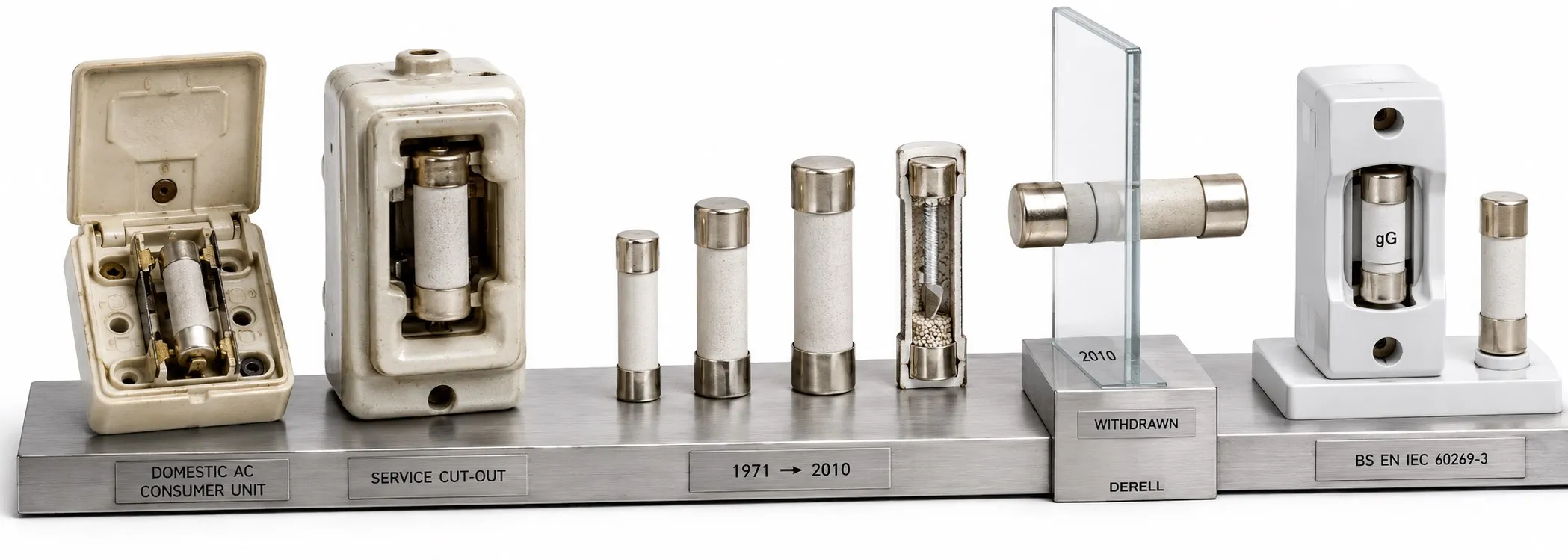
BS 1361 Fuses: Reading an Older Specification Correctly
BS 1361 is a legacy British standard for cartridge fuses used in AC circuits in domestic and similar premises. The reference remains familiar on older consumer units, service intake equipment and replacement cartridge fuse-links.
BS 1361:1971 was withdrawn on 1 March 2010. The relevant fuse systems were incorporated into BS 88-3, within the framework associated with IEC 60269-3. It should therefore be read as an identification reference for existing equipment, rather than presented as a current standalone standard.
Why Do Suppliers Still Use the BS 1361 Name?
A maintenance engineer needs to identify the equipment already installed. Manufacturers may retain the old designation alongside later standards to make that identification possible. Understanding the relationship between British fuse standards helps explain why several references can appear in one product description.
For a new specification, verify the applicable fuse standard and edition against the manufacturer's documentation. The relevant part and fuse system within the IEC 60269 family matter more than a broad catalogue label.
Consumer Unit Fuses and Service Fuses Are Different
| Type | Typical position | Identification priority |
|---|---|---|
| Type I | Consumer units and suitable single-phase circuits. | Match the cartridge, carrier and circuit protection requirements. |
| Type II | House service cut-outs at the incoming supply. | Identify the service equipment and responsible network operator; this is not routine householder maintenance. |
Type IIa and Type IIb distinguish physical formats. Manufacturer data commonly shows IIa at approximately 22.23 mm diameter × 57 mm length and IIb at 30.16 mm diameter × 57 mm length. Equal length does not mean equal fit, and equal current ratings do not make the two formats interchangeable.
These fuses also serve a different application from the BS 1362 fuse inside a UK plug. The service fuse, outgoing circuit fuse and plug fuse occupy different positions in the protection arrangement.
Why Do Some Ratings Change Between References?
Historical comparisons between BS 1361 and BS 88-3 include nominal changes such as 15 A to 16 A, 30 A to 32 A, and 60 A to 63 A. Some product ranges consequently use dual descriptions.
That history is not permission to fit any cartridge with the next higher current rating. Replacement suitability still depends on the manufacturer's declared equivalence, the cable and the required disconnection performance.
What Must Match When Selecting a Replacement?
Circuit duty: Begin with the load and the protection arrangement. A proper fuse selection checks the cable, installation conditions and protective devices as well as the number printed on the old cartridge.
Operating behavior: A fuse does not open instantly at its rated current. Its response depends on the size and duration of the overcurrent. Check the time-current characteristic and coordination with the devices upstream and downstream.
Voltage and fault interruption: The declared voltage and breaking capacity must suit the circuit. A manufacturer may publish 16.5 kA for a consumer-unit range and a different figure for service fuse-links. There is no useful single breaking-capacity value to assign to every product carrying a BS 1361 reference. An AC rating must not be assumed valid for a DC fuse application.
Holder condition: Correct dimensions are necessary, but the contacts and carrier must also remain serviceable. Loose contacts or heat damage can undermine an otherwise suitable replacement. Effective fuse-board maintenance includes the assembly around the cartridge.
The Service Cut-Out Requires Separate Arrangements
In the UK, a sealed service cut-out is normally the distribution network operator's equipment. Do not remove its seals, withdraw the fuse or increase the supply rating yourself. Work must be arranged through the responsible operator or appropriately authorized personnel. Switching off the consumer unit's main switch does not make the incoming side of the service cut-out dead.
Repeated operation requires investigation into why the fuse has opened. Safe fuse replacement requires the appropriate isolation and verification procedures. A higher-rated cartridge does not repair a faulty circuit.
Does a BS 1361 Fuse Provide Residual-Current Protection?
A fuse responds to overcurrent. It can clear an earth fault where sufficient fault current flows, but it does not become an RCD. Understanding the different roles of fuses, RCDs and RCBOs is especially useful when assessing an older installation.
A sound cartridge alone does not establish overall electrical safety in a home. Wiring, connections and the remaining protective measures need consideration. When identifying replacement fuse products, record the part number, ratings, dimensions and holder details together.