
what is the internet of things iot
Turning device readings into useful decisions
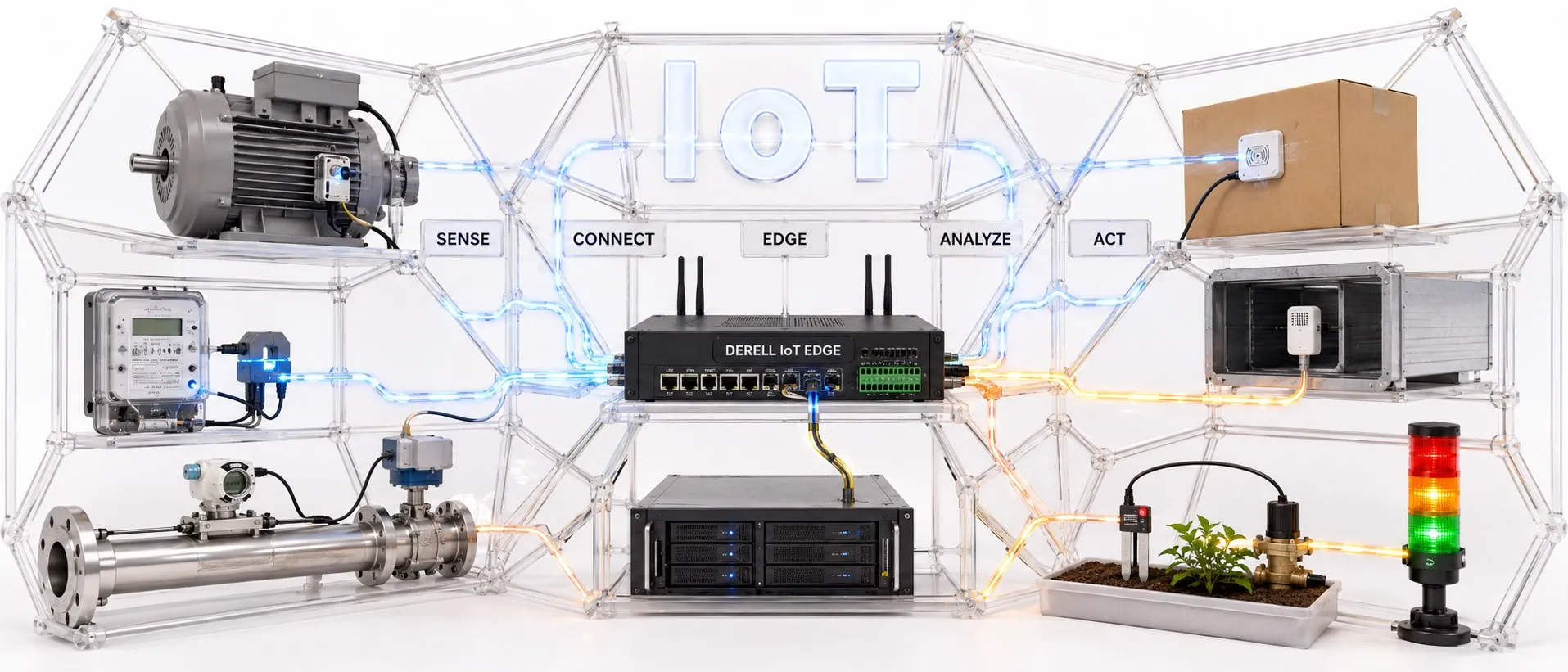
The Internet of Things (IoT) connects physical devices with software that can collect their data, share it and, where appropriate, send commands back. The useful outcome might be a leak alert, a consumption record or an earlier indication that equipment needs attention. Understanding how IoT works starts with a practical question: What will someone do differently because this information is available?
A sensor does not automatically become an IoT device. A conventional sensor may send an analog or digital signal to a controller, while a gateway carries that information to another system. Individual sensors therefore do not all need their own internet connection. Artificial intelligence is optional: recording readings and checking a simple threshold can already provide a useful service.
Follow the reading, not just the connection
Sensing produces a measurement such as temperature, pressure, current or position. Communication delivers it to another device or application. Processing stores the reading, compares it with earlier values or applies a rule. Action might mean displaying a trend, notifying an operator or executing an authorized command. A monitoring system can be useful even when it never controls a physical output.
Consider a cold room with an illustrative alarm threshold of 8 °C. A reading of 9 °C is recorded with its measurement time and sensor identity. If it remains above the threshold for the configured period, the system alerts the responsible person. The temperature limit and delay must suit the application; these example values are not universal storage requirements. A reading needs an age as well as a value. If communication fails, yesterday’s 5 °C reading must not look like a current measurement.
What needs the internet, and what can stay local?
Choosing a connection means balancing range, power consumption, data volume and reporting frequency. Ethernet and Wi-Fi can provide access to a local network; cellular connectivity can serve remote locations. A Bluetooth device may reach an online service through a phone or gateway. Wireless connectivity alone does not establish an internet connection.
A cloud service processes data remotely, but processing can also take place on the device or a local server. Offline behaviour depends on the design: one product may retain local control while another loses essential features when its service is unavailable. Compatibility requires more than a shared network. Devices and applications also need to agree on communication methods, data formats, measurement units and permissions.
Useful at home, more demanding in industry
Everyday applications include water-leak warnings, remote meter readings and heating schedules. Energy savings need a mechanism: measurements must reveal avoidable consumption and lead to a change that reduces it. A connected product does not save energy simply by being connected. Healthcare applications also depend on trustworthy measurements and privacy protection; a consumer-device reading by itself is not a substitute for clinical assessment.
Industrial IoT (IIoT) places greater emphasis on availability, reliable data and predictable behaviour when something fails. Motor runtime, current and temperature trends can support maintenance planning, but one unusually high reading does not prove a particular fault. SCADA can already provide local monitoring without the public internet. IoT can extend such automation systems with access to data from additional sites and remote users.
Evaluate the whole service, including its upkeep
Device security calls for appropriate device credentials, access permissions, protected data transfer and dependable update support. Disable unnecessary network services and assign responsibility for maintenance and updates. Also decide what happens when the manufacturer ends support. Data-breach exposure can involve the account, application and connected network as well as the physical device.
For privacy, establish what is collected, who can access it and how long it is retained. For value, add subscriptions, connectivity, battery replacement and maintenance to the purchase price when estimating ownership costs. Whether a device is worth having depends on the problem it solves and the benefit you can actually measure.
References
AWS: What is IoT?
NIST IR 8259A: IoT Device Cybersecurity Capability Core Baseline
Refine Search
- Are IoT devices really necessary, or are they just a trend?
- Are IoT devices truly secure, or are they vulnerable to data breaches?
- Are IoT devices user-friendly for the elderly or those not tech-savvy?
- Can IoT devices have a negative impact on children's development?
- Do IoT devices increase costs in the long run?
- Do IoT products like smart home devices save energy?
- Does IoT technology cause environmental issues?
- Does IoT technology invade our privacy by constantly monitoring us?
- Does the constant connectivity of IoT devices open up more doors for cyber attacks?
- How are compatibility issues between IoT devices resolved?
- How are maintenance and updates handled for IoT devices?
- How can IoT devices make my daily life easier?