
Yaskawa V7 fault codes
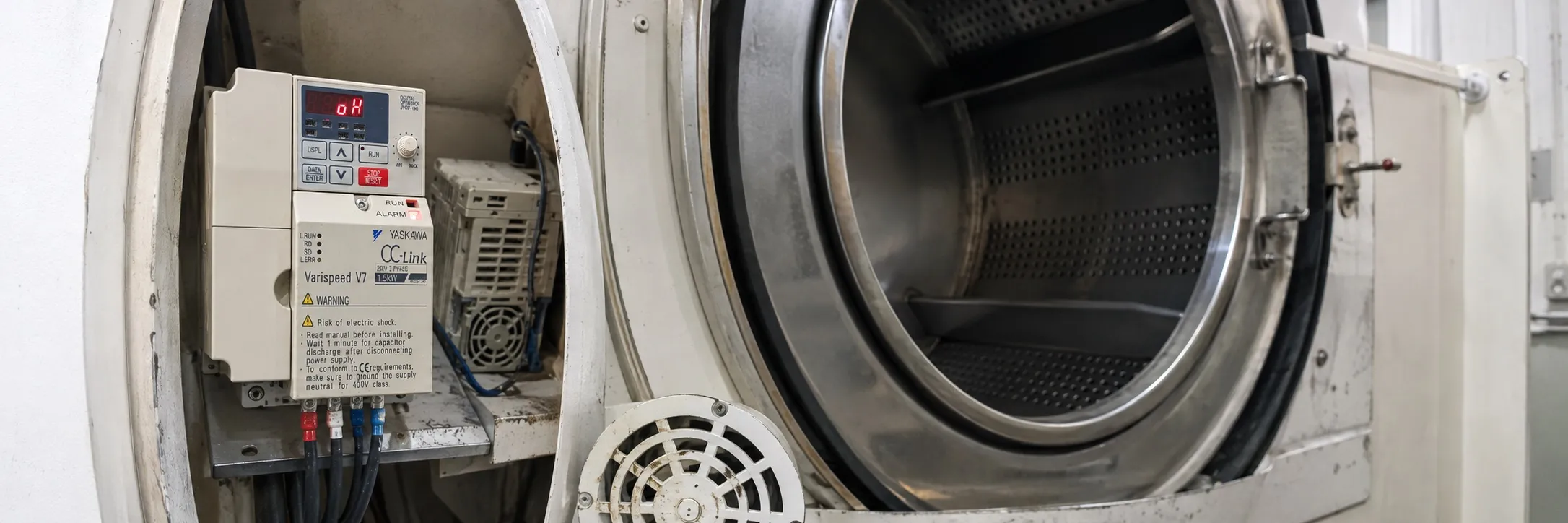
This section provides an overview of the alarm and fault indicators for the Yaskawa V7 VFD, along with explanations for different fault conditions and the corrective actions that should be taken if the drive malfunctions:
Alarm Indication:
Description: A blinking "Alarm" indication serves as a warning that a Drive trouble condition will soon occur, or that a programming error has been made.
Operation: The Drive will continue to operate during an "Alarm" indication. No immediate action is required, but the warning should be investigated to prevent potential issues.
Minor Fault Indication:
Description: A blinking "Minor Fault" indication is displayed during less serious faults, or when a problem exists in the external circuitry.
Operation: The Drive will continue to operate, and a "Minor Fault" contact will be closed if a multi-function output is programmed for the condition. This allows for continued operation while addressing the minor issue.
Major Fault Indication:
Description: A steady "Major Fault" indication is displayed when the Drive's Fault relay has tripped. This usually indicates a more serious problem with the drive.
Operation: The motor coasts to a stop, and a fault signal output is present at control circuit terminals 18-20. Immediate action is required to address the fault and prevent damage to the drive or connected equipment.
For specific fault codes and corrective actions, refer to the detailed descriptions provided in the manual or the fault diagnosis section of the documentation. It is important to address faults promptly to ensure the safe and efficient operation of the drive.
UV (Main circuit low voltage):
Description: Main circuit DC voltage drops below the low-voltage detection level while the drive output is OFF.
Causes and Corrective Actions: Check the power supply voltage, ensure the main circuit power supply wiring is connected, and verify that terminal screws are securely tightened.
OV (Main circuit overvoltage):
Description: Main circuit DC voltage exceeds the overvoltage detection level while the drive output is OFF.
Causes and Corrective Actions: Check the power supply voltage.
OH (Cooling fin overheat):
Description: Intake air temperature rises while the drive output is OFF.
Causes and Corrective Actions: Check the intake air temperature.
OH3 (Drive overheat pre-alarm):
Description: OH3 signal is input, indicating a pre-alarm for inverter overheat.
Causes and Corrective Actions: Release the input of the inverter overheat pre-alarm signal.
General Information:
A blinking "Alarm" indication warns of a potential Drive trouble condition or a programming error. The Drive continues to operate during an "Alarm" indication.
A blinking "Minor Fault" indication is displayed for less serious faults or issues in the external circuitry. The Drive continues to operate, and a "Minor Fault" contact is closed if programmed for the condition.
A steady "Major Fault" indication is displayed when the Drive's Fault relay has tripped. The motor coasts to a stop, and a fault signal output is present at control circuit terminals 18-20.
CAL (DEVICENET communications waiting):
Description: Data has not been received from the PLC when the parameter n003 (operation command selection) is 3 or n004 (frequency reference selection) is 9, and power is turned ON.
Causes and Corrective Actions: Check communication devices and transmission signals. Ensure the Baud Rate and MAC ID of the drive and PLC are matched.
OPE1 (Parameter setting error):
Description: Occurs when two or more values are set for multi-function input selection (parameters n050 to n056), or when the relationship among V/f parameters is incorrect (parameters n011, n013, n014, n016), or when the setting value of electronic thermal standard current exceeds 150% of drive rated current (parameter n036), or when the upper/lower limit of frequency reference is reversed (parameters n033, n034), or when carrier frequency setting is incorrect (parameter n080).
Causes and Corrective Actions: Check the setting values and ensure they are within the correct range and do not conflict with each other.
OL3 (Overtorque detection):
Description: Motor current exceeded the preset value in parameter n098.
Causes and Corrective Actions: Reduce the load and increase the acceleration/deceleration time.
SEr (Sequence error):
Description: Drive receives LOCAL/REMOTE select command or communication/control circuit terminal changing signals from the multi-function terminal while the drive output is ON.
Causes and Corrective Actions: Check the external circuit (sequence) to ensure proper signal sequencing.
BB (External baseblock):
Description: Baseblock command at the multi-function terminal is active, the drive output is shut OFF (motor coasting).
Causes and Corrective Actions: Check the external circuit (sequence). The temporary condition is cleared when the input command is removed.
EF (Simultaneous FWD/REV run commands):
Description: When FWD and REV run commands are simultaneously input for over 500ms, the drive stops according to parameter n005.
Causes and Corrective Actions: Check the external circuit (sequence) to ensure proper signal sequencing.
STP (Operator function stop / Emergency stop):
Description: Drive receives a stop command (STP) during running by the control circuit terminals FWD/REV or an emergency stop alarm signal.
Causes and Corrective Actions: Open FWD/REV command of control circuit terminals. Check the external circuit (sequence). The drive stops according to parameter n005.