
Resettable Fuses
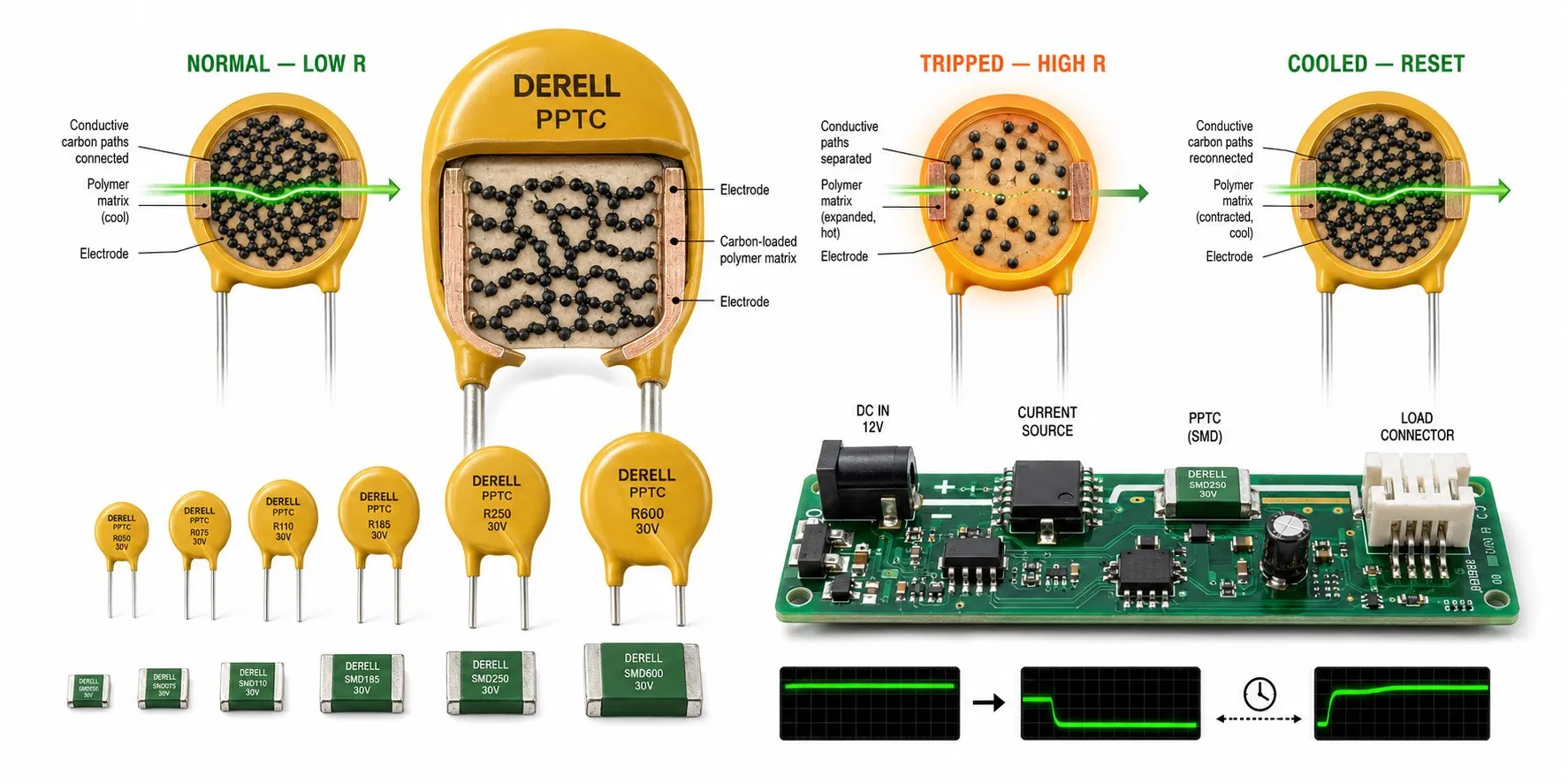
Illustrative image; the example markings and voltages are not specifications for selecting a product.
Resettable fuses are protection components that limit overcurrent in electronic circuits and can be used again when the required reset conditions are met. In PPTC (polymeric PTC) devices, heat generated by excessive current separates conductive paths within the polymer. Resistance increases, reducing the current through the circuit. Their operating principle differs from that of other fuse types.
Surface-mount, radial-leaded and battery-strap versions are selected for circuit boards, ports and supply lines according to each model's electrical limits.
Choosing a resettable fuse
Hold and trip current: IH is the highest current the device can carry without tripping at the specified temperature. IT is the minimum current guaranteed to trip under the specified test conditions. Behaviour between these two values is not guaranteed.
Voltage and fault current: The Vmax and Imax limits must suit the maximum circuit voltage and prospective short-circuit current. A DC voltage rating does not establish approval for the same numerical AC voltage.
Ambient temperature: Hold current generally decreases as temperature rises. Check the manufacturer's current-versus-temperature table.
Time to trip: Assess normal, start-up and fault currents against the time-current curve. Matching the ampere rating alone is insufficient.
Package and resistance: Compare the SMD package, lead spacing and mounting dimensions, along with initial resistance and post-trip resistance. These resistance values affect the voltage drop during normal operation. SMD describes the mounting style; it does not establish resettable operation.
Visit the main fuse category for product options. If the required PPTC is not listed, send the seller identified in the relevant product listing the existing part number or a photo, supply voltage and AC/DC type, normal and start-up currents, ambient temperature and package dimensions.
To compare protection types, see: Which type of fuse should I choose?