
Which is more efficient, electric vehicles or solar powered vehicles, and why?
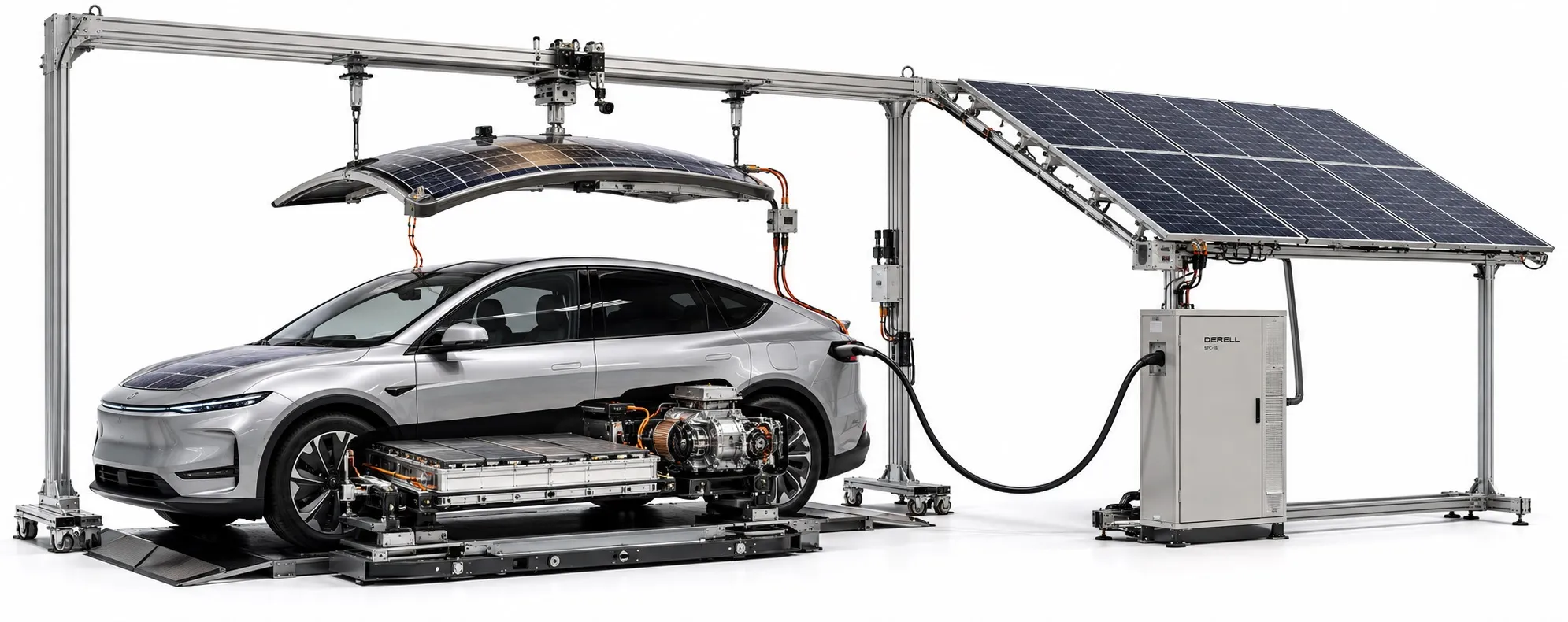
Is an EV or a solar car more efficient? There is no automatic winner: a solar car is electrically driven too. Its panels provide extra energy, but their presence does not prove that the car uses less energy per kilometre. Keep the car's energy consumption separate from the amount of solar energy it can use each day.
Where the electricity comes from: An EV can charge from the grid, from a charging system supplied by stationary solar panels, or from panels on the vehicle itself. Rooftop solar and onboard solar are different installations serving electric transport. “Electric” and “solar-powered” do not describe two competing motor technologies.
Compare energy per distance: kWh/100 km and Wh/km tell you how much energy a car uses to travel a given distance. Compare vehicle performance and range at similar speeds, loads, routes, temperatures and cabin climate settings. An ultralight solar race car and an everyday passenger car are different starting points.
Panel efficiency measures something else: PV panel efficiency is the share of incoming sunlight converted into electricity. Drivetrain efficiency describes how electrical energy becomes motion. Those percentages cannot be compared directly. State where energy is measured: electricity drawn from a charging outlet includes losses that a battery-output reading does not.
A car has limited panel space: Roofs, bonnets and other surfaces offer only so much room for solar panels. Their shape and angle affect output. A solar vehicle design must balance panel capacity against daily driving needs. Better cells help, but do not remove the area limit. Look at energy produced during normal use, rather than peak power alone.
Where you park matters: Weather, season, shade and location change daily solar production. A car parked outdoors can collect sunlight that one kept in a garage cannot. Hotter cells can also produce less power. One excellent summer day is not a reliable estimate for the whole year.
Making use of the available power: MPPT tracks a suitable operating point for the panels. Partial shade, different surface angles and conversion losses still affect the result. Suitable power electronics and battery management are needed to use that energy in the vehicle. MPPT helps collect available power; it cannot replace missing sunlight or extra panel area.
Solar cars can drive at night: Both types can run on stored battery energy when they have enough charge. Losing solar production after sunset does not stop the electric motor. External charging support depends on the model. Having both solar panels and a charging socket does not make a car a plug-in hybrid; that term also involves a combustion engine.
Charging from stationary solar: A suitable roof or parking canopy can provide more panel area and better orientation than a car body. It can supply an EV that has no onboard panels. The timing of generation and charging matters. Compare daytime use, energy exchanged with the grid and additional storage as separate arrangements.
A worked example: Assume the onboard array is rated at 0.6 kWp and receives 4 equivalent sun hours per day. Allow for real-world operating, conversion and storage losses by assuming 80% of the nominal estimate is usable at the battery output, giving a factor of 0.80. This gives 0.6 × 4 × 0.80 = 1.92 kWh/day. These are illustrative inputs. Equivalent sun hours describe daily solar irradiation, not simply time spent outdoors.
How much driving could that support? Suppose the same car uses 16 kWh/100 km at the battery output, or 0.16 kWh/km. The example's solar contribution provides energy for 1.92 ÷ 0.16 = 12 km. That is not a range promise: output and consumption can change. The kWp rating is already electrical power, so do not multiply it by panel conversion efficiency again.
Solar share is different from vehicle efficiency: At the same assumed consumption, 40 km of daily driving needs 6.4 kWh. The 1.92 kWh solar contribution supplies about 30% of that requirement. It does not make the motor 30% more efficient. The percentage describes how much of the day's energy comes from solar.
Allow for the added equipment: Panels, mounting and power electronics can add weight. Their installation may also change air resistance. Net benefit therefore depends on both solar production and any change in driving consumption. Low weight and good aerodynamics help even without solar. Compare versions with and without panels using the same load and driving conditions.
Environmental impact is another question: An environmental comparison goes beyond energy per kilometre. A carbon footprint assessment includes electricity supply, vehicle, battery and panel production, and end-of-life treatment. Solar can reduce the need for electricity from higher-emission sources. Keep energy savings and life-cycle emissions as separate measures.
Check output over time: Suitable panel maintenance helps preserve the expected solar contribution. During vehicle maintenance, assess panel surfaces, connections and production records according to the manufacturer's instructions. A peak power rating is different from energy collected over months of use. Record actual production and the time the system is available.
What matters in practice? A car that needs less energy to drive has a lower kWh/100 km figure under comparable conditions. Solar assistance can reduce the energy required from external charging. Evaluate low driving consumption and usable solar production together. Compare onboard panels with stationary solar charging using the driver's daily mileage and parking routine.