
What type of pumps should I choose for home use?
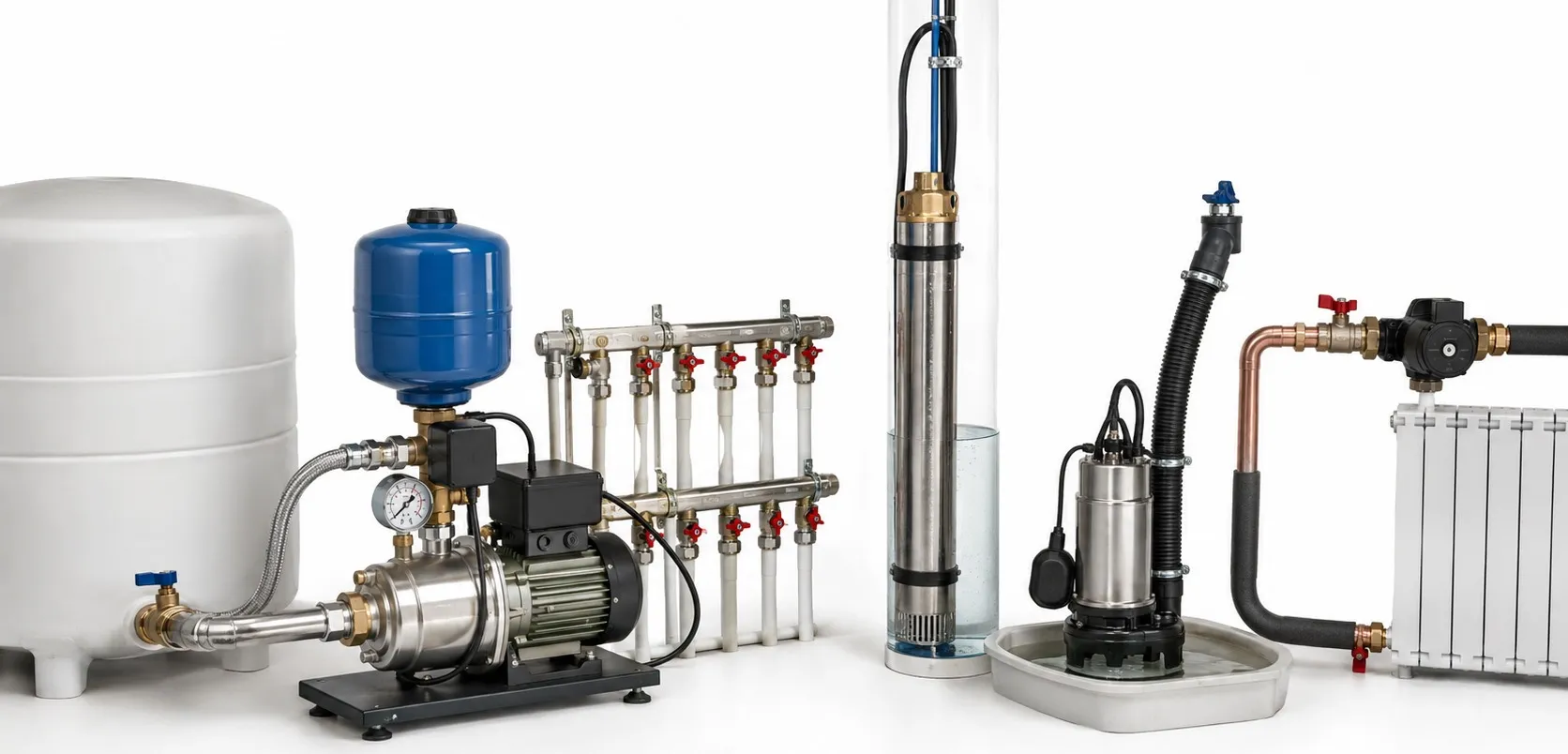
Choose a home pump by the job it needs to do
A household may need better shower pressure, water from a well, garden irrigation, heating circulation or basement drainage. Each calls for a different design. Start by matching the pump type to its function; motor power is a later decision.
For better tap pressure: a domestic booster set
An automatic booster supplies the house from a storage tank. Where demand varies, a correctly sized variable-speed, constant-pressure unit can improve shower comfort. A conventional pressure-switch system with a pressure vessel can also work well. Pump controls and PID regulation manage pressure, but cannot compensate for an inadequate water source.
Before connecting directly to a public water main, check the water supplier's connection requirements; a break tank may be necessary. Wetted components must be suitable for potable water where applicable. Check total inlet-plus-pump pressure against system ratings. Compare noise levels for the intended location, rather than treating an indoor installation as an afterthought.
For well or tank water: consider the source first
A deep borehole generally calls for a multistage submersible pump sized to fit its diameter. The pumping water level matters more than total borehole depth alone. If a 40-metre borehole has water 18 metres below ground during pumping, an ordinary surface suction pump is unsuitable. Check well yield, sand content, motor cooling and minimum water level. Any submersible pump drive must be compatible with the motor.
A shallow well or tank may allow a self-priming surface pump, provided the suction conditions are suitable. A submersible pressure pump is another option where the source and installation allow it. Self-priming does not mean unlimited suction depth. Pipe length, diameter, air leaks and water temperature affect performance. Initial filling may still be required; follow the particular model's limits and instructions.
For the garden: match sprinkler pressure and flow
A suitable centrifugal pump or self-priming garden pump can supply clean water to hoses and sprinklers. Add the flow requirements of the heads that will run together and check their required pressure. Irrigation systems also need appropriate filtration; drip lines may require pressure regulation. A larger motor does not replace either. Sediment in a rainwater tank must be considered when choosing the pump and intake arrangement.
For heating: an appropriately controlled circulator
Choose a heating-rated electronic circulator for a radiator or underfloor heating circuit. In a fully filled closed loop, it mainly overcomes pipe and equipment resistance; building height alone is not the sizing criterion. Check flow, head, connection size, installation length and temperature rating. Adding a second pump to a boiler system requires a hydraulic assessment and compliance with the boiler instructions. Correct control settings support efficient operation and lower electricity use.
If the aim is faster hot water at the tap, use a potable hot-water return circulator designed for that service. A standard heating circulator is not automatically suitable. The return pipework, wetted materials and control arrangement all matter. Continuous circulation can increase heat loss, so insulation, timing and water hygiene should be considered together.
For a wet basement or sewage: do not mix the duties
For rainwater, seepage or lightly contaminated water, consider a float-controlled drainage submersible with adequate solids passage. The sump must leave room for the float to move. Check the residual water depth after shutdown; removing water down to a few millimetres requires a model specifically capable of that task. A portable pump is not necessarily suitable for every kind of wastewater.
If a toilet cannot discharge by gravity, use a sewage-rated pump or enclosed lifting station. A general drainage pump is not a substitute. Choose a grinder only where the application calls for it; wipes, cloth and metal must not be treated as acceptable waste. Backflow protection, ventilation and alarm arrangements are part of the installation. The distinction between household and industrial pumps is less useful here than knowing exactly what the liquid contains.
A practical sizing example
Estimate simultaneous demand. Assume two showers each use 10 L/min and a tap uses 6 L/min. Combined demand is 26 L/min, or 1.56 m³/h. These are illustrative figures; use the actual fixture flows and expected simultaneous use.
Calculate the required head. Assume the highest outlet is 8 metres above the water surface in an open tank, it needs 2 bar while flowing, and pipe losses are estimated at 5 metres. For water, 1 bar is approximately 10.2 metres of head. The total is therefore about 8 + 20.4 + 5 = 33.4 metres. Look for a pump curve that can provide approximately 1.56 m³/h at 33.4 metres. Account for available source pressure where applicable. The 5-metre loss is an assumption for this example and must be calculated for the actual installation.
Maximum flow and maximum head are not available simultaneously. A “50-metre head” claim or a “1 HP” motor label is not enough to choose a pump. Power sizing follows the hydraulic requirement and efficiency; compare purchase and running costs at the intended operating conditions.
What to establish before ordering
Record the source, pumping water level, simultaneous flow, required outlet pressure, elevation, pipe length and diameter, temperature and solids content. Then compare power supply, dry-run protection, allowable starting frequency, service access and spare parts. These details make brand comparisons meaningful; a familiar name or a higher wattage alone does not establish suitability.
Select accessories such as filters, check valves, pressure vessels and level controls to suit the arrangement. Rapid cycling in a conventional pressure-vessel system can indicate leakage, incorrect settings or a vessel problem. Consider fault symptoms, overheating, maintenance and service life together. Electrical connections, earthing and suitable residual-current protection must follow the product instructions and installation requirements. Do not enter a flooded area containing energised equipment.
Technical references: Grundfos — Domestic pressure boosting · Grundfos — Tank and shallow-well supply · Grundfos — Suction lift · Grundfos — Duty point · Wilo — Hot-water circulation · Wilo — Drainage and sewage