
What steps should be taken to adopt Industry 4.0?
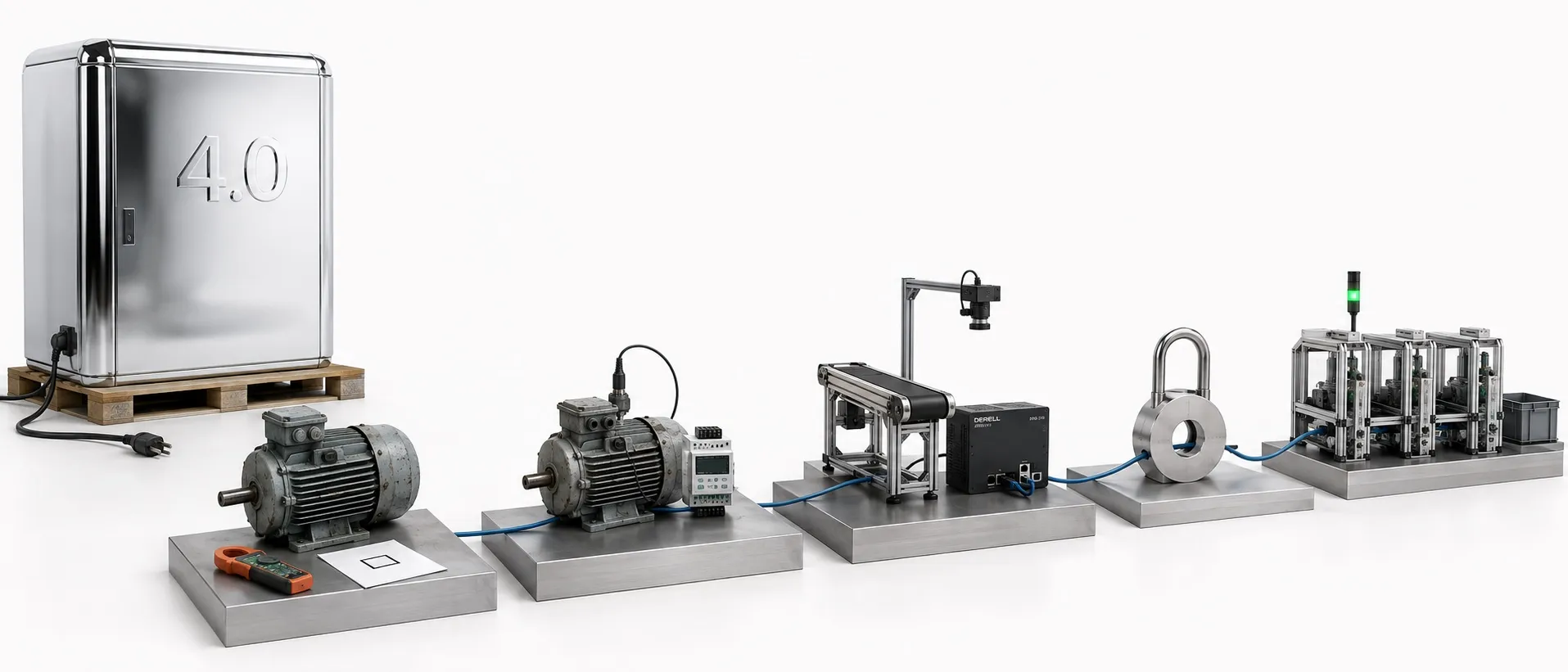
Establish the actual need first
Starting with the assumption that you must adopt Industry 4.0 puts the sales package ahead of the business's needs. Our approach is to define an operating problem before accepting the marketing label. If the business needs less scrap, shorter downtime, more reliable monitoring or lower energy costs, design a project around that requirement. “Moving to 4.0” is not itself a measurable operating objective.
1. Identify the loss and its cause
Which machine causes a loss, under what conditions, and how large is that loss? Examine the production problem using fault records, quality results and operator observations. Investigate inaccurate measurement, mechanical wear, inadequate maintenance or incorrect settings where relevant. A cloud platform does not repair a worn component. Selecting technology before understanding the cause can become an expensive guess.
2. Assess the existing infrastructure
Review PLCs, HMIs, drives, sensors, SCADA and logging capabilities. Identify usable interfaces, program backups and maintenance responsibilities. Compatibility cannot be established by a label alone; check protocols, versions, data models and access conditions. Implementation challenges include obtaining reliable data from older equipment. Consider whether the need can be met while retaining the functioning system.
3. Define the target and baseline
Record suitable indicators such as scrap rate, unplanned downtime, energy per good unit and maintenance costs before the project begins. Define success criteria and the measurement period upfront. The U.S. Department of Energy emphasises documenting baseline conditions and adjusting comparisons when conditions change to verify energy savings. A lower bill caused by lower production is not automatically an energy-efficiency improvement.
4. Select the appropriate solution
Compare technologies against the operating problem. Cloud services are not mandatory when local logging suffices; neither is artificial intelligence when a simple alarm is adequate, nor a digital twin when direct measurement meets the requirement. IoT connectivity can improve data access, but it is not a universal package for every machine. Let functionality, reliability, maintainability and total cost guide the choice.
5. Run a limited pilot
Start with one line, machine or measurement point. For example, recording the causes of pump downtime can help distinguish those causes. Value is demonstrated if action based on those records actually reduces downtime. A functioning dashboard and improved operating results are different acceptance conditions. The pilot should represent real loads and product variation; one good shift is insufficient grounds for a decision.
6. Clarify all costs and exit conditions
Include hardware, integration, subscriptions, training, security maintenance and commissioning losses in the total cost of ownership. Particularly for SMEs, resources to sustain the project matter; the OECD discusses financing, skills and interoperability barriers to digitalisation. Clarify data export, functions remaining after licence expiry, support charges and switching suppliers in writing. Do not build the budget solely around the initial quotation.
7. Design security and rollback
Industrial security measures, access permissions, backups and restoration planning should be part of the initial scope. NIST addresses OT security alongside performance, reliability and safety. Assess the effect of new connectivity on production, behaviour during internet or service outages and the path back to the previous operating arrangement under controlled conditions. A remote monitoring project should not create unnecessary external-service dependencies for basic control functions.
8. Train staff for their actual tasks
Training should go beyond slogans about digital culture. Operators should interpret alarms, maintenance staff should diagnose faults, and designated personnel should restore backups. Specify data units, timestamps, measurement sources and responsibilities. Incorporate staff's practical plant knowledge into the design and measure the additional workload created by the system.
9. Extend demonstrated improvements
If the pilot meets its targets, expand to similar applications in a controlled way. Promised customer benefits or supply chain improvements also need evidence. Distinguish whether the benefit came from maintenance, control adjustments or data use. Stopping a project that fails to demonstrate value can be a better business decision than continuing an unnecessary investment.
Editor's note: Accepting a useful automation improvement does not require embracing the Industry 4.0 narrative. The sources support the discussion of measurement, costs, skills and security; the marketing critique is our editorial position. Evaluate the need, the solution and then the outcome. Oversized packaging does not justify an oversized project.
Related topics: Marketing or technical innovation?; Measuring success; Costs and risks.